
Imagine the weight of receiving a phone call from a distant country, only to realize that the miles between you and your loved one now feel like an insurmountable wall of red tape and foreign regulations. It's a moment where the world feels suddenly too large and the path forward seems hidden behind layers of bureaucracy. You likely feel a deep need to bring them back to familiar soil, yet the fear of legal delays or the complexities of international funeral transportation can be paralyzing.
We understand that bringing a loved one home is about much more than logistics; it's about honoring a life and fulfilling a final wish. You aren't alone in this process. This guide offers a clear roadmap to navigate the complexities of international mortuary shipping and consular coordination in 2026. We'll explore the essential documentation required for repatriation, the vital role of TSA-approved shippers, and the ways a dedicated partner ensures your cultural and religious traditions are respected every step of the way. Our goal is to provide the steady presence you need to bridge the distance with dignity and peace.
Key Takeaways
- Understand why repatriation is a specialized field that requires much more than standard cargo shipping to ensure your loved one is handled with dignity and care.
- Identify the critical legal paperwork, including Apostilled death certificates and consular transit permits, required to navigate foreign border requirements smoothly.
- Evaluate the logistical differences between shipping a casketed body in a specialized container versus the simpler, more cost-effective process of transporting cremated remains.
- Learn how a local Brooklyn partner can manage the complexities of international funeral transportation by serving as a TSA-approved "Known Shipper" on your behalf.
- Follow a step-by-step roadmap specifically for NYC and Nassau County families to ensure every cultural and religious tradition is honored during the journey home.
Table of Contents
- Understanding International Funeral Transportation and Repatriation
- Essential Documentation and Consular Coordination
- Logistical Choices: Air Freight vs. Local Disposition
- A Step-by-Step Guide for NYC Families
- How Horizon Funeral Home Eases the Burden of Global Logistics
Understanding International Funeral Transportation and Repatriation
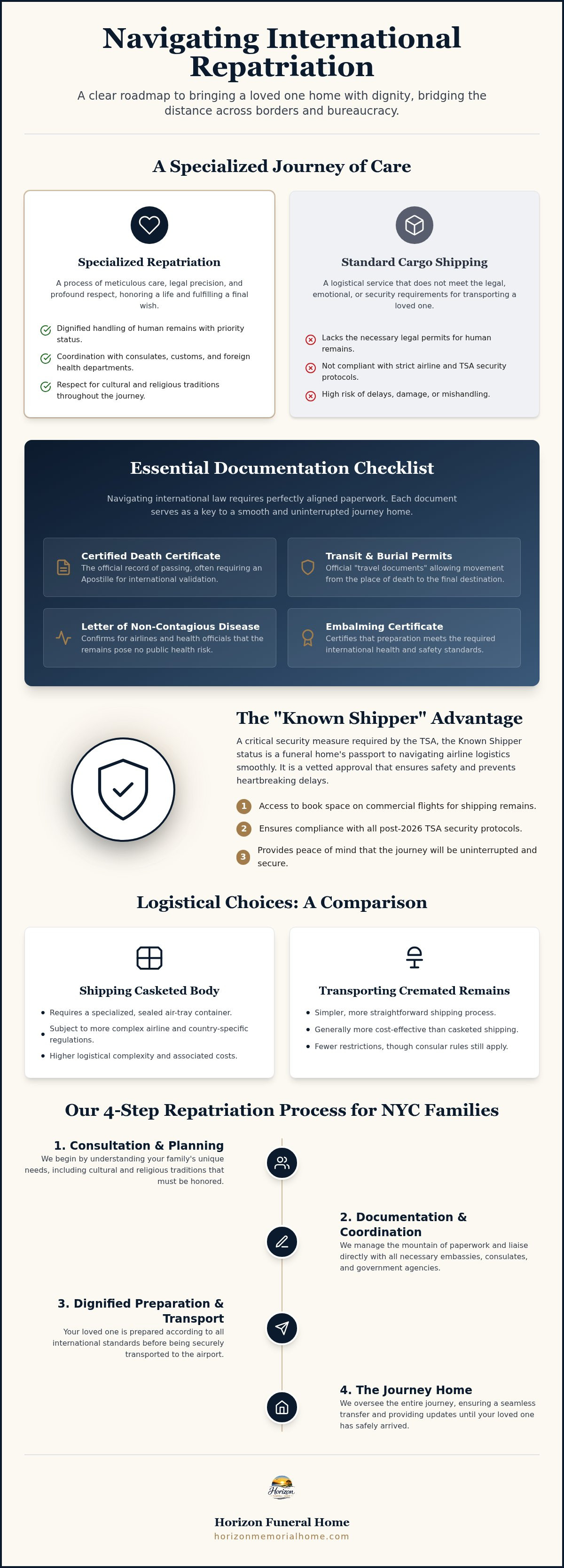
When a loved one passes away far from the place they called home, the distance can feel like an added layer of grief. The term for bringing them back is repatriation. Understanding Repatriation means seeing it as a bridge between a foreign land and a final resting place. This isn't a simple shipping task. It is a specialized form of international funeral transportation that requires meticulous care and legal precision.
Standard cargo shipping won't suffice for such a delicate journey. Airlines and international borders have strict protocols that treat human remains with a specific level of priority and dignity. International transport differs significantly from domestic state-to-state transfers because it involves customs agents, foreign health departments, and consular officials. Each country has its own set of rules regarding how remains must be prepared and what type of container must be used. We manage these variables so you don't have to carry that burden alone.
One of the most critical security measures in 2026 is the "Known Shipper" status. The TSA requires that any funeral home handling air transport be vetted and approved. This status allows us to book space on commercial flights that are otherwise closed to the general public for shipping remains. It's a layer of security that ensures safety while preventing the heartbreak of unexpected delays at the airport. We maintain this status to ensure your loved one's journey remains uninterrupted and secure.
The Emotional and Cultural Significance of "Coming Home"
For many families, the desire to be buried in ancestral soil is a sacred tradition. It's a way to reconnect with heritage and find peace in a familiar landscape. We recognize that every culture has unique nuances. Some traditions require specific prayers before the journey, while others have strict timelines for burial. Having a steady guide helps lower the anxiety of these global logistics. We focus on the details so you can focus on your family's needs and the memory of your loved one. Our role is to provide a sanctuary of stability during this uncertain time.
Common Destinations for NYC Families
New York City is a vibrant tapestry of global communities. We frequently assist families in Brooklyn, Queens, and Nassau County who need to reach specific international destinations. Our team has developed deep expertise in the Repatriation of remains to Georgia, ensuring that all local requirements are met with precision. Similarly, we provide a compassionate roadmap for shipping remains to Armenia from NYC. Whether the destination is a bustling city or a quiet village, we ensure the journey is handled with the utmost respect for the individual's story and heritage.
Essential Documentation and Consular Coordination
The logistical side of saying goodbye often involves a mountain of paperwork that can feel overwhelming during a time of loss. To ensure your loved one moves safely across borders, several key documents must be perfectly aligned. The first of these are the Transit Permit and the Burial-Transit Permit. Think of these as the official travel documents that allow a body to be moved from the place of death to the airport and eventually to their final destination. Without these, the journey cannot begin.
A certified Death Certificate is also non-negotiable. For international travel, this document usually requires an Apostille, which is a specialized form of authentication used in international law. Airlines also strictly require a "Letter of Non-Contagious Disease" to confirm that the remains don't pose a public health risk. This letter, alongside an Embalming Certificate, ensures that the remains have been prepared according to international health standards and are ready for the flight. You can find further details regarding health requirements and Logistical Choices: Air Freight vs. Local Disposition on the CDC website. The paperwork involved in international funeral transportation can feel like a labyrinth, but it's a necessary path to bring your loved one home.
Navigating Embassy and Consulate Requirements
Every nation maintains its own unique set of rules for receiving remains. This is where the process often slows down, as we must coordinate directly with the embassy or consulate of the destination country. One of the most important documents we secure for you is the Consular Mortuary Certificate. This document acts as an official approval from the receiving country's government. Language barriers and different time zones can make this part of the process feel daunting for families. We step in as your advocate, managing these foreign bureaucratic timelines so you don't have to worry about the details.
The Role of the Apostille in International Law
An Apostille is more than just a stamp; it's a form of international notarization that makes a local document legally valid in another country. For NYC families, this involves a multi-step process that includes the County Clerk and the Secretary of State. In 2026, an Apostille serves as a globally recognized verification that confirms the authenticity of a public official's signature on a document for use in countries participating in the Hague Convention. If you're feeling unsure about where to begin with these forms, our team is here to help you manage the worldwide transportation details with care.
Logistical Choices: Air Freight vs. Local Disposition
Deciding how to bring your loved one home involves both emotional and practical considerations. You might choose to transport them in a casket for a traditional burial, or you may find that cremation before travel offers a gentler path. Each choice carries its own set of requirements. For a casketed body, airlines often require a "Ziegler case." This is a specialized, zinc-lined container designed to provide a hermetic seal. It ensures both the dignity of the deceased and the safety of the flight crew and passengers during the long journey.
The choice between these methods significantly affects body repatriation costs and logistics. Weight is a primary factor in air freight. A standard casket and its outer shipping container can weigh several hundred pounds. This requires careful coordination with airline cargo departments to secure the necessary space. In 2026, the timeline for international funeral transportation typically spans five to ten business days. This depends on the destination and the speed of consular document processing. We work to keep this timeline as short as possible while ensuring every detail is handled with precision.
Shipping Cremated Remains Internationally
Transporting ashes is often the most straightforward way to bridge the distance. It's a quiet alternative that avoids many of the heavier logistical hurdles of full-body transport. However, security remains a priority. Urns must be made of materials that can be X-rayed, such as wood, plastic, or non-lead ceramic. This allows airport security to verify the contents without opening the vessel. It's also important to remember that some countries have very specific laws regarding the import of remains. Some nations don't allow the private transport of ashes and require them to be shipped directly to a local funeral home or cemetery.
TSA Regulations and Airline Coordination
Not all airlines are equipped to handle human remains. We maintain partnerships with specific carriers that prioritize these shipments with the respect they deserve. Because we're a TSA-approved "Known Shipper," we can manage the entire transfer from our Brooklyn base directly to JFK or Newark airports. This status is essential for booking cargo space on commercial flights. We handle the physical transport in our own specialized vehicles. This ensures your loved one is never left in the hands of a third-party courier during the journey to the terminal.
A Step-by-Step Guide for NYC Families
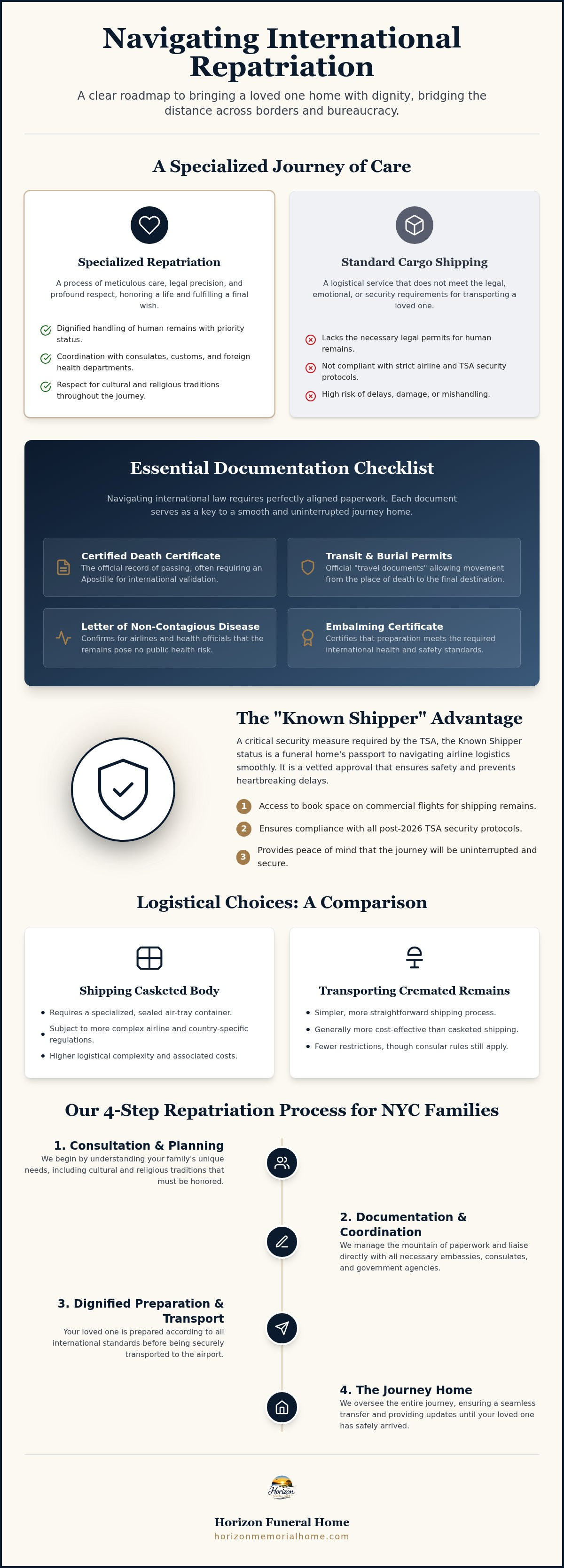
When you are tasked with bringing a loved one home, the process often feels like a series of steep hurdles. We've found that breaking the journey into clear, manageable steps helps restore a sense of control. The first step is to notify the local authorities, such as the hospital or medical examiner, and then reach out to a funeral director who specializes in international funeral transportation. We'll take the lead from there, acting as your liaison with all involved agencies.
Once we're working together, you'll need to decide on the final destination and whether you prefer to ship a casketed body or cremated remains. This decision determines which permits we need to prioritize. Next, we'll ask you to provide the deceased’s original passport and vital information; these are the foundational documents for all consular work. While we handle the NYC side, you'll need to coordinate with a receiving funeral home in the destination country. Finally, once we have secured consular clearance, we'll finalize the flight schedule and provide you with all the tracking details.
Preparing for the Costs Involved
Understanding the financial landscape is an important part of finding peace of mind. The total cost is generally a combination of airline cargo fees, consular filing fees, and professional service fees for the funeral home's coordination. It's important to remember that arranging a funeral from overseas often requires extra steps, such as international wire transfers. We recommend checking with your bank early to understand their timelines for global payments, as this can help prevent logistical delays.
Coordinating with the Receiving Country
The journey doesn't end when the plane lands. A local funeral director must be ready at the destination airport to receive your loved one from the airline. This hand-off is a formal process that requires specific identification and paperwork. The local director will also manage customs clearance, ensuring that the remains are admitted to the country according to their specific national laws. We stay in close contact with these international partners to ensure the transition is seamless and respectful. If you need help starting this process, our team is here to manage every detail of worldwide transportation from our Brooklyn base.
How Horizon Funeral Home Eases the Burden of Global Logistics
Choosing a partner for international funeral transportation is a decision rooted in deep trust. At Horizon Funeral Home, we act as a steady, grounded presence during a time that often feels like a logistical storm. Our Brooklyn-based team doesn't just manage forms and flight schedules. We stand beside you as a meticulous coordinator who values tradition and personal detail. By taking the weight of consular coordination and TSA-approved shipping off your shoulders, we create a sanctuary where you can focus on your family's emotional needs.
Dignity is our guiding principle through every mile of the journey home. Whether we're coordinating with a consulate in Manhattan or managing a specialized pickup in Brooklyn, our focus remains on the individual story being honored. We maintain clear, open communication with both families and foreign authorities. This ensures that no detail is lost and no cultural tradition is overlooked. Our specialized expertise in worldwide transportation allows us to move quietly and efficiently through the bureaucracy, providing you with the quiet confidence you need to breathe a little easier.
Serving Brooklyn and the NYC Metropolitan Area
Our roots run deep across the NYC metropolitan area, and we take pride in serving our neighbors with a human-centric approach. We assist families throughout Manhattan, Queens, Staten Island, and Nassau County with the same level of meticulous care we provide in our home borough of Brooklyn. NYC families trust us because we understand the unique cultural tapestry of our city. We don't see logistics as a clinical process. Instead, we see it as a way to respect the diverse heritage and final wishes of those who have passed. During this period of uncertainty, we serve as your calm, expert guide.
Next Steps: Securing Peace of Mind
You don't have to navigate these complexities alone. Starting the process is as simple as a phone call to our directors. During your initial consultation, we'll listen to your story and explain the roadmap ahead in manageable, bite-sized pieces. We'll discuss your specific needs, whether that involves veteran honors or specific religious requirements. Our role is to be an available but never intrusive partner in your grief. We'll help you gather the necessary vital information and begin the consular outreach immediately. This first conversation is designed to lower your anxiety and offer a sense of stability. If you're ready to begin, Contact Horizon Funeral Home for immediate repatriation assistance.
Bridging the Distance with Care and Dignity
Navigating the path to bring a loved one home is a journey that requires both legal precision and a compassionate heart. You now have a clearer understanding of the essential steps, from securing an Apostilled death certificate to choosing between air freight and cremation. These logistical details are the foundation for a respectful return. By coordinating with specialized worldwide transportation experts, you can ensure that every border crossing and consular requirement is handled with the utmost attention to detail.
We remain committed to serving families across all five NYC boroughs and Nassau County with steady, TSA-approved logistical coordination. Managing international funeral transportation shouldn't be a burden you carry alone. Our team stands ready to act as your calm guide, protecting your loved one's dignity while honoring your family's unique cultural traditions. You have the strength to take the next step, and we have the expertise to walk beside you. Let us help you bring them home with dignity. Contact our repatriation experts today.
Peace of mind is possible, even when the world feels wide. We are here to help you find it.
Frequently Asked Questions
How much does international funeral transportation typically cost?
The total expense for international funeral transportation is determined by several variables, including the destination, the weight of the remains, and specific airline cargo fees. Consular documentation and legal processing fees also play a significant role. Every country has its own requirements for permits and preparation, which can influence the final cost. We help you understand these variables upfront to ensure there are no surprises during the process.
Can I ship a loved one’s remains to any country from the US?
Most countries can receive remains from the US, but each nation maintains its own strict set of health and safety regulations. Some regions may have temporary restrictions due to diplomatic issues or health crises. We coordinate directly with the embassy or consulate of the destination country to verify current entry requirements. This ensures that your loved one meets all legal criteria before the journey begins.
How long does the repatriation process take from NYC?
The repatriation process from New York City typically takes between five and ten business days. This timeframe depends heavily on how quickly the local authorities issue the death certificate and how fast the consulate processes the necessary transit permits. We work diligently to expedite every step within our control. Our proximity to major consulates in Manhattan helps us move the paperwork forward as efficiently as possible.
What documents are required for international mortuary shipping?
Several critical documents are required for international mortuary shipping, including a certified death certificate and a burial-transit permit. You will also need an Apostille to validate the documents for use in another country. Most airlines and receiving nations also require a non-contagious disease affidavit and a formal embalming certificate. We handle the gathering and filing of these papers to ensure everything is legally sound for travel.
Is it possible to transport cremated remains on a commercial flight?
It is possible to transport cremated remains on a commercial flight, either as carry-on or checked luggage. You must use an urn made of a material that can be X-rayed, such as wood or plastic, so security can verify the contents without opening the container. It's also vital to carry the certified death certificate and cremation permit. We recommend checking with your specific airline for their latest 2026 boarding protocols.
What is a Ziegler case and why is it used for international shipping?
A Ziegler case is a specialized, zinc-lined container used to provide a hermetic seal for remains during air travel. It is a mandatory requirement for many international airlines to ensure public health and safety. This case fits inside a standard casket or a specialized shipping crate. It provides an extra layer of protection and security, ensuring your loved one is handled with the highest level of dignity and care during international funeral transportation.
Can veteran honors be coordinated for an international burial?
We can certainly coordinate veteran honors for an international burial. While the physical honors usually take place at the final destination, we ensure that all military documentation is handled with respect during the transport phase. We can also assist in applying for the burial flag and coordinating with the appropriate military branches to ensure your loved one's service is recognized, even when their final resting place is overseas.
What happens if the death occurs while traveling overseas?
If a death occurs while traveling overseas, the first step is to contact the nearest U.S. Embassy or Consulate. The Bureau of Consular Affairs will assist the family in navigating foreign laws and beginning the repatriation process back to the United States. We can then act as your local partner in New York to receive the remains and manage the final arrangements. We serve as a steady presence during this complex international funeral transportation hand-off.