
You may find yourself standing in a quiet room in Brooklyn, holding a phone and wondering how to fulfill a final promise made to a loved one who wished to rest in their home country. It's a heavy moment. This weight is often made more difficult by the realization that "going home" involves a complex web of international regulations. Understanding body repatriation costs and logistics is often the first hurdle families face, and the fear of hidden fees or customs delays can feel paralyzing. You aren't alone in wanting a steady hand to help you manage these details so you can focus on your own healing.
We believe that every family deserves a clear, honest path forward during this time of transition. This guide is designed to help you move through the process with transparency and grace. We'll walk through the specific requirements for leaving New York, including necessary permits and consulate coordination, while providing a realistic look at the financial landscape. By the end of this article, you'll have a roadmap that prioritizes both your budget and the dignity of your loved one. We'll stand beside you to ensure they are in safe, respectful hands.
Key Takeaways
- Understand the deep cultural significance of returning a loved one to their place of heritage and what this journey entails for NYC families.
- Navigate the complexities of body repatriation costs and logistics with a clear breakdown of professional fees, airline requirements, and international preparation standards.
- Compare the logistical paths of casketed shipping versus cremated remains to determine which option best honors your loved one's wishes and your family's needs.
- Learn about the essential documentation required, such as burial transit permits and non-contagious affidavits, and how NYC's proximity to consulates can expedite the process.
- Discover the value of a steady partner who manages the intricate details of airport coordination and customs, allowing you to focus on your family's healing.
Table of Contents
- Understanding Body Repatriation: The Journey Home from New York
- Breaking Down Body Repatriation Costs in 2026
- Logistics Framework: Casketed Shipping vs. Cremated Remains
- The Regulatory Roadmap: Consulates and Paperwork
- Choosing a Steady Guide: How Horizon Manages the Logistics
Understanding Body Repatriation: The Journey Home from New York
Repatriation is the act of returning a loved one to their ancestral home or place of birth after they've passed away. It's a journey that honors a person's heritage and life story. For many families across the NYC metropolitan area, including Brooklyn, Queens, Staten Island, the Bronx, and Nassau County, the desire to be laid to rest in the soil of their homeland is a final, sacred wish. This process, often referred to as the Repatriation and reburial of human remains, involves a delicate balance of emotional care and rigorous technical coordination. It's about more than just moving from one point to another. It's about ensuring a person's final transition is handled with the same respect they received in life.
The greater New York City area serves as a unique global crossroads for this service. Because of our diverse communities, spanning all five boroughs and surrounding counties, and our proximity to major international airports like JFK and Newark, we manage a high volume of worldwide transportation. The process is dual in nature. It requires strict legal compliance with both New York laws and the regulations of the destination country, alongside the physical logistics of secure transport. Understanding body repatriation costs and logistics begins with recognizing that this isn't a standard funeral service. It's a complex international operation that requires a steady, experienced hand.
Why Repatriation is a Specialized Service
Local funeral arrangements stay within a single jurisdiction. Repatriation crosses borders, which changes everything. This necessitates a partnership between two funeral homes: the sending home here in the greater New York metropolitan area and the receiving home in the destination country. You can't manage this alone. New York State law requires a burial or removal permit issued by the registrar of vital statistics. This permit is only issued after a death certificate is filed. You need a licensed funeral director to navigate these specific legal steps, which typically include:
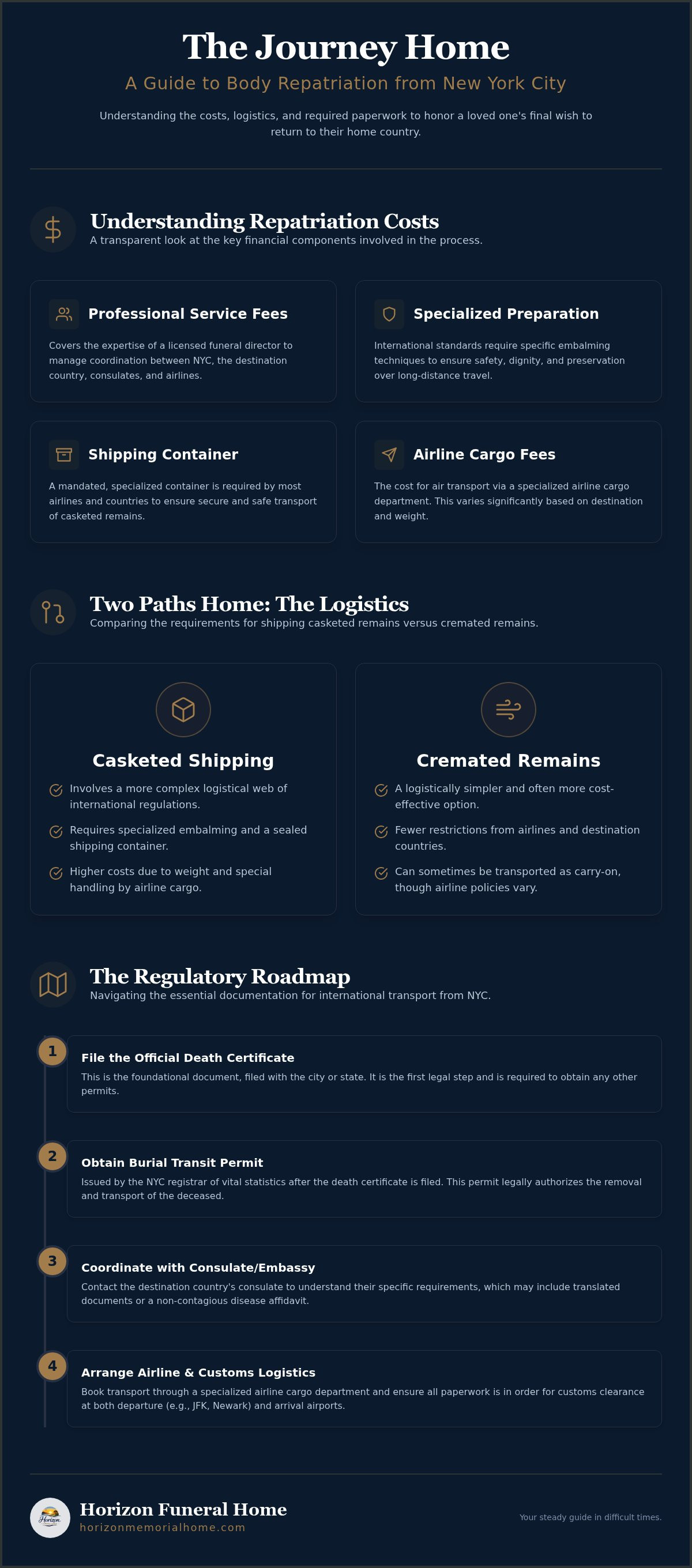
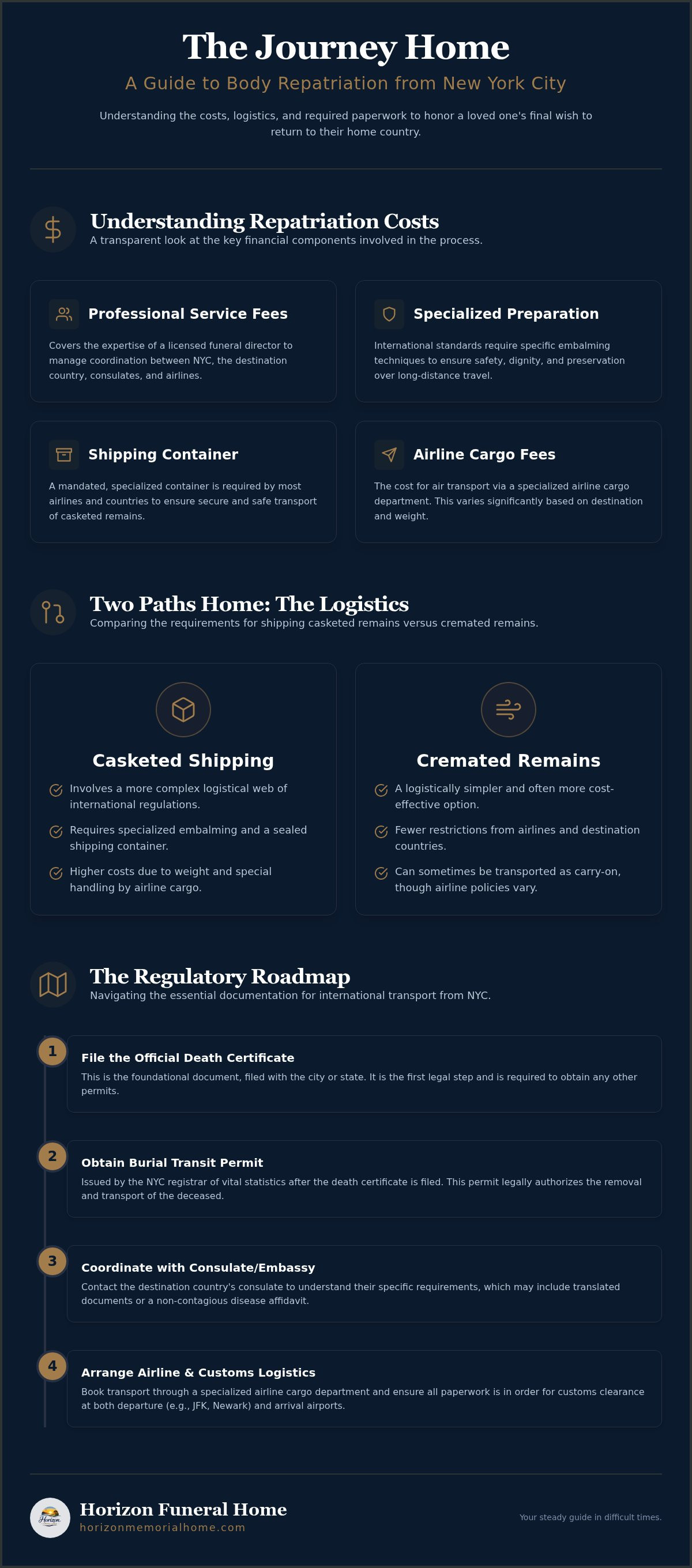
- Filing the official death certificate with the city or state.
- Obtaining a burial transit permit from the registrar.
- Coordinating with the airline's specialized cargo department.
This professional oversight ensures that every step meets international health and safety standards while protecting the dignity of the deceased.
Common Destinations from the NYC Metro Area
Our community, stretching across all five boroughs and Nassau County, is vibrant and far-reaching. We often assist families with the repatriation of remains to Georgia, where specific airline coordination is vital. We also provide guidance for shipping remains to Armenia from NYC, navigating the specific consulate requirements of that region. Beyond Eastern Europe, we frequently coordinate transfers to the Caribbean, South America, and various states within the US. Each route has its own rhythm and set of rules. The process can take anywhere from one week to over a month, depending on documentation and flight availability. Local expertise from Horizon Funeral Home in body repatriation costs and logistics is essential for a smooth transition, as it helps avoid the delays that can occur at customs or during airline transfers.
Breaking Down Body Repatriation Costs in 2026
Planning for a final journey involves many moving parts. Each one carries its own financial weight. Understanding the specific body repatriation costs and logistics helps remove the element of surprise during a time when you need peace most. The total budget isn't just about the flight. It's a combination of professional care, specialized equipment, and administrative requirements. You're balancing the need for a dignified farewell with the practical realities of international travel.
Your professional service fees cover the expertise of a coordinator who manages the delicate liaison between NYC and the receiving country. This includes the preparation and embalming of your loved one. International standards often require advanced techniques to ensure safety and dignity over long distances. Most airlines and destination countries also mandate specialized shipping containers. This typically involves a zinc liner that provides a hermetic seal inside a traditional casket or a sturdy air tray designed for cargo holds. These standards often align with CDC requirements for importing human remains, which prioritize public health and safety during transport.
Direct vs. Indirect Costs
It's helpful to view the budget in two distinct categories. Direct costs include the physical preparation, the casket or shipping container, and the airfare itself. Indirect costs are the administrative necessities that happen behind the scenes. These include consular fees for document legalization, apostilles, and certified translation services for non-English speaking countries. A mortuary certificate is a key cost factor because it serves as a formal declaration that the body was prepared according to international health and shipping regulations. These fees vary depending on the destination's specific legal framework.
Factors That Influence the Total Budget
Several variables will shift the final quote for body repatriation costs and logistics. Distance is a primary factor, but so is route availability from major hubs like JFK or EWR. If a destination requires multiple connecting flights, cargo fees will likely increase. Airline cargo rates are also sensitive to fuel prices and the total weight of the casket and shipping container. The urgency of the transport also plays a role. Choosing a faster, more direct route often costs more than a flexible schedule. If you feel uncertain about these variables, reaching out to a steady guide can help you find a path that honors your loved one while respecting your financial boundaries.
Logistics Framework: Casketed Shipping vs. Cremated Remains
Choosing between a traditional burial and cremation is a deeply personal decision. It's a crossroad where your family’s religious traditions, cultural values, and practical budget meet. While some traditions require the physical body to be returned to ancestral soil, others find peace in the flexibility of returning ashes home. This choice fundamentally shapes the body repatriation costs and logistics you'll encounter. We're here to help you weigh these options with both your heart and your head, ensuring your loved one is honored exactly as they wished.
The complexity of arranging a funeral from overseas shifts significantly depending on this decision. Full-body transport involves a high level of coordination between international health departments and airlines. Cremation, by contrast, offers a more streamlined path that can alleviate some of the immediate pressure on your family during the first few days of loss. Both paths lead to the same destination: a dignified final resting place.
The Full-Body Repatriation Path
Transporting a casketed body is the most traditional but also the most complex logistical route. Airlines operate under strict "known shipper" regulations, which means the funeral home must be a verified partner with the airline’s cargo department. To protect the casket and your loved one during the flight, we use an "Air Tray." This is a sturdy, weather-resistant outer shell with a solid wood base and a thick cardboard top. It ensures the casket remains secure and unmarked during the transition between airport hangars and the aircraft. Once the flight lands, the receiving funeral home must manage customs clearance procedures at the destination airport, which can sometimes take several hours as local authorities verify the mortuary certificates and death records.
Shipping Cremated Remains
For many families, repatriating ashes is a gentle and more affordable alternative. Research indicates that shipping cremated remains can cost approximately 75% less than full-body transport. This path avoids the need for heavy air trays and expensive cargo fees. If you choose to carry the urn yourself, it must be TSA-approved. This means the urn should be made of a material that can be easily scanned, such as wood, plastic, or non-lead-lined ceramic. If you prefer to mail the remains, the United States Postal Service (USPS) is the only legal carrier for cremated remains. They provide specialized "Cremated Remains" shipping kits that include the necessary tracking and labels to ensure the journey is handled with the highest level of priority and care. This simplicity often makes body repatriation costs and logistics much more manageable for families navigating a sudden loss.
The Regulatory Roadmap: Consulates and Paperwork
The path home is paved with paperwork that serves as a final bridge between nations. While the physical preparation is vital, the legal coordination is what truly ensures a seamless transition. Understanding body repatriation costs and logistics means looking closely at the regulatory roadmap required by both New York and the destination country. This phase is often the most confusing for families, but NYC offers a distinct advantage. We are home to nearly every world consulate, from Manhattan to Long Island City. This proximity allows for hand-delivered documents and face-to-face coordination with officials, which often speeds up the process compared to other regions.
The essential document checklist begins with a certified death certificate and a burial transit permit from the registrar of vital statistics. We also secure a non-contagious affidavit, which is a formal statement from the health department. For many countries, these documents aren't enough on their own. They must be apostilled, a specialized form of international legalization, and translated into the destination’s official language by a certified professional. The final requirement is often the 'Consular Mortuary Certificate.' This serves as the official seal from the destination country's consulate, authorizing the entry of your loved one and confirming all health regulations have been met.
Dealing with International Customs
Even with perfect paperwork from New York, the journey isn't complete until your loved one clears customs at the destination airport. This is why having a receiving funeral home already in place is crucial. They act as the local liaison to handle the final release and transportation to the burial site. One common reason for delays is a missing or improperly formatted 'non-infectious disease' certification, which is a requirement stating that the deceased does not pose a public health risk. We ensure this document is meticulously prepared to prevent any hesitation from foreign officials, protecting the dignity of the process.
Timeline Expectations
Patience is a necessary part of this process, as international bureaucracy moves at its own speed. It typically takes 3 to 7 business days just to procure and legalize the necessary documents from NYC agencies and consulates. Once the consulate gives its final approval, we then coordinate with flight schedules. Airlines have specific capacities for 'human remains' transport, and availability can fluctuate based on the season or the specific route. We keep you informed at every step to manage these expectations, providing a sense of stability during the waiting period. If you have questions about the specific requirements for your home country, you can contact our coordination team for clear, personalized guidance.
Choosing a Steady Guide: How Horizon Manages the Logistics
Managing the final journey of a loved one requires a balance of logistical precision and deep emotional awareness. You shouldn't have to carry the burden of international bureaucracy alone while you're grieving. We see our role as a meticulous coordinator, standing beside you to handle every detail with a quiet, steady confidence. By serving as your single point of contact, we manage all international liaisons, from local health departments to foreign consulates and airline cargo offices. This partnership is designed to lower your anxiety, offering a sense of sanctuary during a time that often feels overwhelming and uncertain.
Our deep roots in the NYC metro area provide a distinct advantage when navigating body repatriation costs and logistics. We leverage our local expertise across Brooklyn, Queens, and Nassau County to ensure swift coordination with regional hubs like JFK and Newark Liberty International Airport (EWR). Because we maintain direct partnerships with major airline cargo departments, we can secure space and manage transfers with a level of efficiency that only comes from daily experience. We understand the rhythm of these airports and the specific requirements of their customs offices, ensuring your loved one is always treated with the dignity and respect they deserve.
Personalized Support for Diverse Traditions
Every family brings a unique story and a specific set of cultural or religious mandates for body preparation. We don't believe in a one-size-fits-all approach. Whether your traditions require specific washing rituals, a particular type of casket, or a strict timeline for burial, we honor those needs with sensitivity. Our team has extensive experience with complex international routes, including specialized knowledge in shipping to Georgia and Armenia. We understand the nuances of foreign authorities in these regions and work tirelessly to ensure that all cultural requirements are met without compromising legal compliance. We strive to be a patient listener, ensuring that your family’s heritage is the guiding light of the entire process.
Next Steps: Starting the Process
When you're ready to begin, the first step is an unhurried consultation to establish a clear roadmap. We'll take the time to listen to your needs and explain the timeline for your specific destination. During this initial conversation, we provide transparent estimates for body repatriation costs and logistics that are tailored to your unique situation. We believe in clarity from the very beginning, ensuring there are no hidden surprises or confusing jargon to navigate later. Our goal is to provide you with a clear-eyed guide so you can make decisions with peace of mind. If you need support moving forward, please contact Horizon Funeral Home for a steady hand in international repatriation. We're here to help you bring your loved one home with the grace and dignity they deserve.
Honoring Your Loved One's Final Journey Home
Bringing a loved one home is a profound act of love and respect. It's a journey that involves balancing deep cultural traditions with the practical realities of international travel. By understanding body repatriation costs and logistics, you've taken the first step toward a process defined by clarity rather than confusion. You now know how the choice between casketed shipping and cremation shapes the path forward, and how NYC’s unique position as a global hub can help streamline the regulatory requirements of foreign consulates. This knowledge serves as a foundation for a dignified farewell that honors your family's heritage.
You don't have to navigate these intricate steps alone. As specialized worldwide transportation experts, we provide compassionate, NYC-based support that includes direct coordination with airlines and consulates. Let Horizon Funeral Home handle the complex logistics of bringing your loved one home. We're here to offer a steady presence and a sanctuary of stability during this uncertain time. You can move forward with the peace of mind that your loved one will be treated with the utmost dignity every mile of the way. We'll stand beside you, ensuring the promise of "going home" is fulfilled with grace.
Common Questions About International Repatriation
How much does it cost to ship a body to another country in 2026?
The total expense is determined by a variety of shifting factors including the destination country, current airline cargo rates, and specific consulate requirements. Because fuel surcharges and international regulations change frequently, the budget is often a combination of professional coordination fees and variable third-party costs. We provide personalized estimates that account for these nuances to ensure your family has a clear financial roadmap from the beginning.
Can I fly on the same plane as my loved one's remains?
Yes, it's often possible for family members to book passage on the same aircraft as their loved one. While the deceased travels securely in the airline's specialized cargo hold, many families find comfort in knowing they are making the journey together. We coordinate closely with airline cargo departments to align flight schedules, though availability depends on the specific aircraft's capacity for human remains transport on your chosen date.
Is embalming required for international body repatriation?
Embalming is a standard requirement for nearly all international repatriation routes. This process is mandated by both airline safety regulations and the health departments of receiving countries to ensure public safety and the dignity of the deceased during a long journey. Some countries have very specific preparation standards, which is why professional oversight is essential to ensure all body repatriation costs and logistics meet international legal criteria.
How long does the international repatriation process usually take?
The timeframe typically spans from one week to approximately six weeks. This duration depends heavily on how quickly the death certificate is filed and how long the destination country's consulate takes to legalize the necessary permits. While we work to expedite every step, factors like flight availability and international holidays can also influence the final arrival date in the home country.
What is the cheapest way to send a loved one's remains back home?
Repatriating cremated remains is the most affordable alternative for families. This method significantly reduces expenses because it avoids heavy shipping containers and the higher cargo fees associated with full-body transport. Since ashes can be carried as TSA-approved hand luggage or sent through the postal service, it offers a more flexible and budget-friendly path while still allowing for a traditional burial or ceremony in the homeland.
Do I need a special casket for international air travel?
International regulations usually require a specialized shipping container rather than a standard casket alone. This often involves a zinc-lined casket or a hermetically sealed liner placed inside a traditional casket to meet health and safety standards. Additionally, an "air tray" or "wood box" is used to protect the casket from damage during the loading process and the flight, ensuring it arrives in pristine condition.
How do I find a receiving funeral home in the destination country?
You can choose a local provider in the destination country, or we can assist in identifying a reputable partner through our international networks. It’s essential to have this relationship established early, as the receiving funeral home must be ready to manage customs clearance and local transportation upon the flight's arrival. We act as the primary liaison to ensure they have all the necessary paperwork before the plane lands.
Are there government grants or assistance for repatriation costs?
Low-income residents in New York City may be eligible for burial assistance through the Department of Social Services (DSS). This program can provide a supplement for funeral expenses if the total cost of the service stays within specific city-mandated limits. While these grants are helpful, they are generally designed for local burials, so it’s important to verify current eligibility rules regarding how these funds apply to international transportation.