
Imagine the moment you learn a loved one has passed away far from home. Amidst the sudden grief, a daunting question often arises: how do I bring them back to their final resting place? You're likely feeling a heavy weight of responsibility mixed with confusion over foreign consulate paperwork and strict airline regulations. It's completely natural to feel anxious about potential delays or whether your family member will be treated with the steady dignity they deserve during their journey.
We understand that this process feels like a mountain of bureaucracy during your time of deepest need. This expert-led guide is designed to help you understand the international funeral shipping requirements for 2026, offering a clear and gentle path through the complexity. We'll walk beside you as we break down the legal, medical, and logistical steps required to bridge the distance between where they are and where they belong.
In the following sections, you'll find a methodical roadmap that explains the TSA Known Shipper program, the role of the Consular Mortuary Certificate, and the specific documentation needed for a safe, respectful repatriation. We're here to provide the clarity you need to move forward with confidence and peace of mind.
Key Takeaways
- Understand the essential differences between domestic transfers and international repatriation to help you set realistic expectations for the journey home.
- Learn how to navigate the specific international funeral shipping requirements for 2026, including the vital legal and medical documents needed for customs.
- Discover why a funeral home's "Known Shipper" status with the TSA is a mandatory step for booking air transportation for your loved one.
- Gain insight into the delicate process of coordinating with foreign consulates to secure the necessary mortuary certificates for international entry.
- Find out how specialized local expertise in the NYC area can help manage the heavy lifting of global logistics and paperwork on your behalf.
Table of Contents
- What is International Repatriation? Understanding the Basics
- Essential Legal and Medical Documentation Requirements
- Airline Regulations and the 'Known Shipper' Protocol
- Coordinating with Foreign Consulates and Embassies
- How Horizon Funeral Home Navigates Global Logistics from NYC
What is International Repatriation? Understanding the Basics
At its heart, What is International Repatriation? refers to the process of returning a person to their country of origin for their final rest. It's a journey that carries deep emotional and cultural weight. For many families, this isn't just a logistical necessity. It's a sacred commitment. You're ensuring a loved one returns to their ancestral soil, resting among the generations who came before them. This sense of belonging provides a unique form of peace during a time of immense loss.
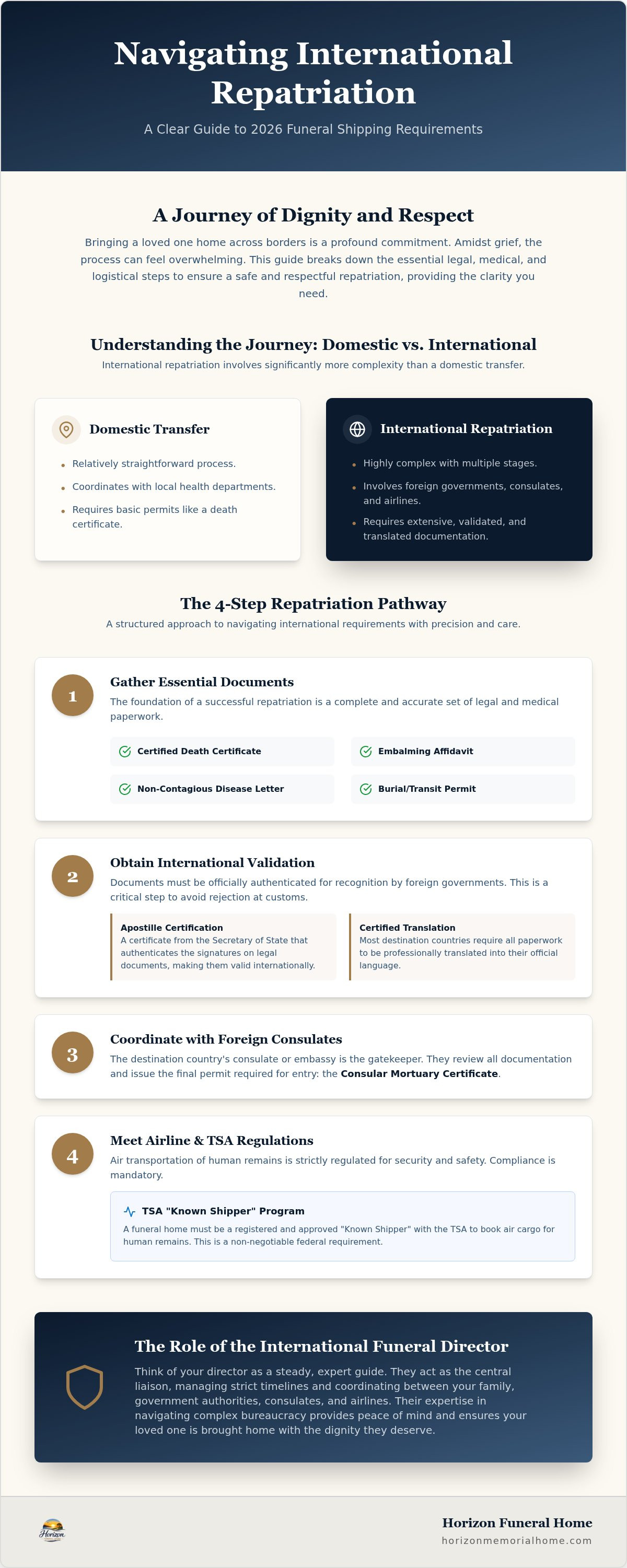
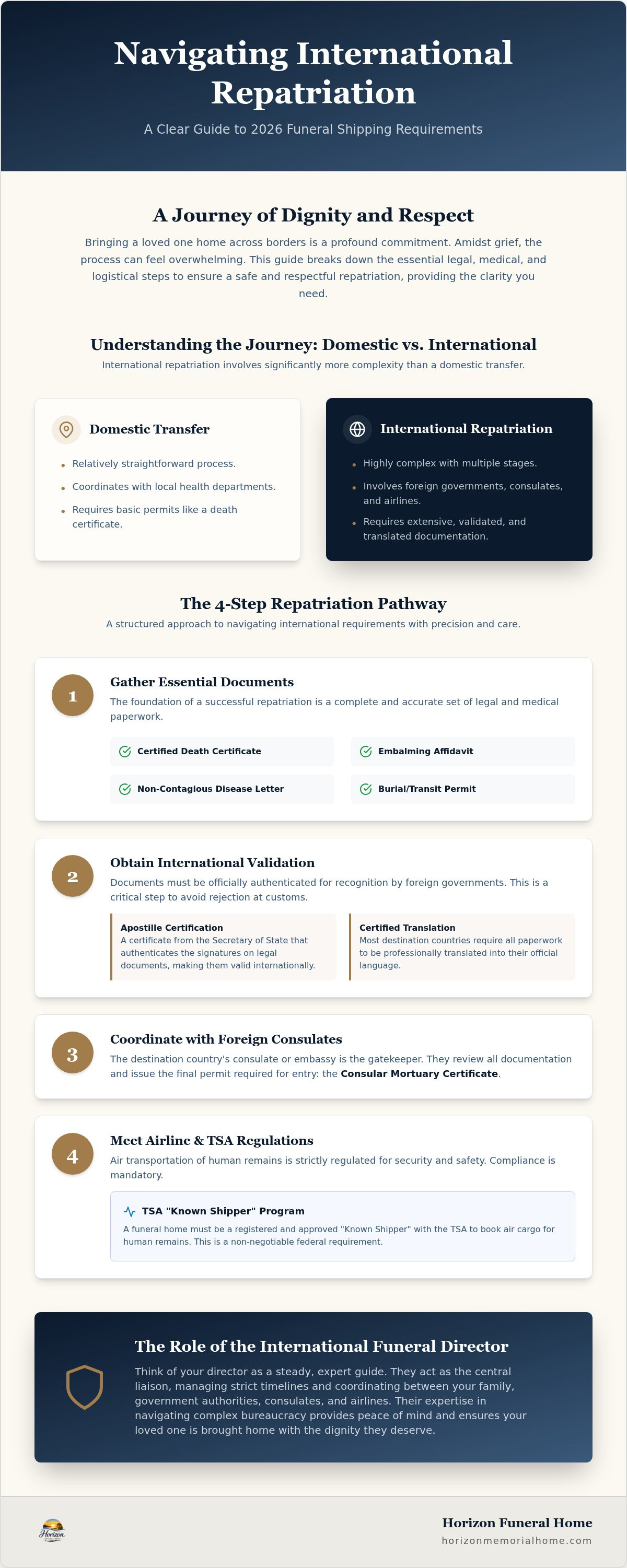
While domestic transfers are relatively straightforward, moving a loved one across international borders is significantly more complex. You aren't just dealing with local health departments. You're coordinating with foreign governments, international airlines, and specific consulate offices. Meeting the international funeral shipping requirements for 2026 requires meticulous attention to detail. Every country has its own set of rules regarding medical preparation, container specifications, and legal documentation. It's a process that demands patience and expert coordination to avoid delays that can be emotionally taxing for your family.
The Role of the International Funeral Director
Think of an international funeral director as your steady, expert guide. We act as the essential liaison between NYC authorities and foreign governments. Our role is to manage the strict timeline, ensuring that every step respects your religious traditions and satisfies legal mandates. We handle the heavy lifting of the paperwork so you don't have to. During this chaotic logistical period, we offer a grounded presence. We stay by your side. We provide the clarity and support needed to bring your loved one home with the dignity they deserve.
Common Repatriation Scenarios in NYC
Living in a vibrant hub like Brooklyn or Queens means we serve families from all over the world. We frequently assist with shipping remains to Europe, Asia, and the Caucasus. We've built a particular specialization in handling the repatriation of remains to Georgia and Armenia. These regions have specific customs and international funeral shipping requirements that we know intimately. Whether you're shipping full remains or cremated ashes, the protocols change. Full remains require specific embalming affidavits and air-safe containers. Cremated remains, while often simpler, still require specific permits and airline-approved vessels. Being located near major international hubs like JFK allows us to coordinate these departures with precision and care.
Essential Legal and Medical Documentation Requirements
Securing the necessary paperwork for repatriation can feel like an impossible task when you're already carrying the weight of grief. It's a complex web of legal and medical certifications that must be perfectly aligned. To satisfy international funeral shipping requirements, you must first gather the foundational documents. The most vital of these is the Certified Death Certificate. This document serves as the primary proof of identity and passing for every authority involved in the journey.
You'll also need an Embalming Affidavit. This document confirms that your loved one has been prepared correctly for the duration of long-haul travel. Most destination countries require a Non-Contagious Disease Letter as well. This letter, typically issued by a physician or the medical examiner, certifies that the remains do not pose a public health risk. Finally, the journey cannot begin without a Burial/Transit Permit. In the NYC metro area, this specific permit is issued by the Department of Health and Mental Hygiene (DOHMH). It acts as the official authorization for the remains to be moved across borders.
The Apostille and Translation Process
An Apostille is a specialized certificate issued by the Secretary of State for international use. This certificate validates the authenticity of the signatures on your legal documents, ensuring they are recognized by foreign governments and consulates. Without this step, your paperwork might be deemed invalid once it reaches the destination country. Most nations also require these documents to be translated into their official language by a certified professional. We understand how tedious this can be. Horizon handles the entire submission process to the New York Secretary of State, managing the stamps and seals with quiet precision.
NYC-Specific Filing Procedures
Navigating the NYC DOHMH requires a steady hand and local expertise. We work directly with city officials to secure expedited transit permits, which is crucial when flight schedules are tight. In some cases, we must coordinate closely with the local medical examiner's office to ensure all clearances are obtained. Understanding Airline Regulations and the 'Known Shipper' Protocol is just as essential as the legal paperwork. We manage these overlapping requirements so you don't have to face the bureaucracy alone. If you're feeling overwhelmed by these logistics, we are here to help you coordinate worldwide transportation with the patience and dignity your family deserves.
Airline Regulations and the 'Known Shipper' Protocol
The physical journey home begins at the airport. This stage involves a specialized airline designation known as "Human Remains" (HUM) status. This isn't just a logistical label. It's a protocol that ensures your loved one is prioritized and handled with the highest level of care throughout the flight. Because we are located in Brooklyn, we utilize the direct global routes available through JFK and Newark (EWR). This proximity is a significant advantage. It reduces travel time and minimizes the number of transfers your loved one must undergo. Meeting the international funeral shipping requirements for 2026 means coordinating these flight paths with precision and care.
The TSA mandates a "Known Shipper" protocol for all air cargo. This means only certified funeral homes that have undergone a rigorous vetting process can book remains for transport. You cannot book these flights as an individual. This regulation exists for security, but it also provides you with a layer of protection. It ensures that only professionals who understand the delicate nature of repatriation are managing the logistics. We maintain our active status in the Known Shipper database to ensure expedited clearance and a smooth transition for every family we serve.
Packaging and Casket Requirements for Air Travel
Most airlines require specific outer containers to ensure safe transit. An Air Tray is a common requirement. It's a sturdy, weather-resistant base that protects the casket from damage during loading and unloading. In certain instances, international health laws or destination-specific rules require a zinc-lined Ziegler case. This hermetically sealed container is often part of the CDC requirements for importing human remains, especially when moving remains across certain borders. We ensure every container used meets the strict International Air Transport Association (IATA) standards for safety and structural integrity.
Navigating TSA Security Inspections
Security screening is a mandatory part of air travel, even for repatriation. The TSA performs these inspections with a focus on maintaining the dignity of the deceased. Because we are a Known Shipper, this process is often more streamlined. We provide the necessary documentation to the airline cargo terminal well in advance. This preparation prevents unnecessary delays at the warehouse and ensures the timeline is respected. For a deeper look at how these steps fit into the larger process, you can read our guide on International Funeral Transportation: A Complete Guide to Repatriation in 2026. We manage these technical international funeral shipping requirements so you can focus on your family and your grief.
Coordinating with Foreign Consulates and Embassies
The consulate acts as the final legal gatekeeper for your loved one's journey home. Every country maintains its own sovereignty over who enters their borders. To satisfy international funeral shipping requirements, we must secure a Consular Mortuary Certificate. This document is the official permission from the destination country's government to allow the remains to cross their border. Securing this certificate often involves a complex dance of document delivery and verification. Consular fees for this specific certificate typically range from $50 to $200. Timelines are equally variable. Some diplomatic offices process requests in as little as two business days, while others may take up to ten.
Country-Specific Requirements and Nuances
Repatriation isn't a one-size-fits-all process. The requirements for Armenia or Georgia differ significantly from those for Western Europe. For instance, some regions require a consulate representative to physically witness and seal the casket with an official "Seal of Office." This ensures the contents haven't been tampered with after the medical preparation. We also manage religious requirements alongside civil laws. Whether you're following Jewish or Muslim traditions, we ensure the preparation respects your faith while meeting the destination's health codes. A critical part of this bridge is the "receiving funeral home." We coordinate directly with your chosen provider in the home country to ensure a seamless handoff once the flight lands.
The Consulate Interview and Document Delivery
Visiting a diplomatic office during a time of mourning is an unnecessary stress. Horizon acts as your proxy. We handle the consulate interviews and document deliveries on your behalf. We ensure every stamp and seal is correctly applied to the transit containers. This meticulous attention to detail prevents your loved one from being held at customs upon arrival. While we focus on global logistics, we remain rooted in our local community. You can learn more about our local services in our guide to Traditional Funeral Arrangements in Brooklyn: A Guide to Dignified Farewells.
We understand that the diplomacy of death is a heavy burden to carry alone. Let our team manage the consulate logistics and the intricate international funeral shipping requirements for you. If you need a steady hand to guide you through this process, please reach out to Horizon Funeral Home today. We are here to stand beside you.
How Horizon Funeral Home Navigates Global Logistics from NYC
Based in the heart of Brooklyn, our team has spent years refining our expertise in worldwide transportation. We understand that meeting international funeral shipping requirements isn't just about checking boxes on a form. It's about honoring a life and supporting the family left behind. We act as your steady, expert partner, managing the heavy lifting of the logistics so you can focus on your memories. From the very first call to the moment your loved one arrives home, we're with you every step of the way.
Why NYC Families Trust Horizon for Repatriation
New York City is a mosaic of diverse cultural and immigrant communities. We take great pride in our deep understanding of these traditions. Whether you're shipping to Western Europe or managing the complex routes to the Caucasus and Eastern Europe, we have the experience to guide you. We've built a specific specialization in the repatriation of remains to Georgia and Armenia, navigating the unique consulate demands of those regions with quiet confidence. For those who wish to ease the burden on their families in advance, we also offer Funeral Preplanning Services in NYC: A Compassionate Guide to Future Peace of Mind.
Our local presence in Nassau County and the NYC boroughs is a vital asset for international speed. Being located near major international hubs like JFK allows us to coordinate departures with precision. We don't work from a distance. We're on the ground, interacting directly with the NYC Department of Health and local medical examiners to secure permits as quickly as possible. This proximity reduces the time your loved one spends in transit, ensuring they are treated with the dignity they deserve. It's our way of providing professional reliability combined with gentle emotional support.
Next Steps: Getting the Process Started
When you're ready to begin, we're here to listen. For our first consultation, it's helpful to have the deceased's passport and basic information about the destination funeral home ready. We'll provide a clear, transparent breakdown of the logistics involved, ensuring you understand every step of the journey. We don't use high-pressure tactics. Instead, we offer a sanctuary of stability during this uncertain time. If you're ready to start this journey, please Contact Horizon Funeral Home for a Compassionate Repatriation Consultation. We'll stand beside you until your loved one is safely home.
Bringing Your Loved One Home with Peace of Mind
Returning a loved one to their ancestral soil is a final, sacred act of devotion. While the path involves intricate international funeral shipping requirements, from securing TSA Known Shipper status to coordinating with foreign consulates, you don't have to walk it alone. We've explored how the right documentation and specialized regional expertise, particularly for destinations like Georgia and Armenia, ensure a journey defined by dignity rather than delay.
Our team in Brooklyn stands ready to handle the heavy lifting of global logistics with the steady, multicultural care your family needs. We bridge the gap between complex NYC regulations and your loved one's final resting place, offering a sanctuary of stability during this difficult time. If you're ready to begin this process, please Speak with our International Transportation Experts. We are here to provide the professional reliability and gentle support you deserve, ensuring your loved one is returned home with peace and grace.
Frequently Asked Questions
How long does the international funeral shipping process usually take?
International repatriation typically takes between 7 and 14 days to complete. This timeline depends heavily on the destination country's consulate processing times, which can range from 2 to 10 business days. We also coordinate with airlines that require 48 to 72 hours of advance notice for booking. Our location in Brooklyn allows us to move quickly through NYC's Department of Health to secure the necessary permits, helping us manage the schedule with precision and care.
Can I ship cremated remains internationally from NYC?
Yes, you can ship cremated remains internationally from the NYC metro area. As of March 1, 2025, the USPS requires all cremated remains to be shipped using the official Priority Mail Express Cremated Remains Box. We help you navigate these specific international funeral shipping requirements to ensure the ashes are transported safely and legally. Whether you are shipping to Europe or the Caucasus, we provide the necessary permits and certified containers to ensure your loved one is treated with dignity.
What is a 'Known Shipper' and why does it matter for my loved one?
A "Known Shipper" is a funeral home registered with the TSA and individual airlines to tender human remains for air transport. This status is mandatory because airlines cannot accept human remains from private individuals due to strict security protocols. Horizon Funeral Home maintains active Known Shipper status with major carriers at JFK and Newark. This registration allows us to bypass common logistical delays and ensures that your loved one’s transportation is handled through secure, professional channels from start to finish.
Are there specific requirements for shipping remains to Georgia or Armenia?
Shipping remains to Georgia or Armenia involves unique diplomatic requirements that differ from Western European protocols. These countries often require a "Consular Mortuary Certificate" and may mandate that a consulate representative physically seals the transit container. We specialize in these specific routes from Brooklyn and Queens. Our team manages the translation of documents and the application of the official "Seal of Office" to ensure your loved one meets all entry criteria without unnecessary complications at the border.
How much does it cost to ship a body internationally in 2026?
The total cost of international repatriation is determined by several variables, including the destination, the weight of the shipment, and specific airline cargo fees. While industry averages fluctuate, the final amount often reflects the complexity of the paperwork and the distance traveled. We provide a clear and honest breakdown of all logistical expenses during our first meeting. This ensures you have a stable understanding of the financial requirements without any unexpected or hidden fees during this difficult time.
What documents do I need to provide to the funeral home to start the process?
To begin the process, you should provide a certified copy of the death certificate and the deceased’s valid passport. We will also need a non-contagious disease letter and an embalming certificate to satisfy international funeral shipping requirements. If the destination country requires document authentication, we handle the submission for an Apostille through the New York Secretary of State. Having these documents ready during our first conversation helps us establish a clear roadmap for your loved one's journey home.
Can a family member accompany the remains on the same flight?
Yes, it is often possible for a family member to travel on the same aircraft as their loved one. While the remains are transported in the cargo hold as "Human Remains" (HUM) status, you can book a seat in the passenger cabin. We coordinate closely with the airline’s cargo department to align the flight schedules. This arrangement can provide a sense of peace, knowing you are accompanying your family member every mile of the way back to their home.
What happens if the death occurred at home in Brooklyn versus in a hospital?
If a death occurs at home in Brooklyn or Nassau County, the local police and medical examiner must be notified before we can begin transportation. This step is necessary to legally certify the cause of death. In contrast, a hospital death usually involves a more direct release process to our care. Regardless of the location, we act as your meticulous coordinator, working with NYC authorities to secure the burial/transit permits required to move forward with the repatriation process.