
What if bringing a loved one home depends on more than gathering the right paperwork? International body transport logistics also involve coordinating the route, required preparations, and airline procedures. Details can differ from one destination to another.
If you’re unsure where to begin, that’s understandable. Families often have to make arrangements across countries and time zones while managing grief. A missing document or overlooked route requirement can add worry. The process is easier to follow when each stage is handled in order, with clear coordination between the people involved.
This guide explains the main steps in international transportation, the route-specific details that can affect requirements and timing, and how the arrangements fit together. You’ll learn what information helps shape a plan and why paperwork is only one part of the journey. From the New York metropolitan area, Horizon Funeral Home coordinates worldwide transportation, including international pickups and deliveries, helping families navigate the logistics with care.
Key Takeaways
- International body transport logistics involve several connected stages, from gathering initial details to coordinating arrival and handover.
- The route, departure and destination locations, airline arrangements, and receiving plans all shape the coordination required.
- Gather accurate identity, location, destination, and family contact information to help organize next steps.
- Documentation and preparation depend on the specific route, so a universal checklist may not fit every journey.
- Horizon Funeral Home coordinates worldwide transportation, including international pickups and deliveries, for families in the New York metropolitan area.
Table of Contents
- International body transport logistics: what families need to know first
- How international body transport moves from local arrangements to arrival
- Which route and transport choices change the logistics?
- What families can prepare while international transport is coordinated
- How Horizon Funeral Home coordinates international body transport logistics
International body transport logistics: what families need to know first
After a death in another country, families may need to make important decisions while grieving, coordinating across borders, and waiting for updates in different time zones. You don’t need to solve every detail at once. Begin with the basic facts and choose a primary family contact. These provide a clear starting point for coordination.
International body transport is the coordinated movement of a person who has died across national borders. It is distinct from funeral or memorial arrangements held before or after arrival. The route, destination, and transport method help determine which arrangements and documents apply. That’s why one checklist cannot cover every journey.
What international repatriation logistics include
International body transport logistics connect arrangements at the place of death with the planned journey and receiving destination. This may involve coordinating a local pickup, transport arrangements, and a handover to those receiving your loved one. Document and handling requirements can differ by route, so the sequence is shaped around the countries involved.
The Agreement on the Transfer of Corpses offers background on an international framework related to cross-border transport. It is one reference point, not a substitute for understanding the requirements that apply to a particular route. This is a personal journey involving a loved one, not ordinary cargo. Respectful handling and clear communication matter throughout.
What to establish before arrangements begin
A few clear details help a coordinator organize next steps. Share what you know and identify what still needs to be gathered. Start with:
- The country and, if known, the city where the death occurred.
- The intended destination country and receiving location.
- The family member or representative who should receive updates and help communicate decisions.
- Any cultural, religious, or personal wishes that should guide handling or arrangements.
These details connect the place of death with the destination and help clarify which route-specific documents and arrangements may apply. Naming one primary family contact can also reduce crossed messages when relatives are coordinating from different locations. Other family members can stay involved, while updates and decisions follow a clear path.
It’s also helpful to distinguish transport planning from the funeral or memorial arrangements the family may want at either end of the journey. The two can be coordinated, but they serve different needs: transport focuses on moving your loved one respectfully across borders, while funeral or memorial arrangements honor their life. Keeping both in view can help the family make decisions with greater clarity, one step at a time.
How international body transport moves from local arrangements to arrival
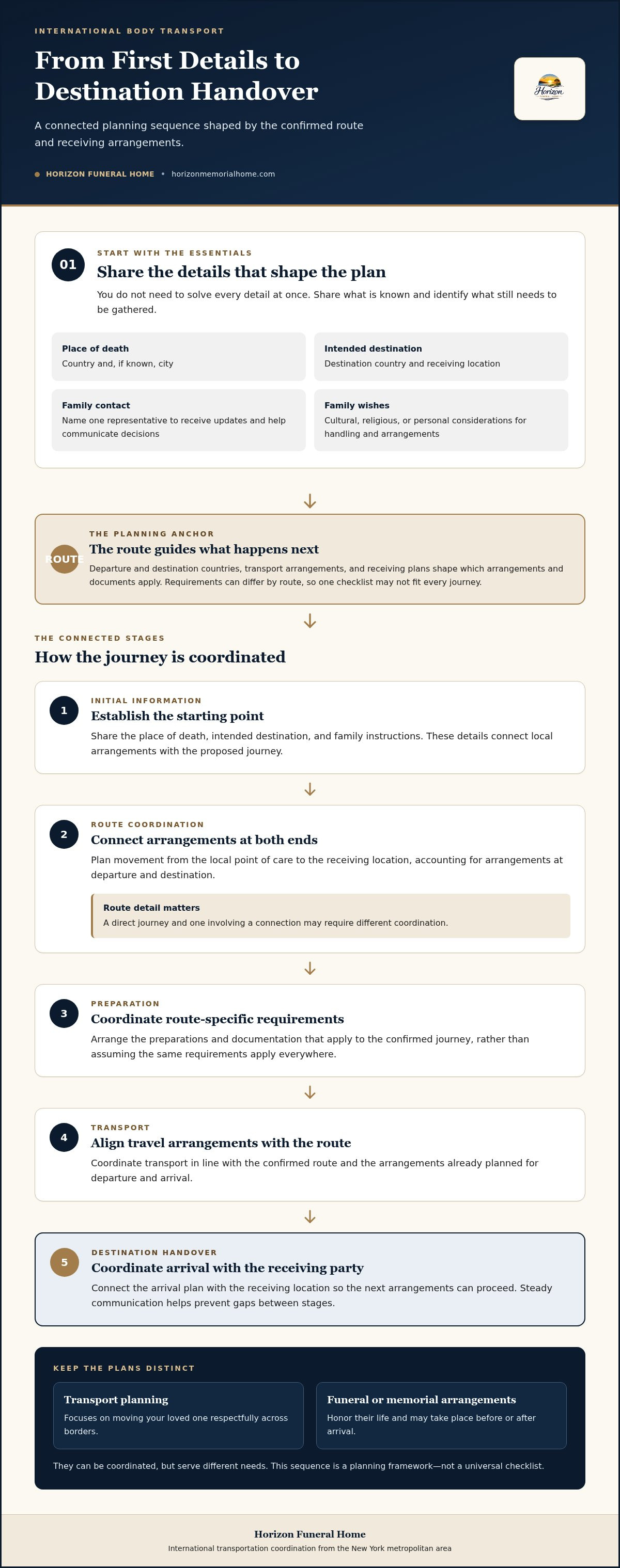
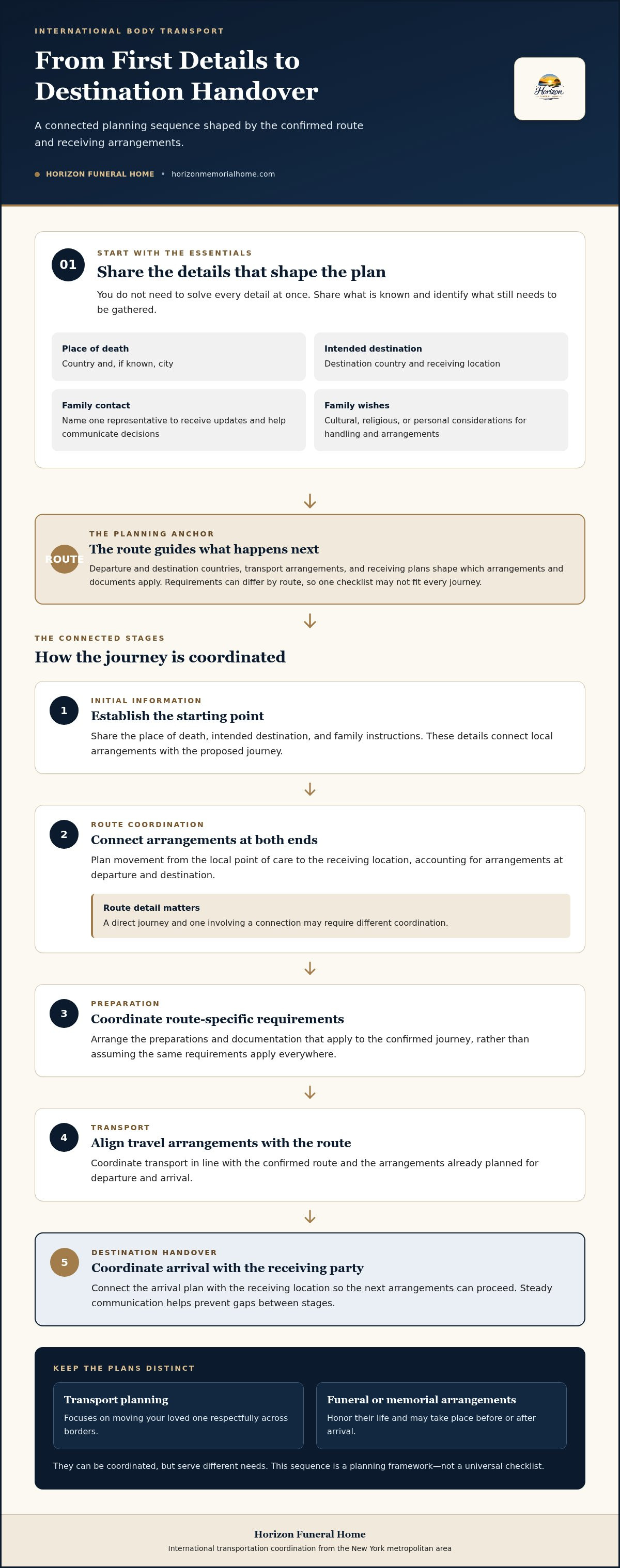
Once the intended destination is clear, coordination moves forward in connected stages. Each stage builds on the last, while route-specific requirements shape what needs to happen and in what order. A confirmed route guides the rest of the plan because the departure and destination countries, transport arrangements, and receiving plans determine which steps apply.
The sequence commonly includes:
- Initial information: Share the place of death, intended destination, and family instructions.
- Route coordination: Plan movement from the local point of care to the receiving location, accounting for arrangements at both ends.
- Preparation: Coordinate the preparations and documentation that apply to the journey.
- Transport: Align travel arrangements with the confirmed route.
- Destination handover: Coordinate arrival with the receiving party so the next arrangements can proceed.
This is a planning framework, not a universal checklist. A direct journey and one involving a connection may require different coordination, and requirements can vary by route. The Chartered Institute for Logistics & Transport shares broader perspectives on transport and logistics. For a family, the practical focus is coordinating each part of this particular journey with care.
From the place of death to transport planning
Planning begins with the location where the death occurred, the intended destination, and the family’s instructions. These details establish how local arrangements connect to the proposed journey. Horizon Funeral Home organizes international pickup and delivery logistics, identifies information needed for the next step, and keeps the family informed as arrangements develop. Clear updates are especially important when relatives are in different time zones or sharing decisions.
Preparing for transport and coordinating arrival
Preparation and transport arrangements follow the requirements for the confirmed route. Rather than assuming the same documents or handling steps apply everywhere, Horizon coordinates around the journey’s departure and destination details. This helps the family understand what is needed next without relying on a checklist that may not fit their circumstances.
Coordination continues across both ends of the journey. Departure arrangements need to connect with the transport plan, while the receiving location needs to be ready for arrival and handover. Each party has a role, and steady communication helps prevent gaps between stages. Timing depends on the route and arrangements involved, so updates are more useful than assumptions about a fixed turnaround.
For families arranging transport from or to the New York metropolitan area, Horizon coordinates worldwide transportation logistics, including international pickups and deliveries. Horizon’s international transportation coordination brings the stages together as part of the planning process.
Which route and transport choices change the logistics?
The route is more than a line between two countries. The departure location, destination, transport method, airline arrangements, and receiving plans all affect how the journey is coordinated. A direct itinerary and one with a connection, for example, may involve different transfer points and handoffs. Neither should be assumed available or suitable before the route is planned.
Destination-country authorities may have their own documentation and handling requirements. Depending on the route, a consulate or embassy may also be a relevant coordination point. The table offers planning questions, not a universal checklist. Specific details need to be confirmed for the countries and arrangements involved.
| Route factor | Possible effect on coordination | Details to verify for the route |
|---|---|---|
| Direct or connecting itinerary | A connection can add a transfer point and another handoff to coordinate. | Available itinerary, transfer arrangements, and how each leg connects. |
| Departure location | The local pickup and arrangements before departure depend on where the person died. | Pickup location and how local arrangements connect with the planned route. |
| Destination country and receiving location | Local requirements and arrival arrangements can differ by destination. | Applicable documentation, relevant consular coordination, and receiving arrangements. |
| Transport method and type of remains | Human remains and cremated remains can involve different handling and transport considerations. | Requirements for the selected method and the specific journey. |
How destination requirements affect the route
Requirements aren’t necessarily the same from one destination country to another, and they may influence which route can be coordinated and what preparations are needed. Avoid relying on a document list prepared for a different country or journey. Where applicable, consulates or embassies may be part of route-related coordination. Horizon helps identify which details need attention for the particular destination, without treating every possible document as universally required.
How transport method affects coordination
Air transport is one possible part of an international journey. Arrangements depend on the itinerary and the coordination required at departure, during any transfer, and at arrival. A direct route may reduce the number of handoffs to plan around, while a connecting route may require coordination across additional points. These are planning considerations, not promises that a particular flight or airline will be available.
The choice between transporting human remains and transporting cremated remains can also shape arrangements. Handling, documentation, and transport considerations may differ, but the applicable details depend on the route and method. Families can share their preferences and destination plans with Horizon, which brings those needs into the transport plan. Aligning the journey with the receiving arrangements helps make each handoff clearer and keeps the family’s wishes in view.
For families, the practical question isn’t simply which route looks shortest on a map. It’s how the departure, journey, destination requirements, and receiving plans fit together for this specific transfer.
What families can prepare while international transport is coordinated
There are useful steps you can take while arrangements are being coordinated, but you don’t need to assemble every document on your own or guess what a country may require. For international body transport logistics, accurate basic information and clear family communication help identify the next steps for the specific route.
Start by gathering what you know. Record the details in a note and update it as information becomes available:
- Your loved one’s full name and other identifying details as shown in available records.
- The country and location where the death occurred.
- The intended destination and receiving location, if known.
- The name and contact details of the family member who will receive updates and help communicate decisions.
- Any cultural, religious, or personal wishes that should guide the arrangements.
These details give Horizon Funeral Home a clear starting point. Horizon coordinates international pickups and deliveries and explains which documents and preparations apply to the route. You can discuss your family’s circumstances as details come together, without needing every answer ready first.
Information that helps coordination begin
Keep available records together, but don’t assume every document mentioned in general guidance will be needed for your journey. The destination determines which documentation must be prepared. Requirements may also depend on the route and circumstances, so follow the instructions for this transfer rather than relying on a list created for another country.
If a detail is uncertain, mark it as unknown instead of guessing. This makes it easier to distinguish confirmed information from details that still need clarification.
Keeping relatives informed across locations
Choose a primary family contact to receive updates and share decisions. This can reduce conflicting messages, particularly when relatives are coordinating across time zones. The contact can keep a simple record of confirmed information, outstanding questions, and arrangements the family has agreed on.
Share updates in calm, direct language. Separate what’s confirmed from what’s still being arranged, and let relatives know when you expect to share another update if that timing is known. This helps family members stay informed without presenting an estimate as a promise.
Make room for individual wishes. Families may have cultural or religious traditions, personal preferences, or different expectations about how arrangements should proceed. Sharing these considerations early gives Horizon an opportunity to keep them in view alongside practical requirements. No single custom should be assumed for every family.
Horizon coordinates international transport and can help your family organize the details as arrangements progress.
How Horizon Funeral Home coordinates international body transport logistics
International transport connects arrangements in more than one place, while family members are coping with a loss and trying to understand what happens next. Horizon Funeral Home coordinates worldwide transportation logistics, including international pickups and deliveries. The goal is to bring the separate parts of the journey into a clear plan shaped by the route and the family’s needs.
For families in Brooklyn, Queens, Staten Island, Manhattan, the Bronx, and Nassau County, local funeral direction can be coordinated alongside transportation arrangements from or to the New York metropolitan area. Families elsewhere can also access Horizon’s worldwide transportation coordination. Each situation is planned around its origin, destination, and instructions, rather than a one-size-fits-all process.
Families seeking wider context on repatriation can explore Horizon’s international funeral transportation guide. It complements the practical coordination discussed here with a broader look at bringing a loved one home.
Coordination shaped around the family and route
Clear communication can make a complex set of arrangements more manageable. Horizon coordinates with attention to the known origin, intended destination, route-related requirements, and the family’s instructions. As details take shape, families can understand what information is needed and what the next part of the coordination involves. Timing and arrangements depend on the circumstances of the journey, so updates focus on the details at hand rather than assumptions or promises.
Dignity is central to the process. A loved one’s transport is connected to the family’s wishes and the care planned at the destination, not simply movement between locations. Cultural, religious, and personal preferences can inform how arrangements are discussed. Families can share what matters to them, and those instructions can be considered alongside the practical needs of coordinating pickup and delivery.
Transportation may also sit alongside local funeral or memorial arrangements. Keeping these connected can help families think through what is needed at the departure point and what they hope to arrange after arrival, while allowing each decision to be handled in turn.
Starting a conversation from the New York area
If your family is in Brooklyn, Queens, Staten Island, Manhattan, the Bronx, or Nassau County, begin by sharing what you know. The same details are useful whether your loved one is being transported from the area or is coming home to it.
- The country and location where the death occurred, if known.
- The intended destination and receiving location.
- Your immediate questions and any family, cultural, or religious instructions you’d like considered.
You don’t need every detail settled before beginning. Horizon Funeral Home coordinates the next steps for your family’s journey.
Take the next step at your own pace
Across borders, international body transport logistics may feel like one more difficult responsibility during an already painful time. You don’t have to resolve every family question at once. A helpful next step is to make space for the conversation: what does your family need to understand now, and what can wait until you have more information?
That pause can help relatives share what matters most without feeling rushed into decisions. It can also give you a clearer starting point for discussing arrangements and honoring your loved one in a way that feels right to your family. There’s no single way to move through this moment. Take it one conversation at a time.
When you’re ready, contact Horizon Funeral Home to discuss international transport coordination. Start with the questions you have today, even if some details are still uncertain.
Frequently Asked Questions
How does international body transport work from start to finish?
It involves a series of coordinated arrangements, beginning with information about the person who died and the intended destination, then continuing through route planning, preparation, transport, and arrival. The steps don’t always happen in a fixed sequence because some details depend on the route. To follow progress, keep a dated record of confirmed updates, outstanding questions, and who is handling each next step.
What documents are needed to transport human remains internationally?
Required documents depend on the countries and route involved. A death certificate, preparation records, transit paperwork, or consular documents may be relevant, but no single list applies to every journey. Keep copies of records already provided and note their issuing location and date. Horizon can explain which documents apply to your route and whether any need additional handling, such as translation or authentication.
How long does international body transport take?
There isn’t one reliable timeline for every international transfer. The schedule can depend on local arrangements, route planning, document readiness, transport schedules, and coordination with the receiving location. A connection or a delay in obtaining route-specific information may affect the sequence. Ask for updates that distinguish confirmed milestones from estimates, and share any family plans that depend on arrival so they can be considered during coordination.
Can human remains be transported by air to another country?
Yes, air transport can be one option for an international journey. The itinerary and airline arrangements need to align with the route’s handling and documentation requirements, so don’t assume a particular flight or connection is available. Horizon brings the departure arrangements, any transfer points, and arrival plans together to help the family understand how air travel fits into the overall journey.
Are the requirements for transporting remains the same in every country?
No. Requirements can differ between destination countries and may also depend on the route and circumstances of the death. A journey with a connection can involve additional coordination between transfer points, even when the final destination is unchanged. A checklist used for another country may not apply to your family’s situation. Route-specific guidance clarifies which preparations and records are relevant.
Can cremated remains be transported internationally?
Yes, cremated remains can be transported internationally, though airline procedures and destination-country requirements still matter. The container and the way it is carried or shipped may affect screening arrangements. Some airport screening equipment, for example, requires a container to be X-rayable. Don’t assume the same instructions apply to every airline or route. Horizon can help identify the arrangements relevant to the intended journey.
What should a family do first when a loved one dies abroad?
Begin by writing down the known facts: your loved one’s name, where the death occurred, the intended destination, and the best family contact for updates. If relatives are coordinating from Brooklyn, Queens, Staten Island, Manhattan, the Bronx, or Nassau County, choosing one person to share confirmed information can help keep messages consistent. Then discuss the situation with Horizon Funeral Home, including immediate questions and family wishes.