
When a veteran dies, military funeral honors can offer a quiet, powerful moment of recognition for a life of service. If you are wondering how to request military honors, you do not need to figure out every detail while grieving. A funeral director can help coordinate the request, confirm the documents needed, and make sure the service reflects your loved one with dignity.
Military honors are available for many eligible veterans at a funeral, memorial service, graveside service, or committal. They may take place at a cemetery, funeral home, place of worship, or another appropriate location. The timing and details depend on the veteran's branch of service, discharge status, service location, and the availability of an honors team.
What military funeral honors may include
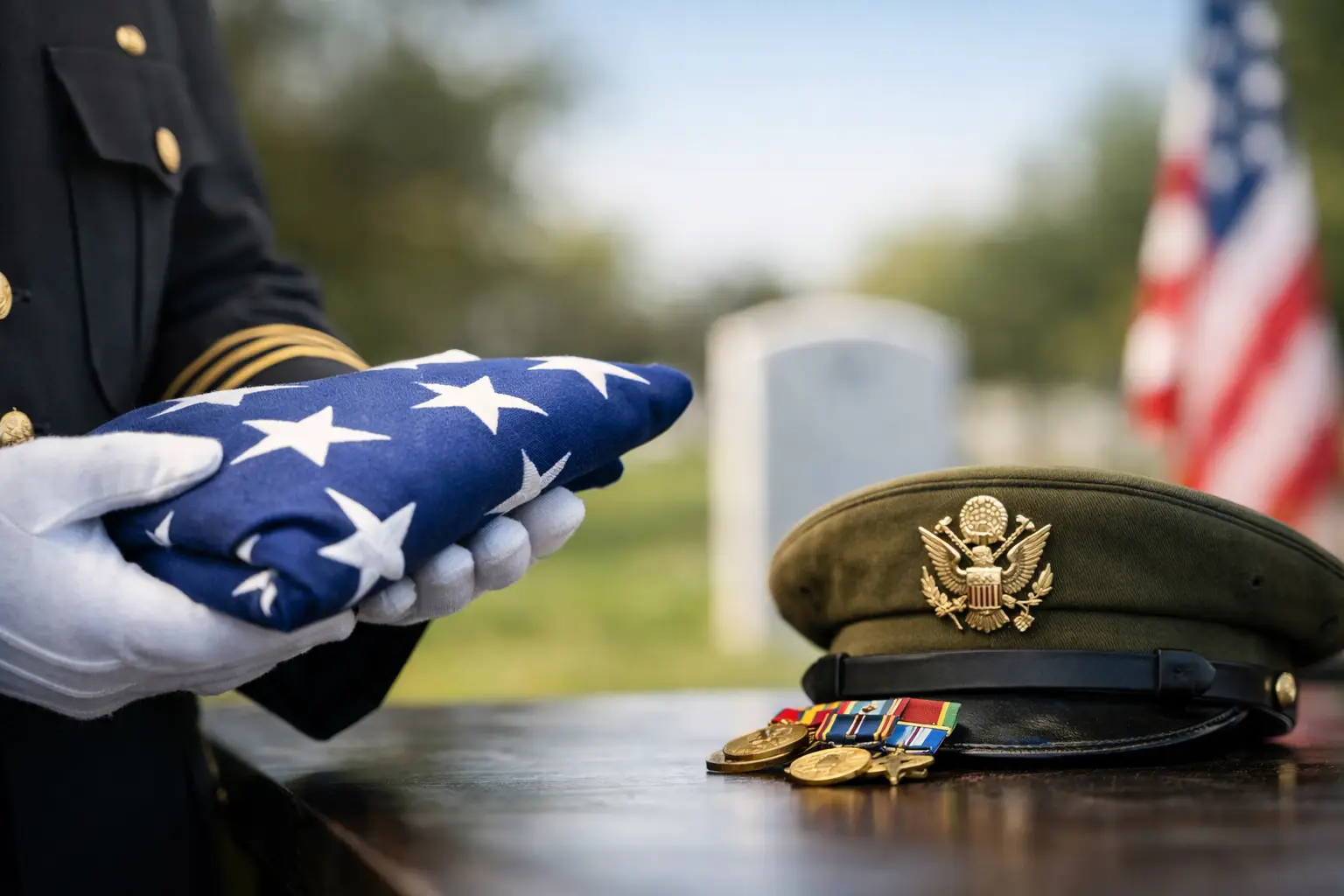
At a minimum, federal law provides for a two-person uniformed detail for an eligible veteran. The detail will fold and present the American flag to the next of kin or another person the family designates. The ceremony also includes the playing of Taps, either by a bugler or an approved ceremonial recording.
Additional honors may be available depending on the veteran's service history and the resources available in the area. These can include a rifle volley, a color guard, pallbearers, or participation by a local veterans organization. These meaningful additions are not guaranteed in every case, so it helps to discuss your wishes early in the arrangement process.
The ceremony does not have to be large to be meaningful. For some families, the flag presentation and Taps are the most personal part of the day. Others may prefer a fuller graveside tribute. There is room to honor both military service and the faith, culture, and family traditions that shaped the person you love.
Who is eligible for military honors?
Most veterans who served on active duty and were discharged under conditions other than dishonorable are eligible for military funeral honors. Certain members of the Selected Reserve and former service members who completed their required service may also qualify. Eligibility can also extend to some commissioned officers of the Public Health Service and the National Oceanic and Atmospheric Administration.
The discharge characterization matters. An honorable discharge is generally eligible, but other-than-dishonorable discharges may also qualify. A dishonorable discharge generally does not qualify. Because individual records and circumstances vary, it is best not to assume that a missing document or an unfamiliar discharge term means honors are unavailable.
A funeral home can review the available information with you and help determine what should be submitted. If your loved one served many years ago, records may take time to locate. Beginning the request as soon as possible gives the military branch and any participating veterans organizations more time to respond.
How to request military honors step by step
The simplest path is to tell your funeral director that your loved one was a veteran and that the family would like military honors. The funeral home can usually make the request with the appropriate military honors coordinator on your behalf. This is often easier than asking a grieving family member to contact multiple offices while also arranging the service.
First, share whatever service information you have. A DD Form 214, commonly called a DD-214, is the most helpful document because it shows dates of service, branch, and discharge status. A discharge certificate, military identification, service record, or VA paperwork can also be useful. Do not delay the conversation because you cannot find everything immediately. There may be other ways to verify service.
Next, decide where and when the honors should take place. The team will need the service date, time, location, veteran's full legal name, branch of service, and the name of the person who will receive the flag. If there will be a burial in a national, state, or private cemetery, the cemetery's schedule must be considered as well.
Then, allow the funeral director or family representative to submit the request to the appropriate branch. Each branch has its own process and availability. In some areas, an active-duty or reserve unit provides the detail; in others, trained veterans organizations assist with elements of the ceremony. The official honors request should be confirmed before the service details are printed or announced as final.
Finally, ask what the family should expect. Knowing where to stand, who will receive the flag, and how long the honors will take can ease anxiety on a difficult day. The funeral director can speak with the honors team about arrival time, parking, weather plans, cemetery rules, and any religious or cultural considerations.
Documents to gather for a military honors request
If possible, keep the veteran's service documents together as arrangements begin. The most useful materials are the DD-214 or other discharge papers, the veteran's full name and Social Security number, branch and dates of service, and contact details for the next of kin.
You may also want to locate a copy of the death certificate when it becomes available, although it may not be required to begin the honors request. If the family wants a burial flag, any military awards displayed, or a specific rank included in the program or obituary, tell the funeral director early so those details can be handled accurately.
Many families do not have a DD-214 readily available. A spouse may not know where it was stored, or an adult child may be handling arrangements from another state. That is common. Let the care team know what you have, even if it is only a photograph, an old military ID card, or the name of a unit. Small details can help guide the next step.
Burial flags and military honors are separate arrangements
The American flag presented during honors is typically a burial flag provided for an eligible veteran. Although the flag and the honors ceremony often happen together, they are separate parts of the process. A family can request a burial flag even if military honors cannot be scheduled, and military honors may still be possible even when the paperwork for the flag is being handled separately.
Only one burial flag is issued for each eligible veteran. After the ceremony, it is presented to the next of kin. Families may choose to display it in a flag case, keep it safely folded, or pass it to the person the veteran would have wanted to receive it. There is no required choice. The right decision is the one that feels respectful to your family.
Timing, availability, and special circumstances
Military honors should be requested as early as possible, particularly when services are planned on short notice, during holidays, or in areas where honors teams have limited availability. A request made several days ahead is preferable when circumstances allow, but an immediate need should never stop you from asking. Funeral directors regularly work within short timelines and can explain what is realistic.
The type of disposition can also affect planning. Honors can be arranged for burial, cremation, a memorial service held before or after cremation, or an interment that takes place later. A family may hold a private funeral now and schedule an honors ceremony at the cemetery at a later date. This can be a thoughtful option when relatives are traveling, records are delayed, or the family needs more time.
If your loved one is being transported from New York to another state or country, coordination may require additional planning. Honors are generally arranged at the location where the ceremony will occur. For families managing transportation, Horizon Funeral Home can help keep the funeral, transfer, and honors arrangements organized so that no detail is overlooked.
Questions families often ask
Is there a cost for military funeral honors?
The basic military honors detail is provided at no cost to an eligible veteran's family. There may be costs associated with other funeral services, cemetery arrangements, flowers, transportation, or optional ceremonial additions. Your funeral director should explain these items clearly and separately.
Can the family choose who receives the flag?
Yes. The flag is customarily presented to the next of kin, but the family can designate another person when appropriate. It can be helpful to decide this before the service, especially in large or blended families, so the moment remains focused on remembrance rather than uncertainty.
What if the veteran's records cannot be found?
Tell the funeral director what you know and begin the request anyway. Service verification may take additional time, and the available options will depend on the circumstances. It is better to ask for help than to assume the opportunity has passed.
A military honors ceremony is not only a formal tradition. It is a public expression of gratitude, offered at a private moment of loss. Give yourself permission to ask questions, take the time you need for decisions, and let experienced professionals carry the coordination that does not need to rest on your shoulders.