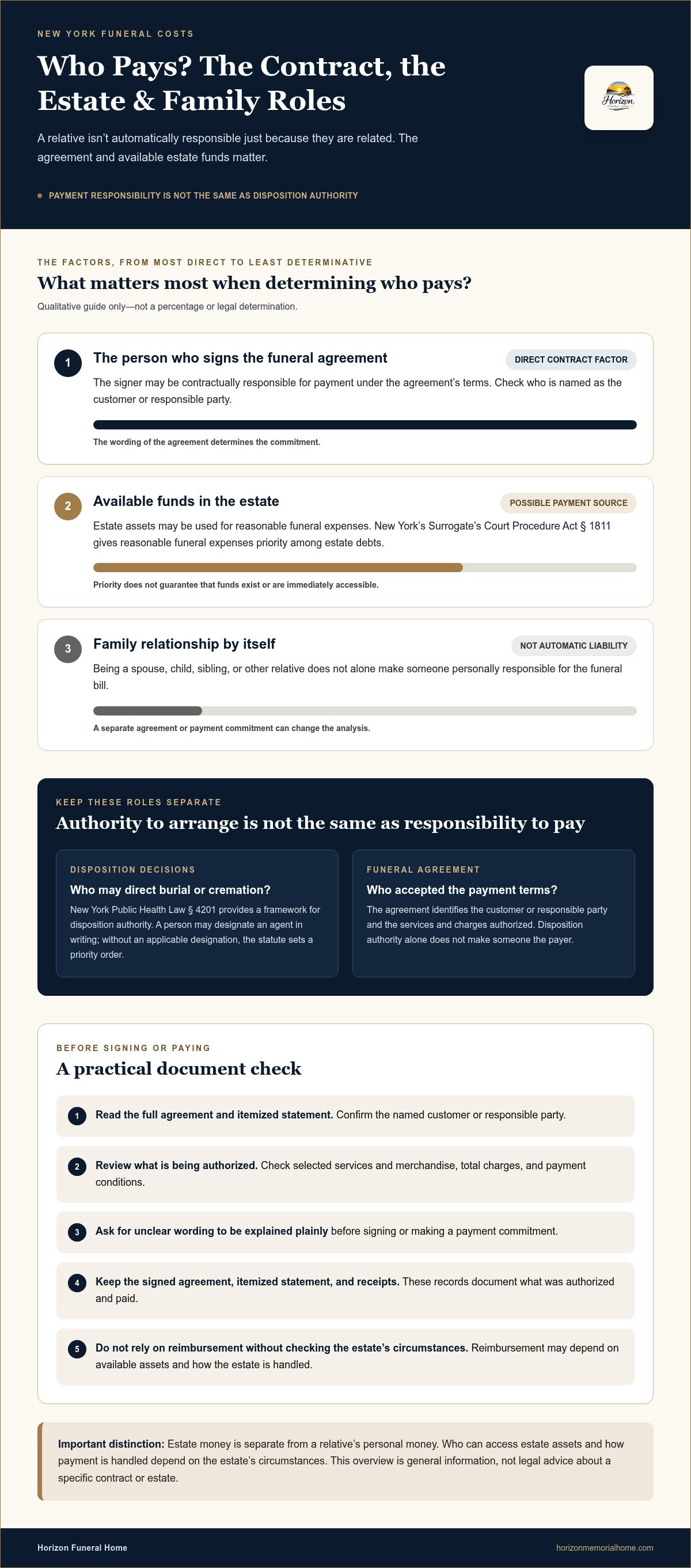

If you're asking who is legally responsible for funeral costs in NY, the answer may depend less on family relationship than on who agrees to pay. A loved one’s child, spouse, or other relative isn’t automatically personally liable just because of their connection to the person who died. This distinction can bring some relief when arrangements must be made before estate funds or insurance proceeds are available.
It’s easy to assume that the person authorized to arrange a funeral must also be responsible for the bill. In New York, those roles are separate. Someone who signs the funeral agreement may be personally responsible for payment under its terms, while reasonable funeral expenses may be paid from the estate if funds are available. Whether the estate can reimburse the signer depends on its assets and circumstances.
This guide explains how authority to make disposition decisions differs from responsibility for a funeral agreement, what signing can mean, and how the estate may fit into the picture. It also offers practical steps for reviewing documents and discussing payment before arrangements are finalized. Taking time to clarify these points can help you make decisions with greater confidence during a difficult moment.
Key Takeaways
- Learn who is legally responsible for funeral costs in NY, and why being related to the person who died doesn’t alone establish personal liability.
- Understand how New York’s rules for disposition decisions differ from responsibility for a funeral agreement.
- Compare how an agreement, estate assets, insurance proceeds, and prepaid arrangements may affect payment, and what steps may be needed to access those funds.
- Use a practical checklist to review service choices, payment expectations, and contract responsibilities before authorizing arrangements.
- See how funeral direction, cremation, direct burial, and memorial coordination can help families understand arrangements and related documents.
Table of Contents
- Who may have to pay funeral costs in New York?
- Must next of kin pay or just arrange the funeral?
- Compare funeral payment sources: contract, estate, insurance, or prepayment
- Before paying funeral expenses in New York
- How Horizon Funeral Home can help families understand arrangements
Who may have to pay funeral costs in New York?
In New York, responsibility for funeral costs depends on what someone agrees to pay, whether the deceased person’s estate has available funds, and the circumstances of the arrangement. Being a spouse, child, sibling, or other relative doesn’t by itself make someone personally responsible for the bill. If you’re asking who is legally responsible for funeral costs in NY, separate a person’s contractual commitment from money that may belong to the estate.
These potential payment sources aren’t interchangeable. A relative may sign an agreement and take on obligations under its terms, while the estate’s assets are separate property that may be used to pay reasonable funeral expenses. For broader background on how funeral customs and legal considerations can vary, see this overview of funeral customs and legal aspects. It isn’t a guide to New York law, so focus on the agreement and the estate’s circumstances.
When can signing funeral arrangements create a payment obligation?
The person who signs a funeral agreement may become contractually responsible for payment under its terms. Before signing, read the full agreement and itemized statement. Check the named customer or responsible party, the services and merchandise selected, the total charges, and any payment conditions. Don’t assume the person making decisions or attending the meeting is automatically the person who must pay.
Documents can differ, so the exact wording matters. If a clause is unclear, pause and ask for an explanation in plain language before signing. Keep a copy of the signed agreement and itemized statement. These records show what was authorized and who accepted the contractual responsibility.
Can a deceased person’s estate contribute to funeral expenses?
Possibly. Estate assets may be used for reasonable funeral expenses, but what is available and how it can be accessed depend on the estate. New York’s Surrogate’s Court Procedure Act § 1811 gives reasonable funeral expenses priority among estate debts. That priority doesn’t mean funds are immediately accessible or that an estate has enough assets to cover every expense.
Estate money also isn’t the same as a relative’s personal money. If you pay from your own funds, whether the estate can reimburse you may depend on its assets, your payment records, and how the estate is handled. Keep receipts and the signed agreement. Get advice specific to the estate before relying on reimbursement or using estate funds. Questions about which assets are available, who can access them, and how payment is prioritized may require guidance from a qualified legal professional.
This section offers general information, not legal advice about a particular estate or contract. If a document or payment decision is unclear, consider getting advice based on the specific circumstances before making a commitment.
Must next of kin pay or just arrange the funeral?
Being authorized to make decisions about a person’s disposition and being responsible for a funeral bill are separate matters. New York Public Health Law § 4201 addresses who may control disposition decisions, including burial or cremation. That authority does not, by itself, make someone the payer. Financial responsibility is a separate question, determined by what someone agrees to in the funeral arrangement documents.
This distinction can help families discuss arrangements without assuming that the person with authority must also take on the expense. For example, an appointed agent may direct disposition arrangements while another person signs the agreement. The agreement’s terms and any separate payment commitment matter when determining financial responsibility.
Who may control disposition decisions under New York law?
Section 4201 provides a framework for identifying who can make disposition decisions. A person may designate an agent in writing for this purpose. If there is no applicable designation, the statute establishes a priority order for others to make those decisions. The order can depend on the circumstances, so this overview isn’t a substitute for reviewing the current statute or getting legal advice about a specific dispute.
The authority is about directing disposition, not an automatic promise to pay for the services selected. If you’re acting as an agent, read any designation carefully and keep the disposition decision separate from any agreement that names a customer or responsible party.
Does being a spouse, child, or other relative automatically make someone liable?
No. Family status alone shouldn’t be treated as automatic personal liability for funeral expenses. A relative may have authority to make disposition decisions under the statutory framework, but that role doesn’t alone establish an obligation to pay. Signing a funeral agreement or making a separate commitment to cover expenses can change the analysis, depending on the wording and circumstances.
If relatives disagree about who may direct disposition, or if a contract’s payment terms are unclear, advice from a lawyer familiar with the specific facts can help. Funeral professionals can explain service selections and documents, but they aren’t a substitute for legal advice.
The comparison below separates the roles at a glance. Use it as a starting point, not as a determination of anyone’s rights or obligations.
| Role | What it may authorize | Does that alone create payment liability? |
|---|---|---|
| Appointed agent or person with statutory priority | Disposition decisions under Public Health Law § 4201 | No, not solely because of that authority |
| Funeral agreement signer | Services and arrangements described in the agreement | Potentially, according to the agreement’s terms |
| Relative who does not sign or separately commit | Family involvement or support, depending on the circumstances | Kinship alone doesn’t establish personal liability |
Clear conversations about decision-making and payment can ease some of the strain of arranging a farewell. Horizon Funeral Home’s funeral arrangement support helps families understand service choices and the documents involved. For legal questions about authority or liability, speak with a qualified attorney.
Compare funeral payment sources: contract, estate, insurance, or prepayment
Families may have more than one possible source of funds, but each follows its own documents and process. The funeral agreement identifies the services selected and may name the person responsible under its terms. Estate assets, insurance proceeds, and prepaid arrangements are separate sources. Knowing who controls each one can help you avoid assuming that funds are ready or available before making a payment decision.
If you’re asking who is legally responsible for funeral costs in NY, separate two questions: who has agreed to pay under a contract, and what other funds may be used toward the expense. A possible funding source doesn’t automatically change the obligations in a signed agreement.
| Payment source | Who controls it | What may be needed |
|---|---|---|
| Funeral arrangement agreement | The person or people named in the agreement have contractual responsibilities under its terms. | Review the signed agreement and itemized statement to understand charges and payment conditions. |
| Estate assets | Access is handled through the estate’s administration. | The estate’s available assets and applicable legal requirements may affect access and payment. |
| Life insurance | The policy’s beneficiary generally handles the claim and receives proceeds if payable under the policy. | Locate the policy and beneficiary information, then follow the insurer’s claim process. |
| Prepaid arrangement | The plan documents and arrangements govern how funds are applied. | Find the prepaid contract and related records to understand what was funded and how it can be used. |
How do prepaid arrangements and life insurance differ?
A prepaid arrangement is tied to documents describing funeral arrangements and how funds are designated for them. Life insurance is governed by a policy, and proceeds are handled through a claim by the beneficiary. These are different payment routes. Before relying on either, locate the plan or policy, confirm the named parties and terms, and understand the steps required to access or apply the funds.
New York requires prepaid funeral funds to be held in an interest-bearing, government-backed trust account, with principal and interest remaining the consumer’s property. The plan’s specific terms still matter. Likewise, being named as an insurance beneficiary doesn’t automatically mean you’re obligated to spend those proceeds on funeral expenses. Consider the beneficiary’s rights and any separate agreement independently.
What should families know about estate funds and reimbursement?
Estate funds may contribute to funeral expenses, but a relative shouldn’t count on immediate access or automatic reimbursement after paying personally. The estate’s administration, available assets, and legal requirements can affect what can be paid and when. Keep receipts and copies of relevant documents. Ask an estate attorney or other qualified legal adviser about reimbursement, access, and payment priority in your circumstances.
Before treating any source as settled, compare the agreement with the estate, policy, or prepaid-plan records. This review can clarify which funds might apply and who has authority to use them, without assuming a benefit or reimbursement is guaranteed.
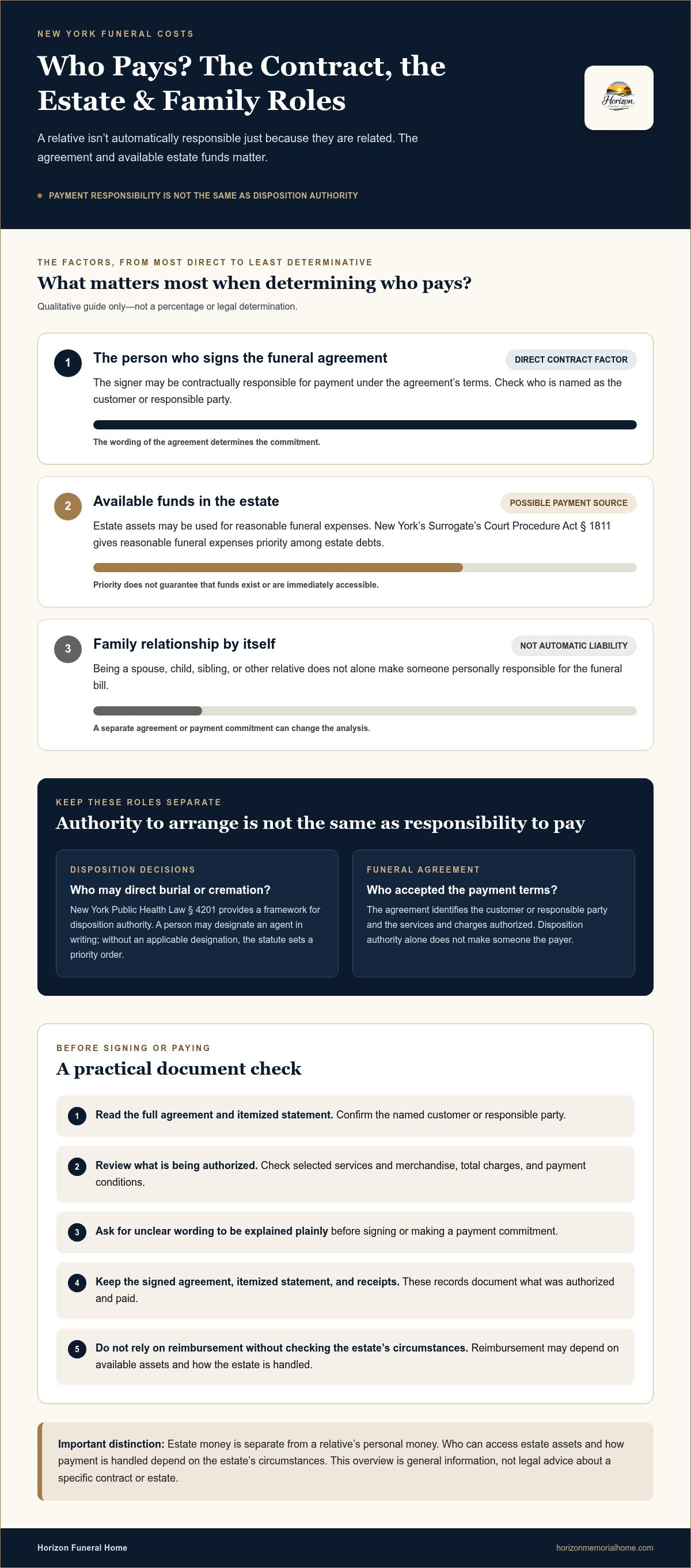
Before paying funeral expenses in New York
A short pause to review the paperwork can make a difficult set of decisions feel more manageable. The question of who is legally responsible for funeral costs in NY is easier to assess when you keep two choices separate: what kind of farewell the family wants, and who will sign an agreement that may create payment responsibilities.
Use this checklist before authorizing services or signing:
- Confirm who can direct disposition. Locate any written appointment of an agent or final instructions, and identify who is authorized to make disposition decisions.
- Discuss service preferences separately. Talk about burial or cremation, the kind of gathering the family wants, and any cultural or personal wishes. These choices don’t determine by themselves who signs the agreement.
- Gather relevant funding records. Look for prepaid-plan paperwork and insurance documents. Treat possible proceeds as unconfirmed until you understand the documents and steps for accessing them.
- Review the itemized statement. Compare the listed selections and charges with what the family intends to arrange. Ask the funeral director to explain anything unclear, including who is named as the customer or responsible party.
- Clarify before signing. Make sure the person signing understands the agreement’s terms and payment conditions. Keep copies of the signed documents and receipts.
Which documents and details should you gather?
Keep the relevant paperwork together: an agent appointment, written final wishes, prepaid-plan records, and insurance policy or beneficiary documents. Make a simple note of who may direct disposition decisions and who is considering signing the service agreement. That distinction can prevent assumptions during a family discussion. Protect sensitive account and policy details. Don’t share them in public or unsecured settings.
How can families discuss payment without adding pressure?
Start with service preferences, then talk about payment as a separate practical question. Relatives may choose to contribute, but family custom isn’t the same as a legal duty. A calm conversation can clarify whether anyone is voluntarily offering help and whether that contribution has limits, without placing an expectation on every family member.
Ask the funeral director to explain the itemized charges and agreement language in plain terms before anyone signs. If relatives dispute responsibility, estate access is uncertain, or contract obligations remain unclear, seek advice from a qualified legal adviser familiar with the circumstances. Funeral professionals can help families understand arrangement choices and related documents, but they don’t determine legal rights.
Families considering a traditional service can explore these traditional funeral arrangements in Brooklyn as they discuss the kind of farewell that feels right. For help understanding service choices and arrangement documents, speak with Horizon Funeral Home.
How Horizon Funeral Home can help families understand arrangements
Questions about who is legally responsible for funeral costs in NY can feel especially difficult while a family is grieving. Funeral direction can make the arrangement process easier to understand by laying out service choices and explaining the documents involved. A funeral professional can discuss what a service includes and help families keep arrangement decisions distinct from questions about who signs an agreement.
Horizon Funeral Home coordinates traditional funeral services, direct burial, cremation, and personalized memorials and celebrations. Families can talk through the kind of farewell that reflects their loved one’s wishes, traditions, and personal story, then review the arrangements and related paperwork at a steady pace. Clear information helps families make decisions without feeling pressured to proceed before they understand the details.
What support can a funeral director provide?
A funeral director can guide families through service planning, explain available choices, and review arrangement documents and itemized charges in plain language. This practical support can help you understand what you’re authorizing and identify questions that still need answers. Funeral direction isn’t legal probate advice, however, and it can’t replace guidance from a qualified lawyer about estate access, disputed liability, or contract obligations.
Horizon Funeral Home serves families in Brooklyn, Queens, Staten Island, Manhattan, the Bronx, and Nassau County. Whether you’re considering a traditional service, cremation, direct burial, or a memorial gathering, discussing wishes and practical details together can help keep legal and payment questions clear and separate.
Where can families learn about related planning options?
If your family is reviewing documented wishes or considering arrangements ahead of time, the guide to funeral preplanning services in NYC offers a place to explore that conversation. Written preferences can help loved ones understand what matters to the person, though they don’t replace reviewing applicable contracts or legal documents.
For families honoring a veteran, veteran funeral honors in New York may be part of the farewell they wish to arrange. The right choices are personal, and families can take time to talk through what feels meaningful.
For help understanding service options and arrangement documents, speak with Horizon Funeral Home about arrangements. A conversation can help you identify the decisions ahead without requiring you to resolve every legal or financial question at once.
Take the next step with clarity and care
Before moving forward, write down the questions that still feel unresolved. Note which wishes should guide the service, what documents your family has located, and which payment or contract details need a clear explanation. This can help keep the next conversation focused, even when emotions make it difficult to sort through everything at once.
If you’re still wondering who is legally responsible for funeral costs in NY, remember that a conversation about service arrangements can clarify practical details, while questions about legal rights or estate obligations may call for advice from a qualified legal professional. You don’t have to settle every issue in a single moment.
Horizon Funeral Home supports families across New York City and Nassau County as they consider traditional services, direct burial, cremation, or a personalized memorial. When you feel ready, speak with Horizon Funeral Home about arranging a dignified service. One thoughtful step at a time is enough.
Frequently Asked Questions
Can a funeral home require payment before the service?
Whether payment is due before a service depends on the agreement’s terms. Before signing, ask what charges are due and when, and make sure any payment arrangement is in writing. If one relative is coordinating from Brooklyn or Queens while another expects to pay, clarify who the agreement names as the customer. Don’t rely on informal family assumptions to determine contractual payment responsibility.
Can an executor use estate funds for funeral expenses before distributing an inheritance?
An executor may generally pay reasonable funeral expenses from available estate assets before distributing inheritances, subject to the estate’s circumstances and applicable requirements. New York law gives reasonable funeral expenses priority among estate debts, but that doesn’t mean funds are immediately accessible or that every estate can cover them. The executor should keep invoices and payment records, and seek estate-specific legal advice if asset access or payment priority is uncertain.
What happens if family members disagree about who should sign the funeral agreement?
Pause before anyone signs, especially if relatives disagree about disposition authority or who will accept payment responsibility. Review any written agent designation or final instructions, and keep the proposed agreement separate from the family’s discussion about who may direct arrangements. A funeral director can explain the document’s wording, but a lawyer can advise on disputed legal rights or obligations. Clear answers now may help prevent a disagreement from becoming a contract dispute later.
How much do funeral expenses cost in New York?
There isn’t one amount that applies to every New York funeral. The total depends on the services and merchandise selected, so request an itemized statement and review each charge before authorizing arrangements. You can also use the funeral home’s General Price List to understand available prices and compare selections. Ask for an explanation of any line item you don’t recognize, and make sure the written estimate reflects the choices your family wants.
Is the person named in a will automatically responsible for funeral costs?
No. Being named as executor in a will doesn’t, by itself, make someone personally responsible for funeral expenses. The role generally concerns handling the estate, while personal responsibility may arise if that person separately signs an agreement or commits to pay. Who is legally responsible for funeral costs in NY depends on the documents and circumstances, so an executor should get legal advice before using estate assets or accepting personal responsibility.
Can life insurance pay funeral expenses if the beneficiary has not received the proceeds yet?
Insurance proceeds may ultimately help cover expenses, but a pending claim isn’t the same as funds already available for payment. The named beneficiary generally needs to submit a claim under the policy’s process, and the policy terms determine whether proceeds are payable. A beneficiary isn’t automatically required to use the money for funeral costs. Before relying on insurance, review the policy and discuss how any current payment obligations will be handled.