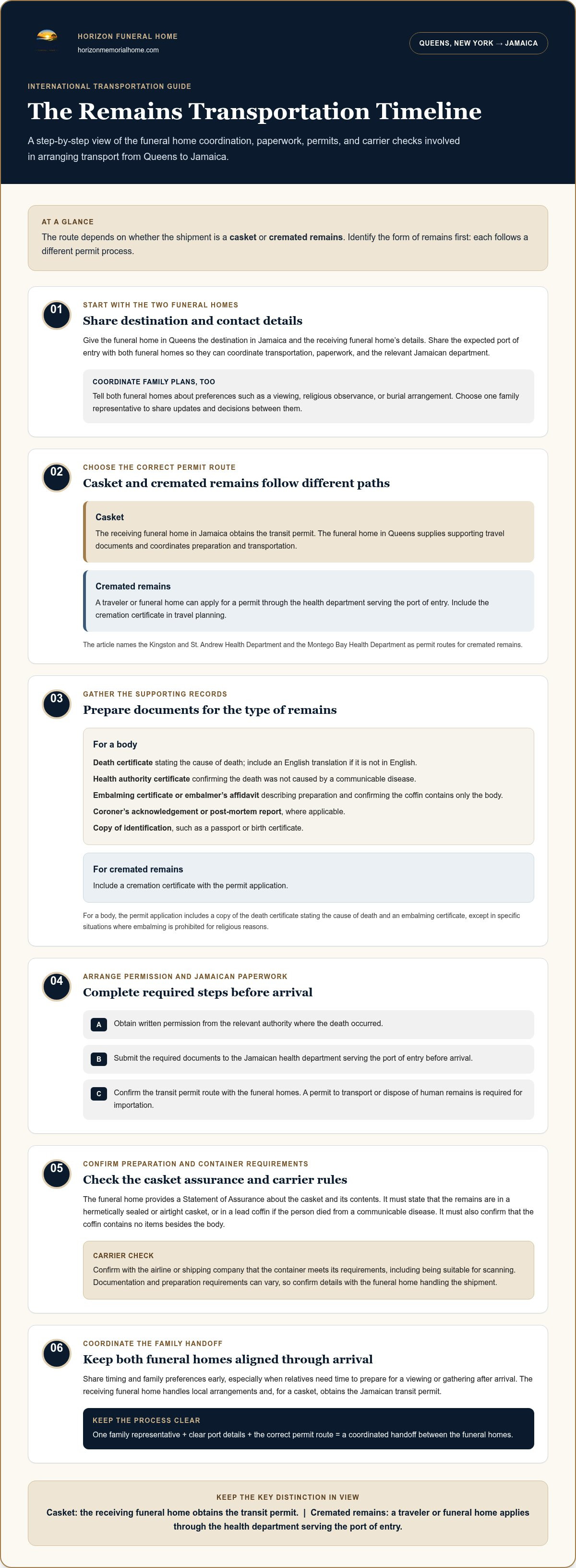
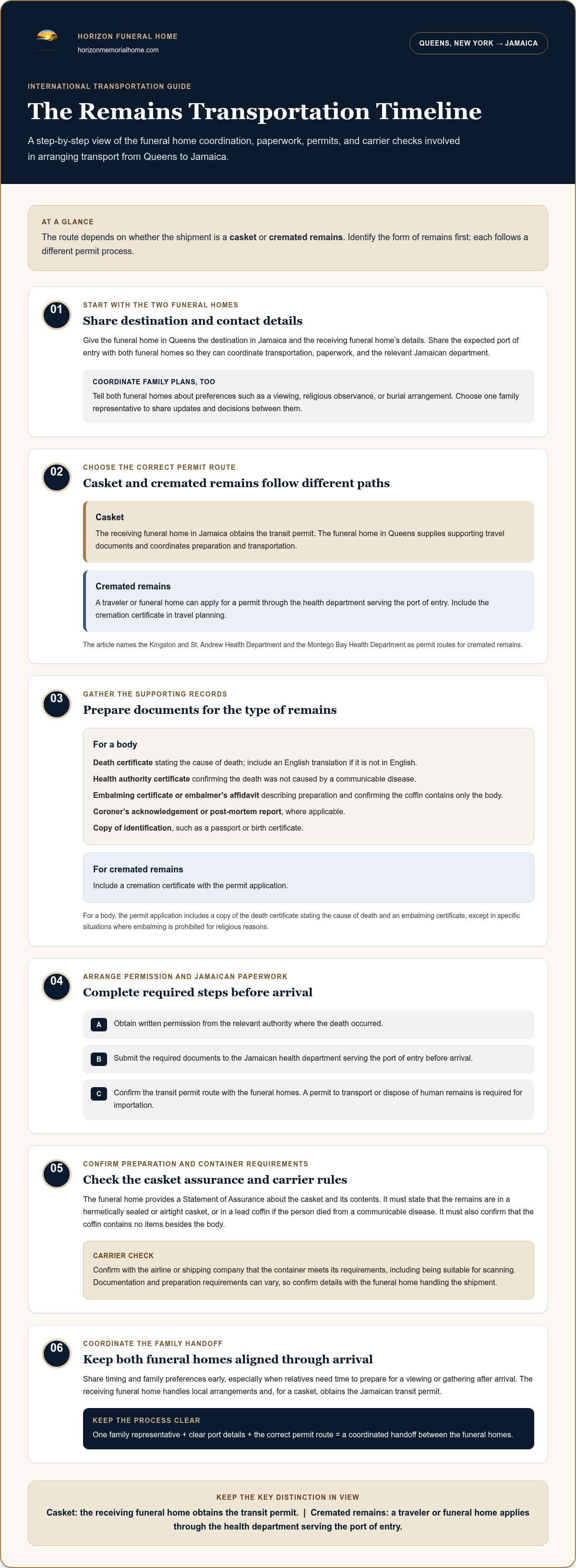
Transporting human remains to Jamaica from Queens is generally coordinated through a funeral home, which prepares the remains and arranges the required travel documents. For a casket, the receiving funeral home in Jamaica obtains the transit permit. Cremated remains follow a separate permit process. Documents for a body include a death certificate stating the cause of death, a health authority certificate confirming the death was not caused by a communicable disease, and an embalming certificate or embalmer’s affidavit.
It is understandable to want a clear plan for these arrangements while making space for your family’s needs. Before travel, obtain written permission from the relevant authority where the death occurred and submit the required documents to the Jamaican health department serving the port of entry. The container must also meet carrier requirements, including being suitable for scanning. This guide explains the process from Queens, the documents and permissions involved, and what to clarify about the container before arranging transportation.
Key Takeaways
- Use a funeral home to coordinate preparation, travel documents, and transportation; casket shipments and cremated remains follow different permit routes.
- Gather the death certificate with cause of death and the required health and preparation documents. Cremated remains need their own supporting certificate.
- Arrange written permission from the relevant authority where the death occurred, and submit Jamaica’s required paperwork before arrival.
- Confirm with the airline or shipping company that the container meets its requirements and can be scanned.
- Learn how Horizon Funeral Home’s Worldwide Transportation can help coordinate arrangements when your family needs support moving a loved one across borders.
Table of Contents
- Arranging transportation through a funeral home
- Documents required to import human remains to Jamaica
- Written permission from the authority where the death occurred
- Checking container requirements with the carrier
- Transportation of human remains from the United States to Jamaica
- Horizon Funeral Home: Traditional Funeral Services
Arranging transportation through a funeral home
A funeral home in Queens can coordinate preparation and travel documents for a loved one’s journey to Jamaica. The process also involves a receiving funeral home, which handles local arrangements and, for a casket, the Jamaican transit permit.
Funeral Home Coordination
Funeral home coordination brings together preparation, documents, and transportation between the funeral homes involved. Start by sharing the destination in Jamaica and the receiving funeral home’s details with the funeral home in Queens. The funeral home can coordinate transportation and provide travel documentation. Sharing this information early gives both funeral homes clear points of contact for planning the journey.
For a casket, the receiving funeral home in Jamaica obtains the transit permit through the funeral-home process. For ashes in an urn, a traveler or funeral home can arrange transportation and apply for a permit through the Kingston and St. Andrew or Montego Bay Health Department, depending on the port of entry. These are separate routes, so identify the form of remains at the outset.
Preparation of Remains
Preparing remains means making the body and its documentation ready for international transportation. Documentation for preparing a body for international transport can vary, so confirm the requirements with the funeral home handling the shipment. The funeral home also provides a Statement of Assurance about the casket and its contents.
The assurance must state that the remains are in a hermetically sealed or airtight casket, or in a lead coffin if the person died from a communicable disease. It must also confirm that the coffin contains no items besides the body. Give the funeral home accurate information about the cause of death, since it affects the required assurance. Have the receiving funeral home coordinate preparation questions directly with the funeral home in Queens.
Jamaica Transit Permit
A transit permit is the authorization required to transport or dispose of human remains in Jamaica. For a casket, the funeral home in Jamaica obtains the permit, while the overseas funeral home supplies the supporting travel documents. For cremated remains, a traveler or funeral home can apply through the health department serving the port of entry.
Share the expected arrival port with both funeral homes so they can coordinate with the relevant department. The stated permit routes are the Kingston and St. Andrew Health Department and the Montego Bay Health Department. For cremated remains, include the cremation certificate in travel planning. A casket shipment follows the receiving funeral home’s permit process.
Family Customs and Funeral Plans
Funeral customs reflect a family’s religious, cultural, and personal choices for honoring the deceased. Tell both funeral homes what matters to your family, such as a viewing, a religious observance, or a preferred burial arrangement. This helps them coordinate transportation with the funeral you have in mind, without assuming that every Jamaican family follows the same customs.
Share preferences early, especially if they affect when the receiving funeral home should expect the remains or when relatives plan to gather. For example, relatives in Jamaica may need time to prepare for a viewing after arrival. The funeral homes can use this information to coordinate arrangements and travel documents. Choose one family representative to pass updates and decisions between both funeral homes.
Documents required to import human remains to Jamaica
For transportation from Queens to Jamaica, prepare the death and health records, preparation certificate, and Jamaican transit permit. The exact documents depend on whether the shipment contains a body or cremated remains.
Export and International Transportation Documents
Export and international transportation documents are official records that identify the deceased and describe how the remains were prepared. Begin with a death certificate stating the cause of death, issued by the appropriate authority. If the certificate is not in English, include an English translation for importation into Jamaica.
For a body, include an embalming certificate or embalmer’s affidavit describing the preparation and confirming that the coffin contains only the body. Add a health authority certificate confirming the death was not caused by a communicable disease. Include a coroner’s acknowledgement or post-mortem report where applicable, as well as a copy of identification, such as a passport or birth certificate.
Import Documentation and Permits
Import documentation is the paperwork Jamaica requires before human remains enter the country. A permit application for a body must include a copy of the death certificate stating the cause of death and an embalming certificate, except in specific situations where embalming is prohibited for religious reasons.
For cremated remains, include a cremation certificate with the permit application. Before arrival, submit the required documents to the Kingston and St. Andrew Health Department or the St. James Health Department to facilitate a transit permit. A permit to transport or dispose of human remains is required for importation. For a casket, the Jamaican receiving funeral home obtains the permit through its funeral-home process.
Documents Required on Arrival
Arrival documents are the records that travel with the remains and support their release in Jamaica. Whether the remains travel accompanied or unaccompanied, include the relevant documents. For a body, these include an official death certificate or post-mortem report, preparation and health certificates, and the transit permit.
Cremated remains must travel with an official death certificate or post-mortem report stating the deceased’s name, age, and cause of death. Include the funeral home’s cremation certificate; if it’s unavailable, the method of disposition is usually recorded on the death certificate. The airline or importer must notify Jamaica’s Medical Officer (Health) or Chief Public Health Inspector and the Quarantine Officer at least 24 hours before arrival. Cremated remains are excepted from that notice requirement but must have the relevant documents.
A document checklist can help keep the records together: match each certificate to the deceased’s identity, separate body and cremation paperwork, and keep the permit with the travel documents. For help coordinating international arrangements, Worldwide Transportation support can be a practical next step.
Written permission from the authority where the death occurred
Written permission is authorization from the relevant authority in the area where the death occurred, allowing the remains to be transported. For a death in Queens, arrange this authorization before transportation to Jamaica and keep it with the travel documents.
A transit permit is official permission for human remains to enter or leave a country. Jamaica’s import process and the authority where the death occurred have separate roles, so establish which permission each office issues. The death certificate helps confirm the deceased’s identity and cause of death. Keep names and details consistent across all documents for the journey.
Permission for Release and Transport
Permission for release and transport is the written authorization required from the authority in the place where the person died. Ask the funeral home coordinating the arrangements to include this step in the document plan. The relevant authority depends on where the death occurred, not where relatives live or where the funeral will be held.
For a death in Queens, the paperwork should identify the deceased and the destination in Jamaica. Keep the written permission with the death certificate and other travel records. If the death occurred elsewhere, the relevant authority is in that area. This distinction matters because international transportation requirements can depend on where the death occurred, where the remains transit, and their destination.
Transit Permits for Cremated Remains
A transit permit for cremated remains authorizes ashes to travel to Jamaica in an urn or another suitable container. A traveler or funeral home can arrange transportation and apply through the Kingston and St. Andrew or Montego Bay Health Department, depending on the port of entry.
Obtain the permit before the cremated remains arrive in Jamaica. Include the cremation certificate with the application and travel records. The permit fee for human remains imported into Jamaica by individuals is JA$ 3,000.00. The applicable route depends on the port of entry, so include that destination when arranging the application.
Transit Permits for Caskets
A casket transit permit is the authorization required for a casket shipment entering Jamaica. A funeral home in Jamaica must obtain it, and casket transit permits are only obtained through funeral homes.
The transit permit fee for human remains imported into Jamaica by a funeral home is JA$ 6,000.00. This is a permit fee, not a transportation service price. Give the receiving funeral home the death certificate and supporting documents so it can coordinate the application. Keep a copy of the permit with the documents accompanying the deceased.
Before departure, organize the documents by purpose: written permission from the area where the death occurred, Jamaica’s applicable transit permit, and supporting certificates. For cremated remains, use the health department route connected to the port of entry. For a casket, coordinate the permit with the Jamaican funeral home. This distinction helps families follow the correct authorization process.
Checking container requirements with the carrier
A transport container is the enclosure used to carry a body or cremated remains by air or sea. Before booking, tell the airline or shipping company whether the shipment is a casket or an urn, and confirm that the container can be scanned.
Both carrier requirements and Jamaica’s entry rules matter. Human-remains containers must meet airline and consular requirements, so do not assume one carrier’s rules apply to another. Share the planned route and port of entry with the funeral homes coordinating the journey. This helps them match the container and paperwork to the shipment type and destination.
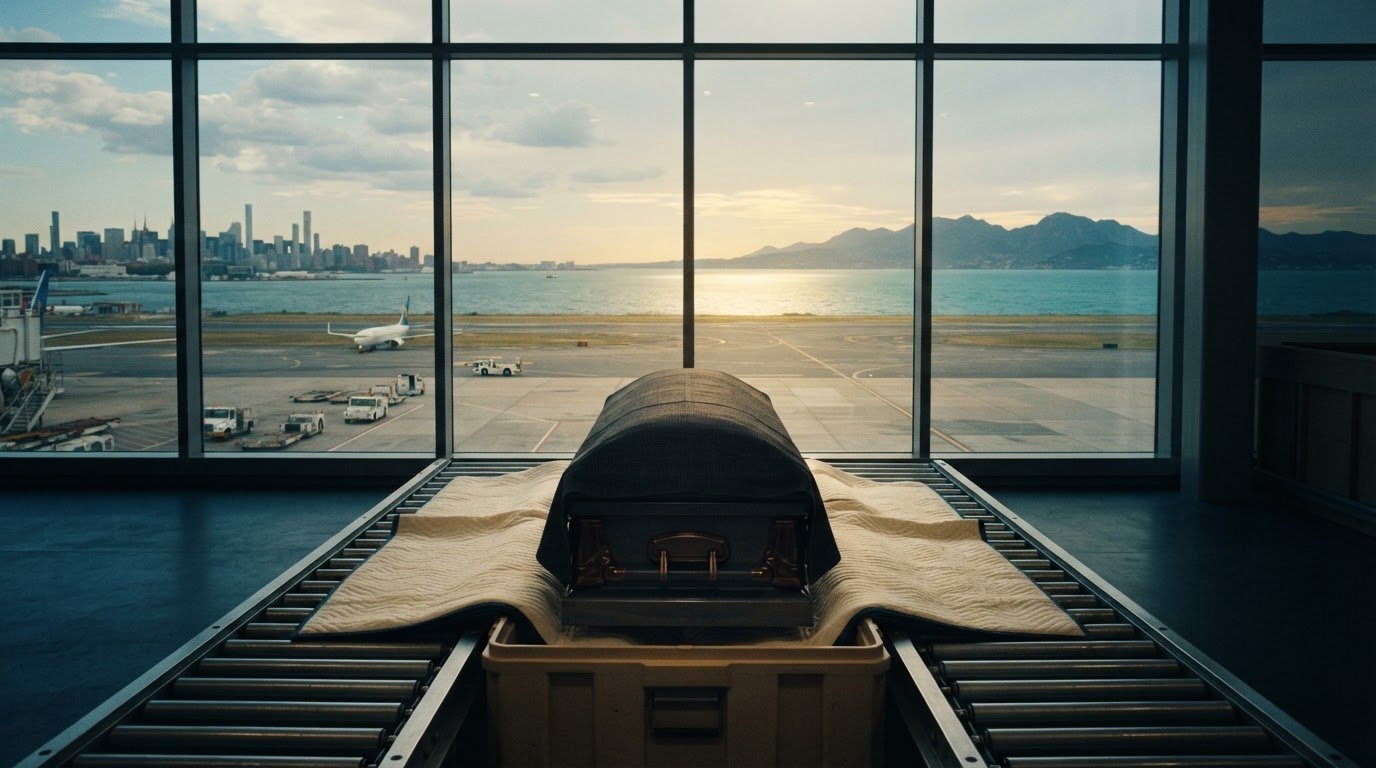
For a casket traveling by air, it should be carried in an airtray or kept separate from regular luggage in the aircraft cargo hold. Jamaica admits properly embalmed remains in a hermetically sealed casket for a quarantinable communicable disease, or in a leak-proof container for other causes of death. These requirements make the cause of death and planned transport relevant when arranging the container.
Cremated remains have different container requirements. Jamaica admits ashes in an urn or another impervious container. Tell the carrier that the shipment contains cremated remains, and confirm that the chosen container can be scanned. Keep the cremation certificate and transit permit with the travel documents, since the container and paperwork serve different purposes.
Use this checklist when speaking with the carrier:
- Identify the contents as a body in a casket or cremated remains in an urn.
- Give the carrier the planned route and Jamaica port of entry.
- Confirm the container can be scanned and meets the carrier’s requirements.
- For air travel with a casket, clarify the airtray or separate cargo-hold arrangement.
- Match the container type to the applicable Jamaican entry requirements.
Check requirements for the exact container being shipped. For example, confirmation for an urn does not establish that a casket meets the airline’s rules. If the itinerary changes, revisit the container arrangements with the carrier handling the revised route. International transportation requirements can vary according to where the death occurred, where the remains transit, and where they are being sent.
Before the shipment leaves Queens, make sure the funeral home and carrier have consistent details about the container, contents, and route. A body requires the applicable casket preparation and assurance documents; cremated remains require their cremation documentation. The carrier’s scanning requirement is a practical checkpoint, while Jamaican entry rules determine which container is acceptable. Keeping these checks separate helps prevent confusion between carrier handling and destination requirements.
Transportation of human remains from the United States to Jamaica
Arrange transportation from Queens through a local funeral home, which coordinates preparation, travel documents, and shipment with a receiving funeral home in Jamaica. International transportation can take as little as 7 to 10 days, depending on documentation requirements and flight availability.
Arranging International Transportation
International transportation is the coordinated movement of a deceased person or cremated remains across national borders. For families transporting human remains to Jamaica from Queens, start by giving the Queens funeral home the destination, the receiving funeral home’s details, and whether the shipment is a casket or urn. The local funeral home can arrange transportation and provide travel documentation.
For a casket, the Jamaican receiving funeral home obtains the transit permit. The overseas funeral home prepares the body and provides the required assurance about the casket and its contents. For ashes, a traveler or funeral home can apply for a transit permit through the Kingston and St. Andrew or Montego Bay Health Department, depending on the port of entry.
Keep both funeral homes aligned on the route, port, and arrival arrangements. Jamaica requires a hermetically sealed casket for remains of someone who died from a quarantinable communicable disease. For other causes of death, remains must be in a leak-proof container. Cremated remains may arrive in an urn or another impervious container.
Transportation Timeline
The transportation timeline is the period from arranging shipment to arrival in Jamaica. International remains transportation from the United States to Jamaica can take as little as 7 to 10 days, depending on documentation requirements and flight availability.
Documents and flight schedules affect timing. A missing document can delay permit processing, while limited flight availability can affect the shipment date. For example, a casket shipment requires coordination with the Jamaican funeral home obtaining its permit. An urn shipment follows a different permit route based on the port of entry.
Use the timeline as a planning guide, not as a fixed date for every family arrangement. First coordinate the documents and permit route, then align the shipment with the carrier’s available flight. The funeral home receiving the remains in Jamaica can use the expected arrival information to plan collection and next steps.
For families transporting human remains to Jamaica from Queens, the funeral director’s declaration must confirm that remains of someone who died from a communicable disease are in a hermetically sealed casket or lead coffin. Jamaica’s Medical Officer (Health) may require measures such as detention, disinfection, disinfestation, or fumigation to help prevent the spread of communicable disease.
To arrange the cross-border details, get help coordinating international transportation.
Horizon Funeral Home: Traditional Funeral Services
Horizon Funeral Home can help families coordinate Traditional Funeral Services and Worldwide Transportation when a loved one needs to travel from Queens to Jamaica. Its Worldwide Transportation service addresses the international logistics involved, while Traditional Funeral Services can support funeral arrangements that honor your family’s wishes.
If cremation is your chosen disposition, Horizon also offers Cremation. Families planning to recognize a loved one’s military service can ask about Veteran Honors. The next step is to share the destination, your preferred arrangements, and whether the remains will travel as a casket or cremated remains. This gives the conversation a clear starting point during a difficult time.
You’re welcome to contact Horizon Funeral Home or visit horizonmemorialhome.com to discuss the arrangements.
Take the Next Step with Care
Planning to transport human remains to Jamaica from Queens involves decisions at a time of grief. You do not have to make every arrangement at once. Start by identifying the support your family needs now, whether that is coordinating the journey, choosing cremation, or planning a traditional funeral service that reflects your loved one’s life.
Horizon Funeral Home provides Worldwide Transportation, Cremation Services, and Traditional Funeral Services. Its team can help you consider how these arrangements fit together, so you can focus on the choices that feel right for your family. Every family’s traditions and wishes are personal, and Horizon serves all faiths and respects every tradition.
When you’re ready to talk through the next step, contact Horizon Funeral Home for assistance. You can move forward one decision at a time, with care for both the practical details and the person you’re honoring.
Frequently Asked Questions
What are Jamaica’s import requirements for human remains, including permits and health certificates?
Jamaica requires a permit and supporting documents for imported human remains. For a body, prepare a death certificate stating the cause of death, a health authority certificate confirming the death was not caused by a communicable disease, and an embalming certificate or embalmer’s affidavit. A post-mortem report is needed where applicable. The required documents must accompany the remains, and the airline or importer must provide the required arrival notice for a body shipment.
Can cremated remains be transported to Jamaica, and what rules apply?
Yes. Cremated remains may travel in an urn or another impervious container with the relevant documents. Include an official death certificate or post-mortem report stating the deceased’s name, age, and cause of death, as well as a cremation certificate. Obtain a transit permit before arrival. Without one, Customs may examine the ashes and detain them at the airport until the permit is obtained.
Which airlines carry human remains from JFK to Jamaica, and what are their requirements?
Which airline can carry remains depends on the itinerary and the carrier’s acceptance rules; there is no universal carrier requirement. Contact the airline handling the shipment to confirm cargo acceptance and container rules, including whether the container can be scanned. For air transport, a casket should travel in an airtray or separately from regular luggage in the aircraft cargo hold. An urn has different container requirements.
What steps are needed to transport remains from Queens to Jamaica, from death certificate to arrival?
Start by having a Queens funeral home coordinate preparation and travel documentation with the receiving funeral home in Jamaica. Assemble the death certificate and supporting health and preparation records, then arrange the applicable Jamaican transit permit. Coordinate the shipment’s container and itinerary with the carrier. For a body, the airline or importer must notify Jamaican health and quarantine officials at least 24 hours before arrival. Keep copies of the documents together for the consignee.
What customs, airline, or funeral-home fees may apply when shipping remains to Jamaica?
Jamaica’s listed transit-permit fees are JA$ 3,000.00 for an individual and JA$ 6,000.00 for a funeral home. A separate import-permit application requirement lists $10,000.00 or the amount prescribed by the Minister of Health. Airline, consular, and receiving-funeral-home charges may also apply. Horizon Funeral Home’s service costs vary with the services, merchandise, transportation, disposition, and outside providers selected; third-party charges are separate.