
Imagine standing in a quiet hospital hallway in Manhattan, the city's relentless hum suddenly feeling worlds away as you face the first few hours of a profound loss. It is a moment where time seems to stop, yet the list of necessary decisions begins to grow. This NYC funeral planning guide is designed to be your steady companion through these initial steps and the weeks that follow. We understand that you're likely feeling overwhelmed by the weight of logistics, from hospital release forms to the delicate balance of honoring a lifetime of traditions. It is a heavy burden to carry, especially when the city feels so large and its procedures so complex.
We're here to help you navigate these challenges with clarity and grace, ensuring every detail reflects the dignity your loved one deserves. You don't have to manage the paperwork or the coordination alone. This manual provides a clear path forward, covering everything from immediate NYC morgue procedures and local legal rights to the intricate details of international repatriation. We will walk through a checklist of actions, explore ways to manage urban funeral costs, and help you create a farewell that truly honors your family's unique story and heritage.
Key Takeaways
- Learn how to identify the necessary first calls based on whether a death occurs at home, in a hospital, or under the care of the NYC Medical Examiner.
- This NYC funeral planning guide explains your legal right to a General Price List, ensuring you understand costs and choices without pressure.
- Discover the differences between traditional burial, cremation, and international repatriation to find the path that best honors your family's traditions.
- Gain a clear understanding of the permits and paperwork required by the DOHMH to move forward with local or global arrangements.
- Explore how preplanning and personalized memorial services can provide both emotional relief and a sense of sanctuary for those you love.
Table of Contents
- Immediate Steps: What to Do When a Death Occurs in NYC
- Understanding NYC Funeral Laws and Consumer Rights
- Choosing the Right Service: Burial, Cremation, or Repatriation
- Navigating NYC Logistics: Permits and Paperwork
- Planning for Peace: Pre-Arrangement and Memorials
Immediate Steps: What to Do When a Death Occurs in NYC
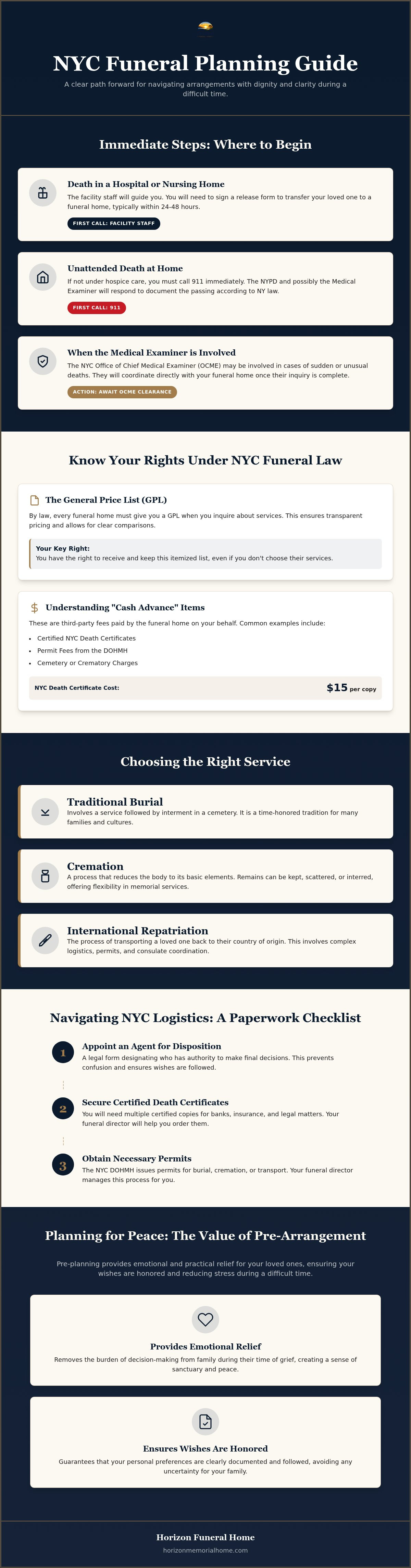
The first few hours after a loss often feel like a blur. While the city continues its pace outside, your world has likely slowed to a standstill. During this time, the most important thing to know is that you aren't alone in managing the details. This NYC funeral planning guide starts with the immediate logistical needs that arise depending on where your loved one passed away. Your first call will depend entirely on the setting, whether it's a bustling city hospital, a quiet nursing facility, or your own home.
If the death was expected and occurred under hospice care, your first call should be to the hospice nurse. They'll guide you through the next steps and handle the official pronouncement. However, if the death was unexpected or occurred without medical supervision, the process involves more city agencies. Identifying the legal next of kin is also a priority, as this person holds the authority to make final arrangements and secure personal belongings. Once the initial notifications are made, contacting a funeral director is essential. They act as your meticulous coordinator, arranging transportation and helping you understand various funeral practices that align with your family's heritage and traditions.
In some instances, the NYC Office of Chief Medical Examiner (OCME) may become involved. This happens if a death is sudden, accidental, or occurs under unusual circumstances. The OCME's role is to ensure clarity and legal compliance. While their involvement can feel intimidating, they're a standard part of the city’s protective oversight. They will coordinate directly with your chosen funeral home once their inquiry is complete, ensuring a smooth transition for your loved one.
Deaths in Hospitals or Nursing Homes
When a passing occurs in a facility, the staff usually takes the lead on the initial paperwork. Most NYC hospitals have a decedent affairs office or a social worker dedicated to helping families through this transition. You’ll need to sign a release form to authorize the transfer of your loved one to a funeral home. Facilities generally prefer this transfer to happen within 24 to 48 hours, so it’s helpful to have a funeral director selected early to avoid any rushed decisions during a sensitive time.
Unattended Deaths at Home
If a loved one passes away at home without a hospice program in place, you must call 911 immediately. The NYPD and often the Medical Examiner will arrive to document the scene and ensure everything is handled according to New York law. It can feel overwhelming to have officials in your home, but their presence is a necessary step in the legal process. A pronouncement of death in a residential setting is the formal declaration by an attending physician or emergency responder that life has ceased, which then allows for the official filing of the death certificate.
Understanding NYC Funeral Laws and Consumer Rights
Knowledge is a quiet form of peace. When you're managing the details of a farewell, understanding your legal rights acts as a sanctuary, protecting you from unnecessary stress or financial surprise. This NYC funeral planning guide is here to ensure you feel empowered and respected throughout the process. New York state laws are designed with consumer protection at their heart, ensuring that every family receives clear, honest information before making any commitments.
One of the most vital documents you'll encounter is the Appointment of Agent to Control Disposition of Remains. This legal form allows you to designate exactly who has the authority to make final decisions. Without it, the law follows a specific hierarchy of next of kin. Having this clarity early on prevents confusion and ensures your loved one's wishes are carried out by the person they trusted most. If you're feeling unsure about these documents, a gentle conversation with the team at Horizon Funeral Home can help clarify your options.
The General Price List (GPL) Explained
Every funeral home in the five boroughs is legally required to provide you with a General Price List (GPL) the moment you begin discussing services. This isn't just a courtesy; it's your right to transparent pricing. You can use the GPL to compare the "Basic Services of Funeral Director and Staff" across different Brooklyn funeral parlors. This fee is the only non-declinable charge and covers the essential professional coordination of the service.
The GPL also helps you identify "Cash Advance" items. These are third-party fees the funeral home pays on your behalf, such as:
- Certified copies of the NYC Death Certificate ($15 per copy)
- NYC DOHMH burial or cremation permits
- Crematory fees or clergy honorariums
By reviewing these items individually, you ensure that your final Itemized Statement of Services and Goods Selected is accurate and free from hidden costs. This statement serves as your only legal contract, and you should receive a copy before any services take place.
Embalming and Viewing Rights in NY
It's a common misconception that embalming is always required. In New York, the law does not mandate embalming for direct burial or cremation. If you prefer a simpler, more natural approach, you have every right to decline this service. However, most funeral homes will require embalming if you choose to have a public viewing or an open-casket ceremony to ensure a dignified experience for guests.
Even if you skip a formal visitation, you still have the right to a private identification viewing. This is a brief, quiet moment for the immediate family to say goodbye before the final disposition. It doesn't require full preparation or cosmetics, allowing for a more intimate and grounded experience that respects both your budget and your personal traditions.
Choosing the Right Service: Burial, Cremation, or Repatriation
Deciding on the nature of a final tribute is a deeply personal journey. It’s about more than logistics; it’s about finding a way to honor a unique life that feels authentic to your family’s values. This NYC funeral planning guide is designed to help you explore these options with clarity. Whether you’re looking for a traditional gathering or a simpler path, each choice offers its own form of solace and dignity. We’re here to stand beside you as you weigh these possibilities, ensuring every detail aligns with your heart and your heritage.
Traditional vs. Direct Burial
For many families, traditional funeral arrangements in Brooklyn provide a familiar sense of closure. These services typically include a visitation, a formal ceremony, and a procession to the cemetery. It’s a rhythmic, communal way to say goodbye. If your family prefers a more understated approach, direct burial offers a simple, dignified farewell. This option typically occurs shortly after the passing without a public viewing or embalming. While we coordinate the transportation and professional care, it’s helpful to remember that you’ll work directly with local NYC cemeteries for plot selection, as funeral homes do not sell cemetery property.
Cremation is another path that offers significant flexibility. Approximately 55% of New Yorkers now choose cremation, according to recent industry data. You might opt for a direct cremation, or perhaps a memorial service with an urn present. This allows your family to gather at a later date, providing the time needed to bring distant relatives together in the city. It’s a choice that prioritizes simplicity while still allowing for a deeply meaningful celebration of life.
Worldwide Transportation Logistics
New York is a city of global stories, and often, those stories lead back to a home overseas. Managing international funeral transportation requires a meticulous hand and a deep understanding of embassy requirements. We specialize in the logistics of shipping remains to countries like Georgia and Armenia, where cultural traditions are paramount. This process involves securing "Known Shipper" status with airlines and using specialized containers designed for air travel. We act as your liaison, coordinating with the destination funeral director to ensure your loved one is received with the same care they were given here.
For those who served our country, veteran honors are a vital part of the farewell. We coordinate closely with the VA to arrange military tributes, including the folding of the flag and the playing of Taps. It’s a final, profound thank you for their service, ensuring their legacy is honored with the highest degree of respect in any of the five boroughs. Whether the service is local or involves global travel, we remain a steady presence by your side.
Navigating NYC Logistics: Permits and Paperwork
While the emotional weight of a loss is your primary focus, the city requires a specific sequence of administrative steps to move forward. It can feel like a mountain of paperwork. This NYC funeral planning guide is here to simplify those requirements, turning a complex logistical maze into a clear, manageable path. Your funeral director acts as your meticulous coordinator during this time, handling many of these filings so you can focus on your family. They'll notify Social Security on your behalf and ensure the timeline between the passing and the final service remains smooth and respectful.
Managing the logistics in a city as large as New York means working with various agencies, specifically the Department of Health and Mental Hygiene (DOHMH). We understand that these details feel clinical, but they're the necessary legal foundations for a dignified farewell. If the administrative burden feels like too much to carry alone, the coordinators at Horizon Funeral Home are ready to step in and manage these filings on your behalf.
Ordering Death Certificates in NYC
In New York City, a certified copy of a death certificate costs $15. You'll likely need several copies for probate, insurance claims, and closing bank accounts. It’s often better to order more than you think you’ll need initially to avoid the delay of re-ordering later. There's a difference between a certified transcript, which is the official legal document, and a "working copy" used for internal funeral home logistics. In 2026, the NYC Department of Health and Mental Hygiene utilizes a fully integrated electronic death registration system that allows funeral directors to file records and request certified copies with greater speed and accuracy than in years past.
Local Permits and Borough-Specific Rules
If you're considering scattering ashes, New York has specific guidelines you must follow. For scattering in public parks or city-owned green spaces, you'll need to coordinate with the New York City Department of Parks and Recreation to ensure you’re following local ordinances. For those choosing to scatter in public waters, such as the Atlantic Ocean or the Long Island Sound, federal and local maritime rules apply, including the requirement that the scattering occurs at least three nautical miles from shore.
Transportation also requires careful planning, especially when moving a loved one across the city’s bridges and tunnels. If you’re coordinating a service in Nassau County or further out on Long Island, your funeral director must secure a Burial and Transit Permit. This document is essential for any transport that crosses city or state lines. We handle these borough-specific rules daily, ensuring that your loved one’s journey to their final resting place is uninterrupted and follows every legal requirement of the five boroughs.
Planning for Peace: Pre-Arrangement and Memorials
The final piece of this NYC funeral planning guide isn't about managing an immediate crisis, but about the quiet strength found in preparation. Choosing funeral preplanning services in NYC allows you to make decisions with a clear mind and a calm heart. It’s a profound gift for your family. By documenting your wishes now, you remove the burden of guesswork during their time of grief. Beyond the emotional relief, pre-arranging often allows you to secure current prices for professional services, protecting your loved ones from future inflation in the city’s evolving market.
New York state maintains some of the nation's strongest consumer protections regarding pre-funded funerals. By law, 100 percent of the funds you pay for a pre-arranged service must be placed in an interest-bearing trust. These funds remain yours and are fully portable. If you ever move away from the five boroughs, your plan can typically be transferred to another funeral home. This NYC funeral planning guide encourages you to view pre-arrangement as a way to create a sanctuary of certainty for the future.
The Preplanning Consultation
A pre-arrangement meeting is a gentle, unhurried conversation where we document your specific preferences. You don't need to have every answer ready. It's helpful to bring basic biographical information, Social Security numbers, and military discharge papers if you're a veteran. We'll discuss your cultural or religious traditions, ensuring they're recorded with meticulous detail. In New York, you can choose between a revocable trust, which can be refunded, or an irrevocable trust, which is often necessary for those qualifying for SSI or Medicaid. We'll help you understand which path provides the most stability for your situation.
Personalizing the Celebration of Life
Honoring a life in a city as vibrant as ours often means looking beyond traditional settings. We help families create personalized memorial services in Brooklyn that reflect a person's true spirit. This might involve incorporating references to a favorite neighborhood landmark or choosing a non-traditional venue in Manhattan that held special meaning. Every detail, from the music to the shared stories, should feel like a genuine reflection of the individual. It is a profound responsibility to ensure we are honoring our heroes with full military honors, providing a final, dignified salute to their selfless service. By planning these tributes in advance, you ensure your story is told exactly as you lived it.
Moving Forward with Clarity and Peace
Planning a final tribute in a city as complex as New York doesn't have to be a journey taken alone. We've explored how understanding your legal rights and the immediate logistical steps can transform an overwhelming process into a manageable one. This NYC funeral planning guide serves as your foundation, providing you with the knowledge to make decisions that honor your loved one’s unique story. From navigating the initial hospital release to coordinating intricate details, every step is an opportunity to find peace through preparation.
As an independent, family-owned home, we take pride in offering a steady presence for our neighbors. Whether you require expertise in international repatriation to Georgia and Armenia or need dedicated support for veteran honors, we handle the details with meticulous care. You deserve a partner who listens first and coordinates second. Please Contact Horizon Funeral Home for a steady, compassionate guide through NYC funeral planning. We're here to help you create a dignified farewell that brings comfort to your family and honors a life well lived.
Frequently Asked Questions
How much does a typical funeral cost in NYC in 2026?
Funeral costs in New York City are influenced by the city's unique real estate and operational expenses. While we don't quote specific prices here, industry data indicates that a traditional full-service burial in the five boroughs can be significantly more expensive than in other parts of the state. Factors such as the choice of casket, length of visitation, and cemetery fees all impact the final total. Every funeral home must provide a General Price List to help you understand these variables with transparency.
Can I plan a funeral in NYC if I live out of state or overseas?
It is entirely possible to coordinate arrangements from a distance with the help of a dedicated local partner. We often act as your eyes and ears on the ground, managing the logistics with hospitals, the Medical Examiner, and city agencies through digital communication and phone consultations. This allows you to focus on your family's emotional needs while we ensure every detail of the NYC funeral planning guide is followed with meticulous care and respect for your wishes.
Is embalming required by New York State law for a viewing?
New York State law does not mandate embalming for any service, including those with a viewing. However, many funeral homes maintain a policy that requires embalming if you choose to have a public, open-casket visitation to ensure a dignified experience for all guests. If you prefer to avoid this process, you still have the right to a private identification viewing for the immediate family, which typically does not require full preparation or cosmetics.
How do I obtain a death certificate in New York City?
Your funeral director will file the death certificate with the NYC Department of Health and Mental Hygiene within 72 hours of the passing. Once filed, certified copies can be obtained for $15 each. While you can order these through the VitalChek system or in person, your funeral home usually handles the initial request to ensure you have the necessary transcripts for probate and insurance claims without any added administrative stress during your time of grief.
What is the difference between a direct burial and a traditional funeral?
A traditional funeral typically includes a public visitation, a formal ceremony, and a procession to the cemetery, providing a communal space for grief. In contrast, a direct burial is a simpler, more understated option where the deceased is interred shortly after passing without a formal viewing or embalming. This choice prioritizes a quiet, dignified farewell and is often chosen by families seeking a more private or budget-conscious path that still honors their loved one with respect.
Can I transport a loved one back to their home country from NYC?
Transporting a loved one back to their home country is a complex process that requires specialized expertise in international logistics. We coordinate directly with embassies and airlines to manage the necessary permits and "Known Shipper" requirements. Whether you are shipping to Georgia, Armenia, or elsewhere, we act as a steady liaison between city agencies and the destination funeral director. This ensures your loved one is received with dignity and that all cultural traditions are respected throughout the journey.
What funeral benefits are available for NYC veterans?
Veterans in New York City are entitled to specific honors and financial assistance to recognize their service. This includes a military funeral honors ceremony with the folding of the flag and the playing of Taps. Additionally, the VA provides a headstone or marker at no cost. This NYC funeral planning guide also highlights that the NYC Human Resources Administration offers up to $1,700 toward funeral expenses for qualifying low-income residents, provided total costs remain within city limits.
How long after death does a funeral usually take place in NYC?
The timeline for a service in NYC typically ranges from three to seven days after the passing, depending on the type of service and city requirements. If the Office of Chief Medical Examiner is involved, or if you are coordinating international repatriation, the process may take longer. We work methodically to ensure all permits are secured and that your family has enough time to gather without feeling rushed through these important and deeply personal final moments.