
Can you arrange and pay for funeral services now to protect your family from future price increases, or might some costs still change? If you’re researching how to lock in funeral costs 2026, the answer depends on the written agreement, not simply on making plans or setting money aside.
It’s understandable to want clarity before making a decision. Preplanning lets you record your wishes, while prepaying means funding an arrangement. Neither term alone tells you which services or merchandise have guaranteed prices, what’s excluded, or how funds are handled.
This guide explains what a New York funeral agreement may and may not lock in, and how guaranteed arrangements differ from estimates and other funding options. You’ll learn what to check in the written terms, what to ask about refunds, transfers, exclusions, and future costs, and how to compare options without feeling rushed. A preplanning conversation can help you understand the details and decide what feels right for you and your family.
Key Takeaways
- To understand how to lock in funeral costs 2026, look for clear contract language stating which selected services or merchandise have guaranteed prices.
- Compare planning, paying in advance, and a guaranteed-price arrangement. Check what each clarifies and whether funds are committed.
- Ask how funds are held, whether an agreement can be changed or transferred, and what refund terms apply.
- Request written answers identifying estimates, exclusions, and charges that may be billed separately, then keep a copy of the agreement.
- A preplanning consultation with Horizon Funeral Home can help you clarify your wishes and review available arrangements across the New York metropolitan area.
Table of Contents
- What Does It Mean to Lock In Funeral Costs in 2026?
- How Funeral Preplanning Agreements and Funding Work
- Compare Funeral Cost Protection Options Before Committing
- A New York Checklist for Reviewing a Funeral Cost Agreement
- Plan Ahead With Horizon Funeral Home, Without Pressure
What Does It Mean to Lock In Funeral Costs in 2026?
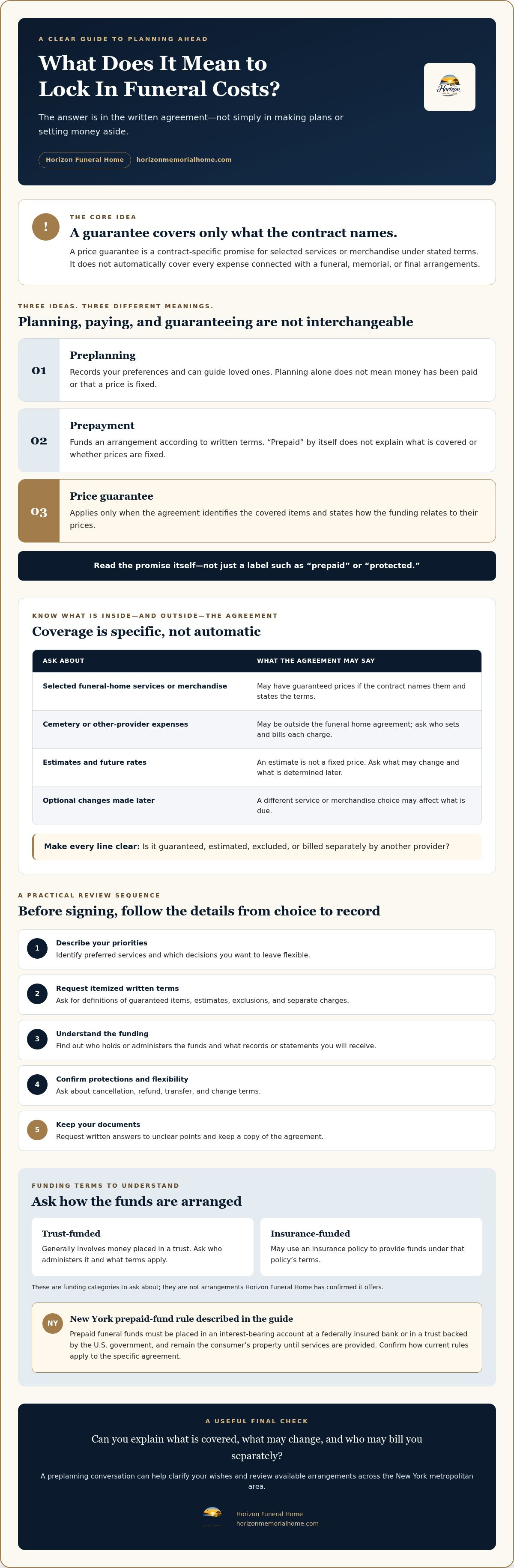
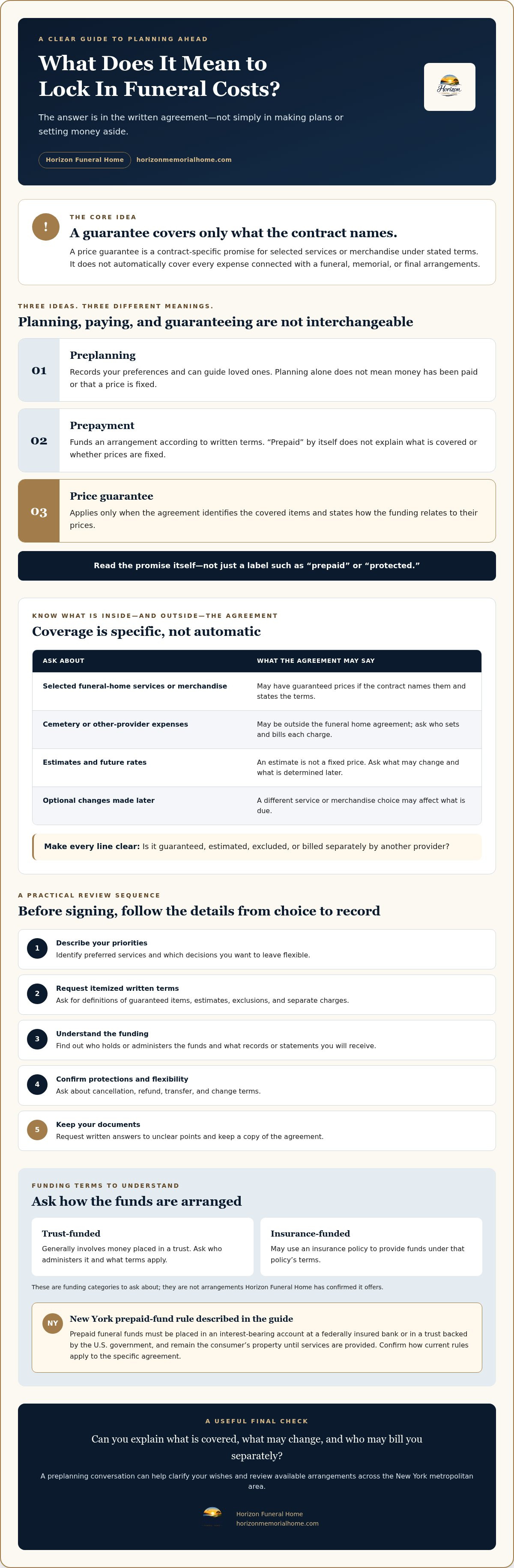
Planning ahead can mean writing down your wishes, paying in advance, or agreeing on prices for particular items. These steps can work together, but they are not interchangeable. A record of your preferences can help loved ones understand what matters to you without requiring payment now. Prepayment means setting aside or paying funds under specific written terms. A price guarantee is a separate question: what does the agreement promise to provide for the amount paid?
A funeral price guarantee is a contract-specific promise that named services or merchandise will be provided under stated terms, even if their prices later change. It applies only to the items the agreement identifies. It doesn’t automatically cover every expense connected with a funeral, memorial, or final arrangements.
Preplanning, prepayment, and price guarantees are not the same
Preplanning lets you document preferences, such as the kind of service or memorial you’d like. People draw on varied funeral rites and practices, so recording the details that matter to you can give family members useful guidance. Planning alone doesn’t mean money has been paid or that any price is fixed.
Prepayment means funding an arrangement according to written terms. A guarantee applies only if the agreement explicitly identifies which selected services or merchandise are covered and explains how the funding relates to those prices. Read the promise itself, not just a label such as “prepaid” or “protected.”
Which funeral expenses might remain outside a guarantee?
Separate the funeral home’s listed charges from expenses that may come from a cemetery or another provider. An agreement might address some funeral-home services while leaving other costs outside its scope. Cemetery charges are one example to ask about. Don’t assume the funeral home’s agreement covers them. Optional changes made later, such as choosing a different service or merchandise, may also affect what’s due.
Ask the provider to identify every excluded item and third-party charge in writing. For each line, find out whether the price is guaranteed, estimated, or determined later by someone else. An estimate is not a fixed price, and a guarantee for selected items does not necessarily extend to the entire arrangement.
For New York-specific treatment of outside expenses, verify current requirements with an authoritative state source and ask how they apply to your agreement. Before signing, make sure you can explain in your own words what the contract covers, what may change, and who may bill you separately. That distinction is central to understanding what it really means to lock in funeral costs 2026.
How Funeral Preplanning Agreements and Funding Work
A preplanning conversation can help you set priorities and understand your choices. Next, find out how those choices are recorded, priced, and funded. If you’re comparing ways to lock in funeral costs 2026, take it step by step: discuss your wishes, request itemized terms, review the funding arrangement, confirm protections, and keep copies of the documents.
From a planning conversation to a written agreement
Start by identifying the services you prefer and the decisions you’d like to leave flexible. Ask the provider for an itemized statement and written definitions of guaranteed items, estimates, exclusions, and separate charges. The Federal Trade Commission explains your rights under the federal Funeral Rule, including access to price information when making arrangements.
Before signing, ask who holds or administers the funds, how you’ll receive records, and what happens if your plans change. The written agreement, not a sales conversation, defines what’s funded, covered, and promised. Take time to read it and request written answers to anything that isn’t clear.
What funding terms should families understand?
Funding structures can differ. A trust-funded arrangement generally involves money placed in a trust; an insurance-funded arrangement may use an insurance policy to provide funds under its terms. These are categories to ask about, not arrangements Horizon Funeral Home has confirmed it offers. In New York, prepaid funeral funds must be placed in an interest-bearing account at a federally insured bank or in a trust backed by the U.S. government, and remain the consumer’s property until services are provided. Confirm how current rules apply to the specific agreement.
Ask the provider to explain in writing:
- Who holds the funds, and what statements or records will you receive?
- Are the prices guaranteed or subject to future rates, and which items are covered?
- What cancellation, refund, or transfer terms apply?
- What happens if the provider, funding arrangement, or your family’s circumstances change?
Don’t assume a trust or policy will grow by a particular amount, be refundable, transfer easily, or receive specific tax treatment. Those details depend on the contract and applicable rules. Review the actual terms and seek qualified advice for questions beyond the funeral arrangement itself.
Horizon offers preplanning consultations for families across New York City and Nassau County. You can discuss preplanning arrangements with Horizon to clarify your wishes and ask questions without treating the conversation as a commitment.
Compare Funeral Cost Protection Options Before Committing
There isn’t one approach that suits every family. Some people want their wishes recorded while keeping financial decisions open; others want to fund an arrangement or seek fixed prices for selected items. To compare ways to lock in funeral costs 2026, look past the label and ask what each option actually does.
| Approach | What it can clarify | Are funds committed? | What to review |
|---|---|---|---|
| Planning only | Preferences and choices to guide relatives | Not necessarily | How wishes are stored, who can access them, and how to update them |
| Paying in advance | How funds are applied to a planned arrangement | Usually, according to the written funding terms | Who holds the funds, covered items, cancellation and transfer terms, and possible additional charges |
| Written guaranteed-price arrangement | Which specifically named items have prices covered under the agreement | Depends on the funding structure and contract | Guarantee language, exclusions, estimates, provider changes, and what happens if choices change |
A documented preference or estimate alone isn’t a guaranteed price. The FTC's Funeral Rule explains funeral providers’ obligations around itemized price information and consumer choice. Use written, itemized details to compare options, and check which costs are included and which may be billed separately.
Preplanning without prepayment
Recorded preferences can help relatives understand your wishes without committing funds or fixing prices. Ask how the provider stores the plan, who can retrieve it, and how you can revise it if your circumstances or preferences change. If financial flexibility matters to you, discuss planning without prepayment and let loved ones know where the current instructions are kept.
Prepaying or choosing a guaranteed arrangement
Prepayment may make the funding and selected arrangements clearer, while a written guarantee may specify fixed terms for particular covered items. Neither should be assumed to save money or eliminate every future expense. Before deciding, get clear answers about exclusions, cancellation, transfer, and what happens if the provider or your needs change. Compare the actual terms, not just a promise made in conversation. The right choice depends on your priorities and the protections the agreement provides.
A New York Checklist for Reviewing a Funeral Cost Agreement
A clear agreement should show what’s covered, what could change, and who is responsible for each part of the arrangement. Bring your questions to the provider meeting, take notes, and ask for written answers. Before signing, make sure you receive a copy of the complete agreement and any documents explaining how it’s funded.
Questions to ask before signing
Ask the provider to walk through the agreement line by line. The FTC Funeral Rule addresses itemized price information and consumer choice; consult current FTC guidance to understand its scope. For New York-specific requirements, check current information from an authoritative state source rather than relying on a verbal summary.
- Which services or merchandise have guaranteed prices, and which are estimates?
- What is excluded, including cemetery charges or other third-party expenses that may be billed separately?
- How would changing a service, merchandise selection, or personal preference affect the agreement?
- What are the cancellation, refund, and transfer terms, and how do I request a change?
- Who should I contact with a concern, and what process is available to address it?
If an answer is unclear, ask for the wording to be added to the agreement or provided in writing. That’s especially useful when discussing how to lock in funeral costs 2026, because a spoken explanation may not describe the contract’s full limits.
Documents and local details to verify
Before committing, check the provider’s identity and contact information, the agreement’s covered items and exclusions, and the name of the person or organization administering the funds. Ask what statements or records you’ll receive, how your family can access them, and how you can update your preferences. Keep the signed agreement and related funding documents together where the family members you choose can find them.
- Get a complete, itemized copy of the agreement and all referenced terms.
- Confirm in writing which charges are guaranteed, estimated, or determined by another provider.
- Request written explanations of funding, cancellation, refund, transfer, and provider-change terms.
- Verify claims about New York law or consumer protections against current official sources.
To clarify your preferences and review available arrangements, you can discuss preplanning questions with Horizon Funeral Home. Take the time you need to understand each term before deciding.
Plan Ahead With Horizon Funeral Home, Without Pressure
A preplanning conversation can be an opportunity to clarify your wishes and understand available arrangements. It doesn’t have to mean you’re ready to purchase or sign an agreement. If you’re weighing how to lock in funeral costs 2026, ask Horizon directly whether a particular guarantee or funding arrangement is available, and request its terms in writing. Horizon offers preplanning consultations for families across the New York metropolitan area.
You may want to explore service choices before meeting. Horizon coordinates traditional funeral arrangements, cremation, and direct burial. As you consider those options, identify which details matter to you and which decisions you’d prefer to leave open for your family.
What to bring to a preplanning conversation
A short list of questions can make a sensitive discussion feel more manageable. Bring any preferences you’ve already recorded, along with questions about prices, funding, and how changes would affect an agreement. Share any cultural, religious, veteran, or personal wishes you’d like considered. These details can guide a conversation about arrangements that reflect your values.
- Which items, if any, have guaranteed prices, and what exclusions or separate charges apply?
- How would changing a service or merchandise selection affect the agreement?
- What funding arrangements are available, and who administers the funds?
- What are the cancellation, refund, and transfer terms?
- Can you take the documents home and review them before making a decision?
There’s no need to decide everything at once. Ask for time to read the written terms and get clarification before signing.
A respectful next step for New York families
Horizon’s preplanning consultations are an opportunity to discuss wishes and review available arrangements, not a promise of a particular price-lock product. Families in Brooklyn, Queens, Staten Island, Manhattan, the Bronx, and Nassau County can ask whether the arrangements they’re considering are available and what the written terms would say. Clear answers should identify what’s covered, what may change, and what needs separate verification.
If you’re ready to talk, speak with Horizon about funeral preplanning. Bring your questions, take the time you need, and decide at your own pace.
Take the Next Step With Clear Questions
Planning ahead can bring clarity, but documenting wishes, paying in advance, and securing guaranteed prices are different things. If you’re considering how to lock in funeral costs 2026, let the written agreement guide your decision. Check exactly which items are guaranteed, which are estimates, what may be billed separately, and how funding or changes to your plans could affect the arrangement.
You don’t have to settle every detail in one conversation. Horizon Funeral Home offers preplanning consultations for families in Brooklyn, Queens, Staten Island, Manhattan, the Bronx, and Nassau County. Use the time to clarify your wishes, ask about available arrangements, and request written explanations of any guarantees, exclusions, or funding terms. A conversation isn’t a commitment to buy.
When you feel ready, speak with Horizon about funeral preplanning. Bring your questions, take the time you need to review the details, and choose the path that feels right for you and your family.
Frequently Asked Questions
Can you lock in funeral costs in 2026?
Yes, some written funeral arrangements may guarantee prices for specified services or merchandise, but there’s no universal guarantee that covers every future expense. If you’re exploring how to lock in funeral costs 2026, check the contract for named guaranteed items, estimates, exclusions, and third-party charges. Funding terms and applicable rules can affect coverage. Request an itemized explanation and verify current New York requirements with authoritative sources before signing.
Does preplanning a funeral lock in the price?
No, preplanning by itself doesn’t necessarily lock in prices. It can record your wishes without prepayment or a price guarantee. A price is protected only if the written agreement explicitly identifies which items are guaranteed and under what conditions. Compare your planning document with any funding agreement, and ask how changes to your choices, exclusions, estimates, and outside charges will be handled before deciding.
Is it better to prepay funeral expenses or save the money yourself?
Neither option is universally better. The right choice depends on your priorities, financial circumstances, and the specific terms available. Prepayment may organize selected arrangements, while keeping separate savings may preserve flexibility. Compare who can access the funds, cancellation and refund terms, any price guarantees, and applicable protections. If the financial or legal terms are unclear, consider reviewing them with a qualified adviser before committing.
What happens if a prepaid funeral plan does not cover every expense?
Expenses outside the agreement may remain to be paid, but responsibility depends on the contract and circumstances. Review the itemized document for exclusions, third-party charges, estimates, and services or merchandise selected later. Don’t assume a particular person will owe a separate charge without checking the terms. Ask the provider to identify each potentially uncovered expense in writing and explain how changes could affect the arrangement.
Can a prepaid funeral plan be transferred to another funeral home in New York?
Transferability depends on the agreement and applicable New York rules. Don’t assume that funds, prices, or guaranteed terms will move unchanged to another provider. Ask who administers the funds, what happens if you relocate or change funeral homes, and whether fees or revised terms may apply. Request the answer in writing, then verify current state requirements through an authoritative New York source before relying on it.
What should I check before signing a funeral preplanning agreement?
Review the itemized list, guaranteed versus estimated charges, exclusions, funding administrator, cancellation and refund terms, transfer conditions, and process for changing preferences. Ask for clear written answers and a copy of every document, with time to review before signing. Verify current New York requirements, and consult a qualified professional if legal or financial terms are unclear. Horizon offers preplanning consultations for families in Brooklyn, Queens, Staten Island, Manhattan, the Bronx, and Nassau County.
Does the FTC Funeral Rule apply to prepaid funeral plans?
The FTC Funeral Rule is a federal consumer-protection regulation, but its specific application depends on the provider, transaction, and services involved. It doesn’t guarantee future prices or necessarily govern every funding arrangement. Review current FTC guidance alongside the itemized statement and contract, and ask which protections apply to your situation. For questions about New York requirements, confirm details with an authoritative state source before signing.