
An emergency funeral director in Brooklyn can coordinate a pickup and transportation. In New York City, permits are required to bury or cremate human remains or move them outside the city or nearby counties. Only funeral directors, undertakers, hospitals, or their representatives registered with the city’s Office of Vital Statistics can obtain those permits.
During a loss, transportation is only one part of the arrangements. Faith, cultural traditions, and family wishes deserve thoughtful attention, too. This guide explains what to expect and which details to share.
Here are the first steps after a death, how local permits apply to pickup and transportation, and what can affect domestic or international transfers. You’ll also find guidance on planning arrangements that respect personal and cultural traditions.
Key Takeaways
- Understand which New York City permits are needed for burial, cremation, or moving remains, and who can obtain them.
- Learn what information helps coordinate a respectful pickup from a residence or hospital.
- See the immediate steps after a death, including how death certificate filing fits into the process.
- Prepare for domestic or international shipping by understanding the coordination and documentation involved.
- Discover how Brooklyn location and your chosen arrangements can shape the practical next steps.
Table of Contents
- Brooklyn funeral and cremation services
- Funeral home pickups from residences and hospitals
- Immediate steps after a death in Brooklyn
- Domestic and international body shipping
- Brooklyn neighborhoods served
- Horizon Funeral Home: Traditional Funeral Services
Brooklyn funeral and cremation services
An emergency funeral director in Brooklyn can coordinate arrangements, but the required permits depend on whether the family chooses burial, cremation, or transfer. In New York City, permits are part of the legal process, not optional paperwork.
Funeral Service Options
A funeral service may include a gathering before burial or cremation, while direct burial focuses on burial without a preceding service. Cremation arrangements may include a ceremony or proceed without one. The choice often reflects personal wishes, faith traditions, and whether relatives want to gather before disposition. Share these preferences early so the arrangements reflect the family’s priorities.
New York City requires permits to bury or cremate human remains or move them outside the city or nearby counties. Only funeral directors, undertakers, hospitals, or their representatives registered with the NYC Department of Health and Mental Hygiene’s Office of Vital Statistics can obtain burial, cremation, or transfer permits. Permits are issued for deaths registered with the Office of Vital Records. Funeral directors must also obtain any other permits, licenses, or authorizations required by the city and state.
For a burial or transfer, tell the funeral director the intended destination and disposition. These details help determine which permit and any additional authorizations are needed. A transfer outside New York City is different from a burial within the city. Since permits depend on the planned action, clarify the destination and disposition before submitting paperwork.
Cremation arrangements may involve paperwork and family authorization, so confirm the necessary steps before proceeding. These are separate steps: the authorization records the family’s consent, while the permit allows the cremation to take place. Identify the legal next of kin early to avoid confusion about who needs to sign.
New York law does not require a casket for burial, although cemetery or mausoleum rules may impose additional restrictions. State law also does not require a casket for cremation, but crematories usually require a container. Ask how the chosen cemetery’s or crematory’s requirements affect the arrangements. Requirements can differ by destination, so burial and cremation plans may involve different practical considerations.
Brooklyn Service Costs
Funeral and cremation costs in Brooklyn vary based on the services, merchandise, transportation, disposition, and outside providers selected. Horizon Funeral Home provides current cost information after learning what the family needs. A simple disposition and a gathering with additional arrangements involve different elements, and outside-provider charges may apply separately.
When discussing arrangements, ask for the costs of the selected services and any separate charges from outside providers. Review each component against the plan, including the service and disposition. This makes it easier to understand what the funeral home coordinates and which costs may come from a cemetery, crematory, or transportation provider.
Funeral home pickups from residences and hospitals
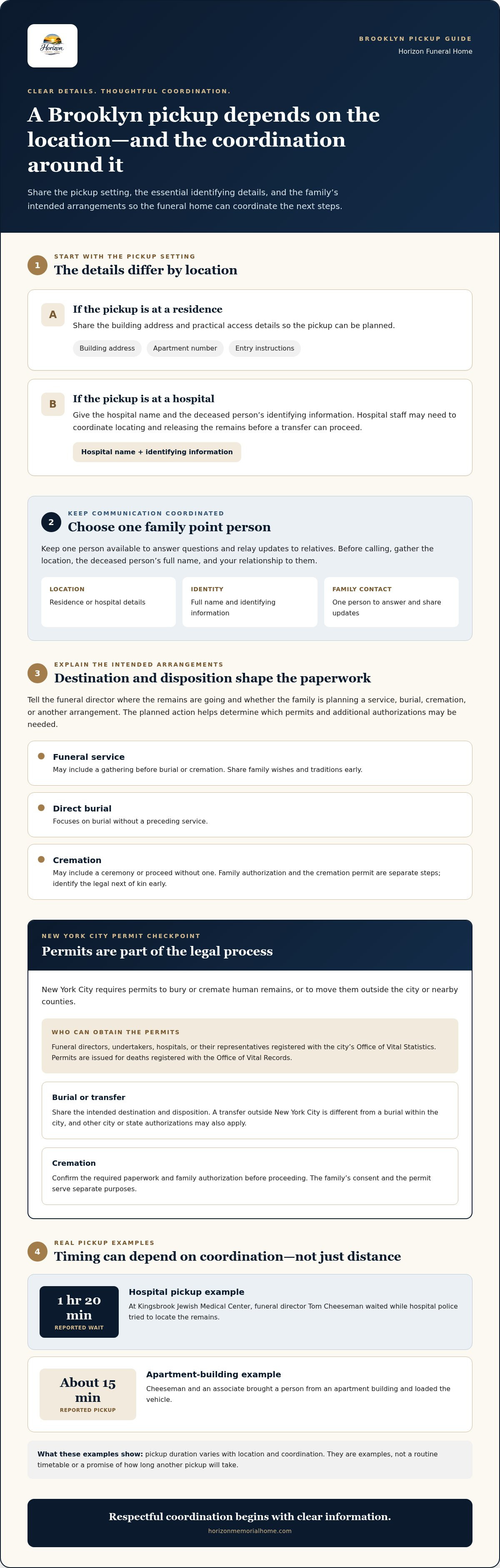
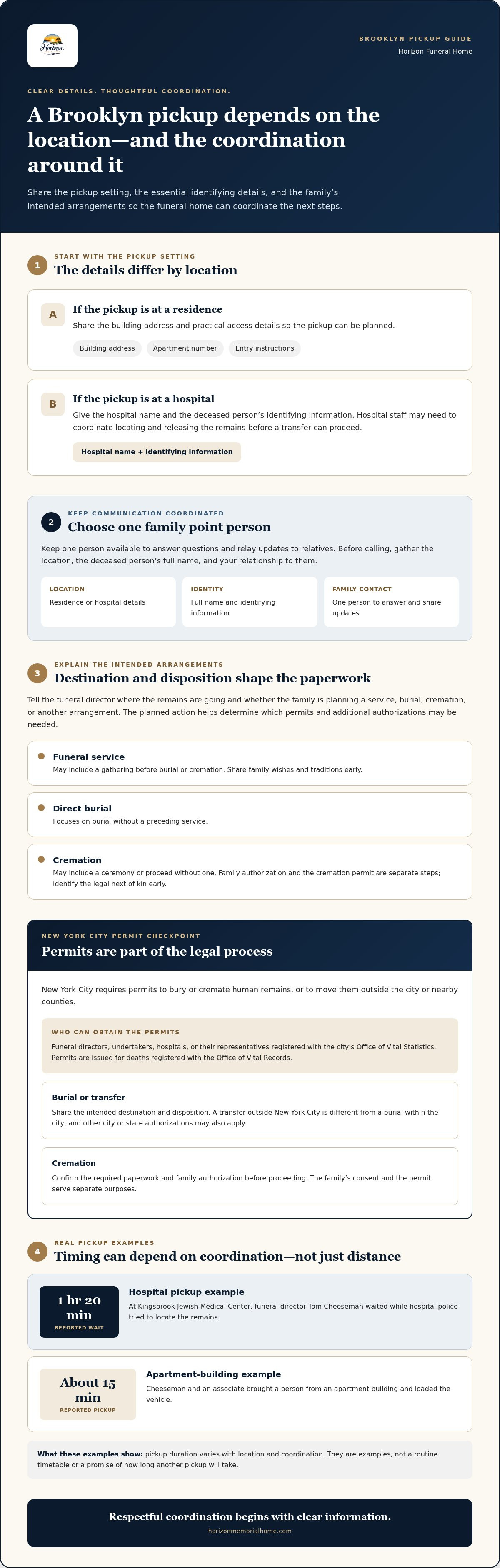
A residence pickup and a hospital pickup involve different coordination. For a Brooklyn transfer, provide the location and the family’s arrangement details so the funeral home can plan with the people responsible for releasing the remains. Keep the conversation focused on the pickup location, family contact, and intended destination.
There isn’t one shared phone number or address for emergency funeral homes in Brooklyn. Each funeral home has its own contact details and location, so use the business’s name when looking for its direct number or address.
For a residence pickup, share the building address and any practical access details, such as the apartment number or entry instructions. For a hospital pickup, give the hospital name and the deceased person’s identifying information so staff can coordinate locating and releasing the remains. A funeral home may need to work with hospital staff before a transfer can proceed. The family can help by keeping one person available to answer questions and relay updates to relatives.
Hospital coordination can take time. In one Brooklyn example, funeral director Tom Cheeseman waited an hour and 20 minutes at Kingsbrook Jewish Medical Center while hospital police tried to locate the remains. On another pickup, Cheeseman and an associate took about 15 minutes to bring a person from an apartment building and load the vehicle. These examples show why a pickup’s duration depends on the location and coordination involved, not simply the drive between two places.
The work can also carry emotional strain for funeral home staff. During the COVID-19 crisis, Cheeseman described making pickups over a 12-hour day and treating every deceased person as if they might have a virus. That account reflects the weight and care involved in this work, rather than a routine timetable for current pickups. Families can help keep communication clear by choosing one point person and sharing essential details in a calm, direct way.
“Emergency” does not mean every funeral home operates 24/7. Around-the-clock availability is a specific business arrangement, not something established by the word itself. Likewise, “family-owned” describes ownership; it doesn’t by itself tell you a funeral home’s hours, pickup process, or staffing. Focus first on the practical facts: who can answer, where the pickup is, and whether the funeral home can coordinate the requested transfer.
Before calling, gather the hospital or residence name, the deceased person’s full name, and your relationship to them. Then explain whether the family is planning a funeral service, burial, or another arrangement. Clear details help the funeral home understand the pickup request and what coordination comes next. For guidance on traditional funeral arrangements, the next conversation can include the service the family has in mind.
Immediate steps after a death in Brooklyn
In Brooklyn, first identify who is coordinating the next steps and where the remains are located. The death certificate, permits, and transfer arrangements follow distinct processes.
Does New York City require a funeral director to handle transportation, permits, and death certificates? Registered funeral directors, undertakers, hospitals, or their representatives can obtain permits for burial, cremation, or moving remains. Funeral directors generally file death certificates, while authorized parties can also file through the city’s designated systems.
Getting Started After a Death
First, note the location of the remains and identify one family contact who can share information consistently. Then discuss the intended arrangements, such as burial, cremation, or transfer, with the funeral director. These details help clarify which paperwork and coordination steps apply. In Brooklyn, the funeral director generally files the death certificate within 72 hours of death.
If the remains will be held for over 24 hours or are in transit, New York requires them to be embalmed, refrigerated, or placed in a leak- and odor-proof container. This rule makes timing and destination relevant from the beginning. Tell the funeral director if a transfer is planned, so the arrangements account for the remains’ storage and movement.
Keep key details together for the funeral director: the deceased person’s full name, location, family contact, and intended disposition. If the death occurred at home, note the residence address. If it occurred at a hospital, include the hospital’s name. A clear point of contact can help avoid repeated calls while relatives make arrangements.
Death Certificates and Permits
In New York City, funeral directors, undertakers, hospitals, or their representatives can file death certificates at the Manhattan or Brooklyn Burial Desks or through the Electronic Death Registration System. A death certificate is separate from the permit required for burial, cremation, or moving remains. The death must be registered with the Office of Vital Records for those permits to be issued.
Funeral directors generally manage the death certificate filing, but families may need certified copies for personal matters. A Brooklyn death certificate costs $15.00 per copy, and veterans receive three free copies. Decide how many copies the family needs and include that request in the arrangements. These are certificate costs, not funeral-service prices.
Use this sequence to keep the first administrative steps clear:
- Share the location and identifying details with the funeral director.
- Explain whether the plan involves burial, cremation, or transfer.
- Coordinate death certificate filing and request needed copies.
- Allow the required permit process to match the selected disposition.
The Electronic Death Registration System provides an electronic filing route alongside the Burial Desks. For the family, the practical priority is to communicate the intended arrangements and keep the designated contact reachable. This gives authorized professionals the information needed to coordinate records and permits.
Domestic and international body shipping
Moving a loved one from Brooklyn to another destination requires coordination between the sending and receiving locations. Identify the destination, receiving funeral home or facility, and family contact responsible for decisions. These details help clarify the route, handoff, and required arrangements. Whether the transfer is domestic or international, a clear plan helps move the remains respectfully and lawfully.
For a domestic transfer, tell the funeral director whether the destination is elsewhere in New York or outside the state. New York City requires a permit to move human remains outside the city or its nearby counties. Only funeral directors, undertakers, hospitals, or their representatives registered with the NYC Department of Health and Mental Hygiene’s Office of Vital Statistics can obtain that permit. The destination helps determine which transfer process applies.
For an international shipment, share the country and receiving location as early as possible. The funeral director coordinates the movement and the handoff with the parties involved at each end. Keep one family member available to relay decisions and receive updates. If relatives are coordinating across time zones, agree on a reliable contact method and share the same destination details with everyone involved.
Use this sequence to make the planning conversation more focused:
- Provide the deceased person’s current location and intended destination.
- Name the family contact who can make or communicate decisions.
- Explain the planned funeral or disposition arrangements at the destination.
- Coordinate the permit and transfer steps with the funeral director.
- Confirm which party will receive the remains and where the handoff will occur.
Timing and handling matter during transit. In New York, remains held for over 24 hours or in transit must be embalmed, refrigerated, or placed in a leak- and odor-proof container. Share the anticipated transfer plan so the arrangements account for the time in transit and the method of care. A change in destination can affect coordination, so communicate it promptly.
Families often want an affordable option while protecting the dignity of the person who died. Costs vary based on the services, merchandise, transportation, disposition, and outside providers selected. For international repatriation, charges such as airline or consular services may apply separately. Review the transportation components and any outside-provider charges as part of the proposed plan.
Before a transfer proceeds, make sure the receiving party understands the intended arrival and disposition. For example, a family sending remains to relatives in another country may need to coordinate arrival details with the service planned there. Clear communication among the family, funeral director, and receiving party helps prevent confusion at handoff and keeps transportation aligned with the family’s wishes.
Brooklyn neighborhoods served
Brooklyn includes neighborhoods such as Bay Ridge, Flatbush, Williamsburg, and Coney Island. A neighborhood name alone doesn’t identify a pickup point or establish a funeral home’s service boundary. For a Brooklyn arrangement, provide the full street address and explain whether the location is a residence, hospital, or care facility. This gives everyone a specific location to coordinate around.
Address details matter within a neighborhood, too. A pickup in Flatbush may involve an apartment building, while one in Bay Ridge may be at a private residence. Share the building name, apartment or unit, entrance instructions, and a family contact. These details clarify where the pickup must take place and any access considerations.
Hospitals and residences require different location information. For a Brooklyn hospital, provide its full name and any department or contact details available to the family. For a residence in Williamsburg or Coney Island, give the exact address and entry instructions. The funeral director can use these details to coordinate the pickup with the people responsible for releasing the remains.
Before making arrangements, gather these details:
- The full street address, including borough and ZIP code.
- The hospital, residence, or facility name.
- The apartment, unit, entrance, or other access information.
- The family member who will remain available for coordination.
- The intended destination, such as a funeral home or another location.
Brooklyn’s location also matters if the family plans to move remains beyond the borough. New York City requires permits to move remains outside the city or its nearby counties. If you’re arranging a transfer from a Brooklyn address, share the destination early so the transfer arrangements and permit steps can be identified.
Neighborhood names can help relatives describe where a gathering or service may take place. Still, distinguish the service location from the pickup address. If the remains are at a hospital in Downtown Brooklyn and relatives plan to gather elsewhere, share both addresses separately. Clear labels prevent confusion between the pickup point and the family’s planned destination.
Use a simple location summary when coordinating: “pickup at [full address], [hospital or residence], contact [family member], destination [location].” Naming “Bay Ridge” without a street address leaves essential details unresolved. A complete summary gives the funeral director a practical starting point for coordinating movement and arrangements across Brooklyn.
If you’re planning arrangements connected to a Brooklyn pickup, discuss your pickup and service plans with a funeral director.
Horizon Funeral Home: Traditional Funeral Services
Horizon Funeral Home can help families arrange traditional funeral services, cremation, or worldwide transportation after a death in Brooklyn. Turn to the funeral home when you need support coordinating a service, choosing a disposition, or planning transportation for a loved one. Its offerings also include Veteran Honors for families seeking to recognize military service.
If relatives live outside New York, Horizon Funeral Home can coordinate transportation, subject to verification of documents, carrier availability, and receiving-provider requirements. If you’re planning a gathering, funeral services can provide a structure for honoring your loved one. Arrangements are personalized around the immediate need, the family’s wishes, and the next practical step.
Contact Horizon Funeral Home to discuss the arrangements that matter to your family.
Choose the Next Step That Feels Right for Your Family
The first conversation doesn’t need to settle every detail. It can begin with what matters most now: arranging a transfer, planning a meaningful farewell, or sharing the wishes your loved one expressed. From there, your family can consider the remaining decisions in a way that respects practical needs and personal traditions.
If you’re seeking an emergency funeral director in Brooklyn, a calm, direct conversation can help clarify the next step. Explain what has happened, describe what your family needs, and discuss how Horizon Funeral Home can help. Care is available in English, Russian, Armenian, Georgian, and Spanish, with respect for all faiths and traditions.
Contact Horizon Funeral Home to talk through the arrangements you’re considering. Your family can move forward one decision at a time, with care for the person you’re honoring.
Frequently Asked Questions
Does This Funeral Parlor Accommodate Different Faiths and Cultural Traditions?
Yes. Horizon Funeral Home serves families of all faiths and respects individual traditions. Discuss meaningful customs, readings, music, and service preferences when planning arrangements. Care is available in English, Russian, Armenian, Georgian, and Spanish, helping relatives communicate in the language they’re most comfortable using. A cultural observance can be incorporated into a personalized funeral or memorial plan.
Which Brooklyn funeral directors offer 24/7 emergency service and immediate body removal?
Horizon Funeral Home provides 24/7 contact by phone at 347-588-5555. Its location is 2009 Mermaid Ave, Brooklyn, NY 11224. A 24/7 contact line offers a way to reach the funeral home at any hour, but it doesn’t mean every pickup happens immediately. Removal timing depends on the pickup location, access, and coordination with the hospital, residence, or care facility.
How quickly can a funeral director respond to a death at home, in a hospital, or in a nursing home in Brooklyn?
Response timing depends on the location and coordination needed to release and transfer the remains. At home, building access and the pickup address shape the logistics. A hospital or nursing home may need staff to coordinate the release. Provide the funeral director with the facility or residence name, exact address, and a reachable family contact so arrangements can reflect the circumstances.
What should you do immediately after someone dies at home in Brooklyn before calling a funeral director?
Start by contacting the person’s medical care team or emergency services so the death can be formally addressed. Then gather the person’s full name, home address, and any building access details. Choose one family member to speak with the funeral director and relay information to relatives. If hospice or another care team is involved, keep its contact details available for coordination.
What documents are needed to arrange a funeral or cremation in New York City?
The paperwork depends on the chosen arrangements. A death must be registered with the NYC Office of Vital Records for burial, cremation, or transfer permits to be issued. Cremation also requires an authorization form signed by the legal next of kin and a cremation permit before it proceeds. Keep the intended disposition and destination clear, as these determine which permits apply.
How much do emergency funeral director services, direct cremation, and basic burial cost in Brooklyn?
Costs vary based on the services, merchandise, transportation, disposition, and outside providers selected. Horizon Funeral Home provides current cost information after learning what the family needs; costs are not the same for every arrangement. Charges from outside providers, such as a cemetery, crematory, clergy, permits, airline, or consular services, may be separate. Ask for the components to be explained together so the planned arrangements are clear.
Can Brooklyn funeral directors arrange transport of a deceased person from another state or country?
Yes. Horizon Funeral Home coordinates nationwide pickup and international transportation. Before booking an international transfer, the required documents, consular process, carrier availability, preparation, and receiving provider’s requirements must be verified. For a transfer from another state or country into Brooklyn, share the current location, destination, and receiving funeral home’s details. This gives the family and coordinating professionals a clear starting point for planning the handoff.
What should families know about funeral home fees, written price lists, and consumer rights in New York?
New York funeral homes must provide current retail price information by telephone. When a consumer makes an inquiry in person, the funeral home must provide a general price list. Review the listed services and merchandise against the family’s intended arrangements, and distinguish funeral home charges from third-party costs. A cemetery, crematory, clergy member, airline, or consular service may involve separate charges.