
When a Muslim family receives news of a death, the first concern is often time. Islamic burial customs generally call for the deceased to be cared for and buried as soon as reasonably possible, often within 24 hours. This Islamic burial customs guide explains the common practices families may encounter, while recognizing that details can vary by family, mosque, cultural background, and school of Islamic thought.
At a difficult moment, a trusted imam, mosque representative, or knowledgeable family elder can help confirm the practices that matter most to your loved one. A funeral home can coordinate the practical requirements with care, but religious direction should come from the family and its faith community.
The priority of timely, respectful care
In Islam, the human body is treated with dignity in death as in life. Families typically begin by contacting a local mosque or imam, then making arrangements for transportation, required paperwork, ritual washing, prayer, and cemetery burial. Because timing is meaningful, decisions are often made quickly and with a clear focus on simplicity.
There can still be practical circumstances that affect the schedule. A medical examiner's review, death certificate process, travel for close relatives, or transportation from another state or country may create a delay. When that happens, families can work with their imam and funeral director to preserve religious customs as fully as circumstances allow.
Islamic burial customs guide: the customary steps
Although practices differ, the following sequence is common in many Muslim communities in the United States.
Preparing the deceased
The body is handled modestly and respectfully. In many families, the deceased is positioned facing the qiblah, the direction of the Kaaba in Mecca, when possible. Family members may wish to be present, recite prayers, or ensure that the person's clothing and personal effects are handled according to their wishes.
Embalming is generally avoided in Islamic tradition because it is not normally needed for a prompt burial. However, it may be required in limited legal or transportation situations. If embalming, an autopsy, or another procedure becomes a question, the family should ask for a plain explanation of the requirement and speak with an imam about available religious accommodations.
Ghusl: ritual washing
A key part of Islamic funeral care is ghusl, the ritual washing of the body. It is usually performed by Muslims of the same gender as the deceased, often trained volunteers from the mosque or members of the family. A spouse may be permitted to assist in some traditions.
The washing is private, gentle, and prayerful. The body remains covered as much as possible throughout the process. It is commonly washed an odd number of times, often three, and may be cleaned with water and mild soap or scented materials permitted by the family's tradition. The exact method can vary, so the people conducting the washing will generally follow guidance from the family's imam or mosque.
In some situations, such as when washing would be medically unsafe or is not possible, an alternative ritual called tayammum may be used. This is one example of why families should not feel they have failed if circumstances require an adjustment. Islamic practice includes compassion and accommodation in hardship.
Kafan: shrouding
After washing, the deceased is wrapped in a simple white burial shroud known as a kafan. The shroud reflects humility and equality before God. The number and style of cloths can differ according to gender and community practice.
Many Muslim families prefer a plain casket or no casket when cemetery rules allow. In New York and elsewhere, cemetery policies, local regulations, and the condition of the grave may affect what is permitted. A funeral director can explain these requirements without steering the family away from a simple arrangement.
Salat al-Janazah: the funeral prayer
The Salat al-Janazah, or funeral prayer, is usually held at a mosque, funeral home, cemetery, or another appropriate gathering place. It is a congregational prayer asking God for mercy and forgiveness for the deceased. Unlike daily prayers, it is commonly performed standing, with a series of invocations and no bowing or prostration.
The prayer may be attended by relatives, friends, neighbors, and members of the wider Muslim community. Attendance can be especially meaningful because supporting the bereaved is an important communal responsibility. Families do not need to create an elaborate program for this gathering. The focus remains on prayer, respect, and presence.
Burial and graveside rites
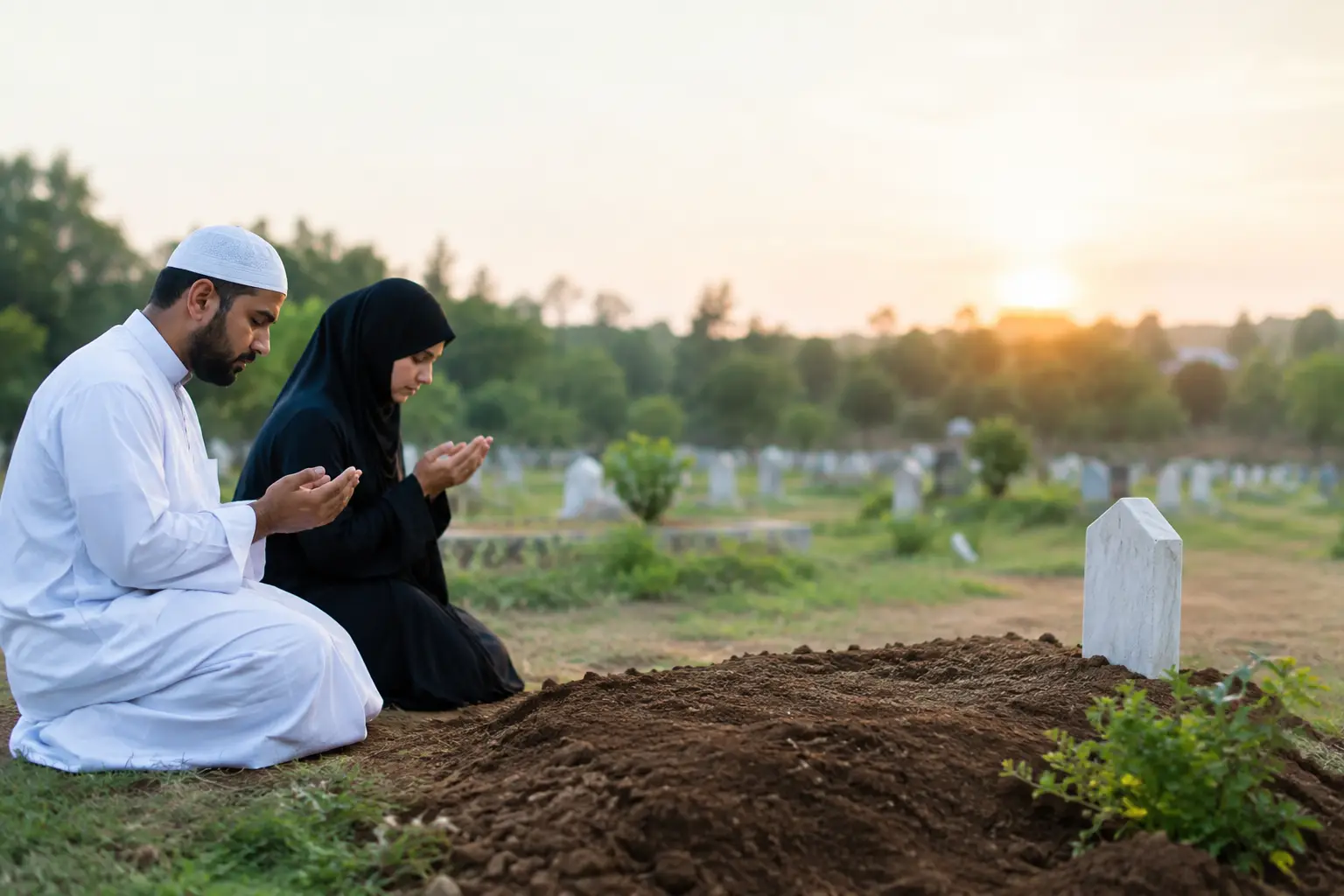
Following the funeral prayer, the deceased is taken to the cemetery for burial. Traditionally, the body is placed in the grave on its right side facing the qiblah. Family members may help place soil into the grave, and prayers or Quranic recitations may be offered.
Muslim burial traditionally takes place in the ground. Cremation is not accepted in mainstream Islamic teaching, and many observant families will seek burial even when other options are less expensive or more readily available. If cost is a concern, ask about simple burial choices, cemetery pricing, and assistance that may be available through a mosque or community organization. Clear information can help a family make decisions without adding unnecessary distress.
Grave markers are often simple. Some families choose a modest stone with the person's name and dates, while others follow stricter customs regarding decoration. A cemetery with a Muslim section may be able to accommodate directional and burial practices more easily, but families should confirm the cemetery's rules before finalizing plans.
Mourning, condolences, and family gatherings
Mourning customs are personal as well as religious. Many families receive visitors at home, at a mosque, or at another gathering place in the days after the burial. Visitors may bring food, offer prayers, share memories, or simply sit quietly with the family. Practical support often matters most: meals, transportation, child care, and help with calls or paperwork can ease the immediate burden.
In many traditions, condolences are received for three days, though grieving does not follow a timetable. A widow may observe a longer waiting period known as iddah, commonly four lunar months and ten days, with particular religious guidelines. Families should consult an imam for guidance that fits their circumstances.
Expressions of sympathy should be sincere and uncomplicated. Saying that you are sorry for the loss, offering a prayer for the deceased, or asking how you can help is appropriate. Avoid pressing grieving relatives to make conversation, explain decisions, or host guests when they need rest.
Planning with a funeral home while honoring faith
A funeral home supporting a Muslim family should listen before making assumptions. The care team needs to know whether the family has an imam or mosque coordinating the rites, who will conduct the washing, whether a casket is needed, the preferred cemetery, and how quickly burial needs to occur.
For families in Brooklyn and the greater New York area, logistics can be the hardest part of a prompt burial. Death certificates, permits, hospital release procedures, cemetery scheduling, and traffic can all affect timing. When a loved one must be transported to another state or overseas, planning may take longer and may involve legal documentation or airline requirements. In these circumstances, early communication among the family, mosque, funeral home, cemetery, and receiving location helps prevent avoidable delays.
It is also reasonable to ask direct questions about costs. Families can request an itemized explanation of transportation, preparation, casket or shroud-related needs, cemetery charges, permits, and international shipping if applicable. A respectful provider will explain what is required, what is optional, and what can be simplified.
A few decisions to discuss in advance
Preplanning cannot remove grief, but it can spare relatives from uncertainty. A Muslim adult may choose to record the mosque or imam they wish to contact, their preferred cemetery, whether they want a simple burial, and who should make decisions if they cannot speak for themselves. It can also help to discuss whether family members abroad should be notified before burial and how the family wants to handle travel constraints.
These conversations do not need to be formal or uncomfortable. They can begin with one simple question: if something happened, who should we call first? Knowing the answer gives loved ones a steadier place to begin when they need it most.