
If you’re wondering how to transport cremated remains on an airplane, plan for three separate requirements: airport security screening, the airline’s baggage rules, and any requirements at your destination. Meeting one doesn’t automatically satisfy the others, so check each part of your route before you travel.
It’s understandable to worry that an urn might be turned away or that you’ll arrive without the right documents. TSA allows cremated remains in carry-on or checked baggage, but the container must be able to pass through an X-ray machine. Officers can’t open it for inspection, so choosing a scannable container matters. Carry-on is generally recommended to reduce the risk of loss or damage, though airline rules vary.
This guide explains how to prepare a container for screening, what to review with your airline, and which documents or destination rules may apply, especially for international travel. You’ll also learn when coordinated transportation may be worth considering. Horizon Funeral Home coordinates worldwide transportation logistics, giving families another option alongside personal travel.
Key Takeaways
- To understand how to transport cremated remains on an airplane, plan separately for security screening, airline acceptance, and destination requirements.
- Choose a container that can pass through an X-ray machine, and compare carry-on and checked-baggage options with your airline’s current rules.
- Review requirements for every carrier and destination before departure, then organize the documents that apply to your route.
- Leave extra time on airport day and keep important records easy to reach at check-in and security.
- Consider whether personal travel or professional transportation coordination better fits your route and family’s circumstances.
Table of Contents
- How to transport cremated remains on an airplane: understand the rules first
- Choose a container and baggage plan that supports airport screening
- Prepare documents and confirm requirements before departure
- Use this airport-day checklist for a calmer journey
- When professional coordination may ease the journey
How to transport cremated remains on an airplane: understand the rules first
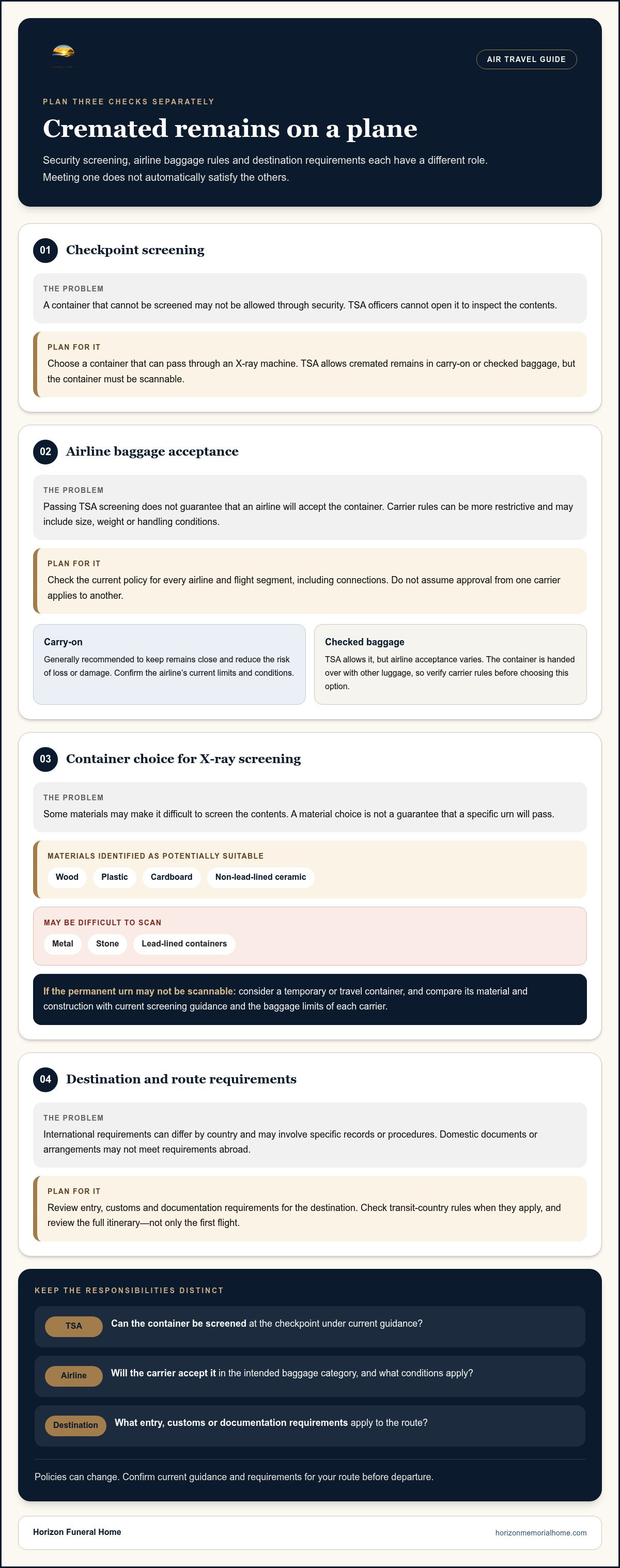
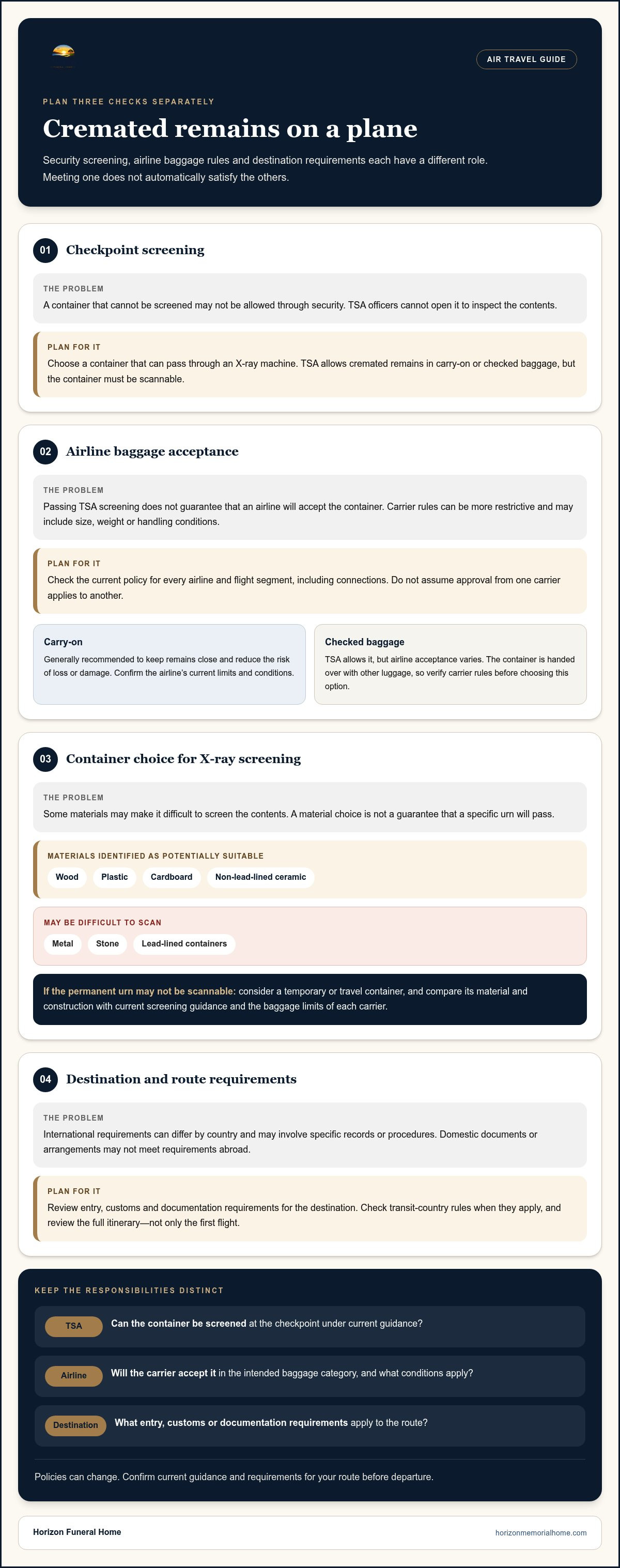
Careful planning can make a sensitive journey feel more manageable. To understand how to transport cremated remains on an airplane, separate the requirements into three parts: TSA screening at the security checkpoint, the airline’s rules for accepting remains as baggage, and any entry requirements at your destination. Each addresses a different part of the trip, and approval under one set of rules doesn’t settle the others.
Cremation and the care of remains have varied cultural and historical contexts; the overview of cremation practices and history offers broader background. For travel, focus on the current requirements for your route. TSA guidance and airline policies can change, and a carrier may have rules that differ from checkpoint screening. Check current information rather than relying on an older online post or another traveler’s experience.
What TSA screening means for cremated remains
Before an item passes through a security checkpoint, it must be screened. TSA guidance allows cremated remains in carry-on or checked baggage, but a container brought through the checkpoint must be scannable by X-ray. TSA officers won’t open the container to inspect its contents, even if you offer. If it can’t be screened, it may not be allowed through security, making container choice an important part of your plan.
Why airline and destination rules need separate checks
Passing TSA screening doesn’t guarantee that an airline will accept a container as carry-on or checked baggage. Each carrier sets its own conditions, which may be more restrictive than screening rules. International travel adds another layer: requirements can differ by country and may involve specific records or procedures. Don’t assume that documents or arrangements accepted for a domestic flight will meet requirements abroad.
Review the full itinerary, not just the first flight. If your booking includes a connection or more than one airline, check the rules for every carrier handling your trip. A container permitted by one airline may not meet another carrier’s baggage conditions. For international journeys, consider destination requirements as well as any transit-country rules that apply to your route.
Keep the responsibilities clear by checking each one separately:
- TSA: Can the container be screened at the checkpoint under current guidance?
- Airline: Will the carrier accept it in your intended baggage category, and does it have size or handling conditions?
- Destination: What entry, customs, or documentation requirements apply to the journey?
In short, airport security screening determines whether an item can pass the checkpoint; the airline separately decides whether it will accept that item as baggage. If the trip crosses a border, destination requirements are a third check. Horizon Funeral Home coordinates worldwide transportation logistics, which can help families consider professional coordination alongside personal travel. For broader international planning, see international funeral transportation guidance.
Choose a container and baggage plan that supports airport screening
The container and baggage choice need to work together. An urn may have personal or ceremonial significance, but its material and construction affect whether it can be screened. Your baggage plan also needs to fit the operating airline’s rules, including any size, weight, or handling conditions. When deciding how to transport cremated remains on an airplane, look for an option that respects the remains and suits the itinerary without assuming every carrier follows the same policy.
How to think about carry-on versus checked baggage
Carrying remains in the cabin keeps them close and reduces exposure to baggage handling, loss, or damage. Checked baggage may be an option on some itineraries, but acceptance depends on the carrier’s rules and involves handing the container over with other luggage. Neither option is universally permitted by every airline, so review the current policy for each operating carrier and flight segment.
Before choosing, check the airline’s carry-on dimensions and weight limits, along with any specific handling requirements for cremated remains. If your trip includes a connection or a change of airline, don’t assume approval from one carrier applies to the next. A plan that meets the first flight’s rules may need adjustment for a later segment.
What to consider when selecting an urn or temporary container
Screening depends in part on whether X-rays can show the contents through the container. TSA guidance identifies wood, plastic, cardboard, and non-lead-lined ceramic as materials that may be suitable for screening. Metal, stone, and lead-lined containers may be difficult to scan. These are considerations, not guarantees that a specific urn will pass. Review the current TSA guidelines for cremated remains before departure.
If your chosen urn may not be scannable, consider a temporary or travel container. You can preserve the permanent urn for its intended use while choosing a container better suited to screening and the airline’s baggage limits. Compare the container’s material and construction with the rules for every carrier on your itinerary.
Use these checks to bring the decisions together:
- Measure the container and compare it with the airline’s current baggage limits.
- Review the policies of every carrier, including those operating connecting flights.
- Consider whether a different container would better suit screening and travel.
A container must meet applicable screening requirements and the carrier’s baggage rules to travel. If managing the route and logistics feels like too much alongside everything else, Horizon Funeral Home coordinates worldwide transportation as part of its funeral services. Learn about worldwide transportation coordination as you consider what best fits your family.
Prepare documents and confirm requirements before departure
Requirements may come from several places, and the documents needed for one journey may not be right for another. A practical way to plan how to transport cremated remains on an airplane is to work through the requirements in order: identify every airline, review each carrier’s policy, confirm destination rules, and then gather the records that apply to your route.
Confirm the rules for every airline and connection
Start with the airline operating each flight, including connections and codeshare segments. The company that sold your ticket may not be the carrier handling a particular leg. Review the operating airline’s current policy for acceptance, baggage dimensions, and any advance-notice instructions. Keep the policy details and relevant carrier contact information with your travel notes so they’re easy to find if plans change.
- List every flight segment. Note the operating airline for each leg, including connections and codeshare flights.
- Review each carrier’s current policy. Check whether remains are accepted in your intended baggage category, along with size limits and any notice requirements.
- Confirm destination requirements. For international travel, consult current guidance from relevant authorities, an embassy, or a consulate.
- Organize relevant records. Gather the documents required by your airline and destination, and keep them accessible during travel.
For domestic trips, TSA screening focuses on whether the container can be screened. Airlines may set separate acceptance rules. Copies of the death certificate and cremation certificate are commonly recommended for travel, but they aren’t a universal checklist. Confirm which records apply to your specific airline and itinerary before departure.
Plan for international entry requirements
International requirements differ by destination and route. Authorities may request particular documents or arrangements, and transit points can add requirements to resolve. Check current guidance from the destination country’s official sources or consular office rather than assuming documents used for a domestic flight will be sufficient. Find out which records are needed, whether translations or authentication are required, and whether any steps must be completed before travel.
Keep your paperwork together in a folder or another secure, easy-to-reach place. Depending on the route, relevant records may include a death certificate, cremation certificate, or additional documents specified by the destination. Carry copies if appropriate, while following the destination’s instructions about originals, translations, and authentication. Requirements can change, so verify them close to your travel date and keep a note of the guidance you relied on.
If you’re arranging cremation as well as travel, understanding the arrangements can help you identify which records to request and keep. Horizon’s Brooklyn cremation services guidance offers context for families considering those arrangements. Treat carrier rules, destination requirements, and records as separate steps, then share the plan with anyone helping you prepare.
Use this airport-day checklist for a calmer journey
Departure day can feel tender and unfamiliar. A written plan gives you practical steps to return to, from home to the security checkpoint. If you’re flying from JFK, LaGuardia, or another airport serving the New York City area, check current airport guidance for travel-day information. Remember that your airline sets baggage policies and TSA conducts checkpoint screening.
Before leaving for JFK, LaGuardia, or another regional airport
Shortly before departure, review your itinerary and the current policy for each operating airline. A schedule change or a different carrier on a connection can affect your plan. Keep relevant documents and written carrier correspondence together in an easy-to-reach place, rather than beneath other belongings. Allow extra time for check-in and security. Processing times vary, so avoid relying on a set estimate.
Use this sequence as you prepare to leave:
- Confirm the flight details and operating airline for every segment.
- Check for schedule or gate updates and review any airport-specific travel notices.
- Make sure the container and baggage plan still match the carrier’s current instructions.
- Keep relevant records and policy notes accessible, and leave time for check-in and screening.
At check-in and the security checkpoint
At check-in, follow the airline’s instructions and explain calmly that you’re traveling with cremated remains if staff need clarification. Keep the container accessible as directed, and have relevant records ready without presenting documents that haven’t been requested. Screening takes place at the checkpoint, and its outcome can’t be guaranteed in advance. If a concern comes up, ask staff respectfully to explain the available next steps.
Check-in staff can address the airline’s baggage requirements; TSA officers handle screening at the security checkpoint. If the container raises a screening issue, ask checkpoint staff what options are available rather than trying to open or alter it yourself. Keeping your records and airline notes within reach can make it easier to answer questions clearly.
A prepared plan may still need to adapt to airport or carrier instructions on the day. If personal air travel feels difficult to coordinate alongside family responsibilities, professional transportation coordination is another option. Horizon Funeral Home coordinates worldwide transportation logistics as part of its funeral services. Read about Horizon’s transportation coordination as you consider arrangements for your journey.
When professional coordination may ease the journey
There isn’t one right way for every family to bring cremated remains to their destination. Some people feel most at ease accompanying their loved one, while others prefer to entrust travel logistics to a funeral professional. As you consider how to transport cremated remains on an airplane, weigh the route’s practical demands alongside your family’s wishes and what feels manageable during a difficult time.
Deciding whether to travel with the remains
Personal travel may suit a straightforward itinerary and a family member who wants to remain physically close to the remains throughout the journey. Professional coordination may be worth considering if the route involves multiple carriers, international requirements, or arrangements that feel difficult to manage alongside other responsibilities. Neither choice is inherently better; the right approach depends on the circumstances and the wishes of those involved.
It can help to talk through a few questions together before deciding:
- Does the itinerary involve connections, more than one airline, or travel across borders?
- Would a family member feel comfortable handling check-in, screening, and any questions during the journey?
- Are family timing, health, mobility, or other responsibilities shaping who can travel?
- Do cultural practices or the person’s expressed wishes guide how the remains should be accompanied?
These considerations may point in different directions. A family may value accompanying the remains but find the route demanding; another may prefer personal travel even when coordination is manageable. Take time to hear each other’s concerns. The decision can honor both practical needs and the meaning the journey holds for your family.
How Horizon can support transportation planning
Horizon Funeral Home coordinates worldwide transportation logistics for families. Professional coordination can bring the moving parts of a complex transfer or international arrangement into one planned process, while allowing family members to focus on their own responsibilities and choices. Planning needs depend on the journey, so the route, destination, and what matters most to your family are useful starting points.
Choosing coordination doesn’t diminish the care behind the journey. It’s one way to manage logistics when traveling personally feels difficult or family circumstances call for another arrangement. There isn’t a single answer for every family. Horizon Funeral Home offers funeral direction, cremation, and transportation coordination as families consider the arrangements that fit their needs.
For help considering next steps, contact Horizon Funeral Home for guidance.
Choose the support that feels right for your family
There’s no single arrangement that suits every journey. As you decide how to transport cremated remains on an airplane, give yourself room to consider both the practical details and what would feel most meaningful to your family. A conversation about your route, timing, and wishes can be a useful next step, even if you don’t have every answer yet.
Horizon Funeral Home provides professional funeral direction and cremation services to families across Brooklyn, Queens, Staten Island, Manhattan, the Bronx, and Nassau County, and coordinates worldwide transportation logistics. Whether you’re weighing personal travel or professional coordination, thoughtful guidance can help you consider the arrangements with greater clarity.
Discuss transportation coordination with Horizon Funeral Home. Take one decision at a time, with care for your loved one and your family guiding the way.
Frequently Asked Questions
Do cremated remains count as a carry-on bag?
Whether a container counts toward your carry-on allowance depends on the airline’s baggage policy. Even if the carrier accepts remains in the cabin, its size and weight rules may affect whether it can travel alongside another bag. Before packing, check how the airline classifies the container and what cabin baggage you’re allowed to bring. If more than one airline operates your itinerary, confirm the allowance for each flight.
Can I bring only a small portion of cremated remains on a flight?
You may be able to travel with a portion, but arrangements for preparing and securely containing it should be handled carefully. The container still needs to meet applicable screening and airline rules, regardless of how much it holds. If the journey is international, check whether destination authorities have requirements relevant to a portion of remains. Avoid dividing them yourself if you’re unsure how to do so respectfully or safely.
Do I need to tell airport security that I am carrying cremated remains?
Follow checkpoint staff instructions, and answer clearly if an officer asks about the container. You can calmly explain its contents if that helps clarify why it needs careful handling, but disclosure doesn’t replace screening or guarantee passage through the checkpoint. TSA officers cannot open a container of cremated remains for inspection. If you have a concern, ask staff what steps are available and follow their directions.
Can I take cremated remains on a connecting flight?
Check whether every airline on the itinerary accepts the container and whether it can be screened at the airports along your route. Review each operating carrier, including a different airline assigned after a schedule change. For international connections, consider whether you’ll remain in transit or enter another country, and consult current official guidance for the route. Keep your flight details and relevant records together in case staff ask questions.
Can cremated remains be shipped instead of carried on a plane?
Professional transportation may be an alternative to accompanying the remains personally. Available arrangements and documentation depend on the route, especially for international journeys, so don’t assume ordinary parcel shipping rules apply. A funeral home can coordinate transportation logistics and help manage transfer requirements. Horizon Funeral Home supports families with worldwide transportation coordination, including families arranging services from Brooklyn, Queens, Staten Island, Manhattan, the Bronx, and Nassau County.
What if my flight is delayed or I am rebooked?
If your flight changes, speak with airline staff before accepting a new itinerary, particularly if another carrier will operate the replacement flight. Explain that you’re traveling with cremated remains and ask whether the new carrier and route can accommodate the container. Keep it and relevant records accessible while receiving instructions. For an international rebooking, check whether the new route changes transit or destination requirements before continuing.