
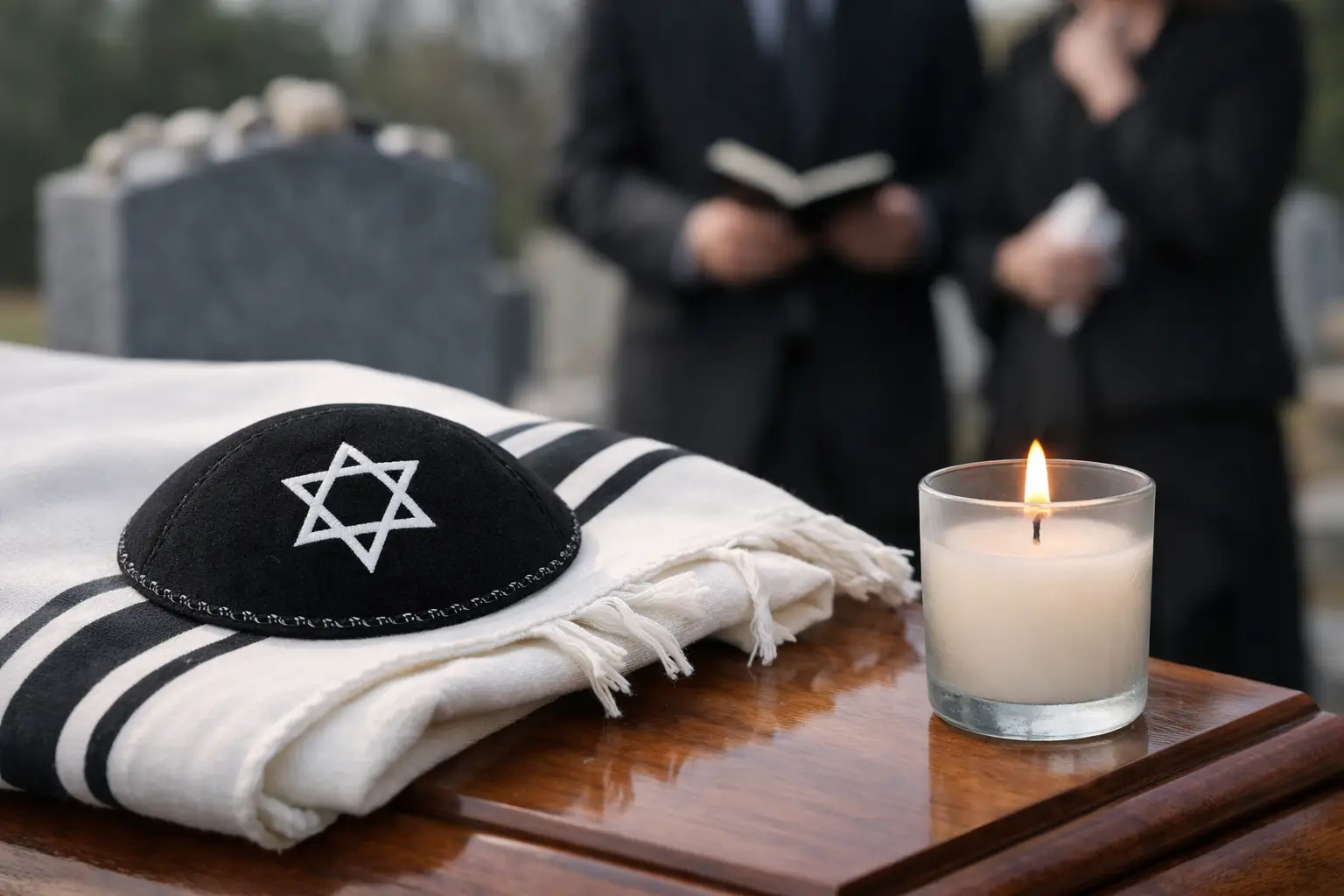
When a Jewish family experiences a death, the first concern is often not ceremony but time. Many Jewish funeral customs place great value on caring for the deceased promptly, with dignity and without unnecessary delay. This guide to Jewish funeral customs explains the practices a family may encounter, the choices that can vary by community, and the practical support that can make a difficult day feel more manageable.
No two Jewish families observe every custom in the same way. Orthodox, Conservative, Reform, Reconstructionist, secular, and interfaith families may have different expectations. A rabbi, synagogue, or trusted religious adviser can help clarify what is meaningful and appropriate for your loved one.
The First Hours After a Death
In many Jewish traditions, burial takes place as soon as reasonably possible, often within one or two days. This practice reflects the belief that the deceased should be returned to the earth with respect. Still, timing can depend on medical examiner requirements, travel for close relatives, holidays, cemetery availability, and the family's circumstances.
The period between death and burial is sometimes called aninut. Immediate family members may be focused on practical arrangements rather than ordinary responsibilities. Friends and relatives can be especially helpful at this time by making calls, bringing food, arranging childcare, or simply being present without asking the family to host or respond.
A funeral director experienced in Jewish arrangements can coordinate with the family, rabbi, cemetery, and chevra kadisha, the Jewish burial society that may prepare the person who died for burial. In Brooklyn and throughout New York City, this coordination may also involve transportation, permits, and tight cemetery schedules.
Taharah and Respectful Preparation
Traditional Jewish preparation for burial is known as taharah. Members of the chevra kadisha carefully wash and prepare the deceased while offering prayers. The person is generally dressed in simple white burial garments called tachrichim. The simplicity is intentional: it expresses the idea that every person is equal in death, regardless of wealth or status.
In many traditional communities, embalming and cosmetic preparation are not customary unless required by law or necessary for transportation. An open casket is also generally not part of a traditional Jewish funeral. These practices are not universal, however. Families who are less observant or who are balancing multiple cultural traditions may make different choices.
A Guide to Jewish Funeral Customs at the Service
Jewish funeral services are usually direct, prayerful, and centered on honoring the life of the person who died. They may take place at a funeral home, synagogue, graveside, or a combination of locations. The service is often led by a rabbi or cantor, though the family may invite relatives and friends to speak.
A eulogy, called a hesped, remembers the person's character, relationships, values, and the impact they had on others. The most meaningful eulogies are specific. A story about generosity, humor, devotion to family, or quiet perseverance can say more than a long list of accomplishments.
Psalms, traditional prayers, and readings may be included. The Mourner's Kaddish is among the best-known Jewish prayers associated with mourning. Despite its association with loss, it is a prayer that affirms God's greatness and life, rather than a prayer focused directly on death.
Family members and guests should usually dress conservatively. Men may be offered a kippah, or head covering, to wear. At some services, women may choose modest clothing or a head covering based on family or synagogue custom. If you are unsure, it is completely appropriate to ask the family, clergy, or funeral director what is expected.
Burial and the Act of Participation
At the cemetery, the casket is lowered into the grave and attendees may be invited to place earth onto it. This can be an emotional moment, but it is also a final act of care. In some communities, mourners use the back of a shovel rather than passing it hand to hand, reflecting the reluctance to make death seem routine. Other families may simply offer each guest a shovel or invite them forward in their own time.
A small stone may later be placed on the grave when visiting. Unlike flowers, which fade quickly, stones can symbolize enduring remembrance. Flowers are not traditionally emphasized in many Jewish funeral settings, though a family may welcome them, especially in Reform, secular, or interfaith households. When in doubt, a contribution to a charity meaningful to the deceased may be more in keeping with the family's wishes.
Burial, Cremation, and Family Decisions
Traditional Jewish law generally favors burial and prohibits cremation. For many observant families, this is a clear religious requirement. Yet Jewish families are diverse, and some choose cremation for personal, financial, environmental, or family reasons.
If cremation is being considered, it helps to speak openly with the rabbi early in the process. Some clergy may not officiate at a service involving cremation, while others will work with the family to create a respectful memorial. Cemetery rules also vary regarding the burial or placement of cremated remains. Clear answers before arrangements are finalized can prevent added stress later.
Cost can be a real concern, particularly when a death is unexpected. Respectful Jewish arrangements do not need to be elaborate to be meaningful. A simple casket, a modest service, and a graveside gathering can honor both tradition and a family's budget. Families deserve straightforward explanations of the available options without pressure.
Shiva and the Days of Mourning
After burial, immediate mourners may observe shiva, a seven-day period of mourning. The word shiva means seven. Traditionally, mourners remain at home, receive visitors, and step back from work, entertainment, and everyday routines to make room for grief and remembrance.
A shiva home may include a photograph of the deceased, candles, prayer books, and food brought by friends and relatives. Visitors often come during specified hours. The best approach is usually simple: enter quietly, offer a brief expression of sympathy, and let the mourner set the tone. You do not need to fill silence with advice or explanations. Being there matters.
Customs during shiva can include sitting on low chairs, covering mirrors, and holding prayer services at home. Some families observe every element, while others gather for only a few evenings or hold a single memorial gathering. A family may also choose a virtual gathering when relatives live far away or cannot travel.
Following shiva, some mourners observe sheloshim, a thirty-day mourning period. For a parent, traditional mourning practices may continue for eleven months, including the recitation of Kaddish. A yahrzeit, the anniversary of the death on the Hebrew calendar, is often observed each year by lighting a memorial candle, attending services, giving charity, or visiting the grave.
How Friends Can Offer Meaningful Support
Grief can make ordinary tasks feel heavy. Practical help is often more comforting than asking a mourner to tell you what they need. You might bring a meal that follows the household's dietary practices, coordinate a meal schedule with relatives, run an errand, or offer transportation for an older family member.
Avoid assuming that all Jewish families observe the same customs. Instead, use gentle language: “I am thinking of you,” “May their memory be a blessing,” or “I am here if you need practical help.” If you attend shiva, follow the visiting hours and any guidance from the family. A short visit can be entirely appropriate.
When You Need Help With Arrangements
The most useful first step is often a call to a funeral professional who will listen before making assumptions. Share whether the family has a rabbi, a synagogue affiliation, cemetery plans, travel needs, or specific traditions to observe. If a loved one died away from home, transportation and timing may require additional coordination.
At Horizon Funeral Home, families can receive calm, clear assistance with Jewish funeral arrangements, local or long-distance transportation, and the details that must be handled quickly after a death. You do not have to know every custom before reaching out. What matters is creating a service that reflects your loved one's faith, your family's values, and the care you want to show in their memory.