What should your family do first when grief arrives alongside a long list of unfamiliar decisions? A funeral planning checklist for families can make the next steps easier to see, from contacting a funeral home to gathering preferences and deciding who will share updates.
You don’t have to settle every detail at once. Start with what needs attention now, then make the remaining choices as your family is ready. A clear list can help relatives share responsibilities, talk through different wishes, and make room for traditions that matter.
This guide covers what to do first and what can wait, including gathering key information, choosing burial or cremation, and planning a service or memorial. It also explains how to organize local arrangements and what to consider when transportation is more complex. Horizon Funeral Home supports families in Brooklyn, Queens, Staten Island, Manhattan, the Bronx, and Nassau County with personalized arrangements, care in English, Russian, Armenian, Georgian, and Spanish, and respect for all faiths and traditions.
Key Takeaways
- Use a funeral planning checklist for families to focus on immediate arrangements first and leave less urgent decisions for later.
- Gather the wishes, personal details, family contacts, and service preferences relevant to the arrangements you’re discussing.
- Compare burial, cremation, and memorial options by considering your loved one’s wishes and what feels meaningful to your family.
- Organize local arrangements around timing, location, transportation, participants, and clear communication among relatives.
- An arrangement conference can bring service choices, merchandise, transportation, and possible outside-provider charges into one family-centered discussion.
Table of Contents
- Funeral Planning Checklist: What to Do First After a Loss
- Gather the Information Your Family Needs for Funeral Arrangements
- Choose Burial, Cremation, and a Service That Reflects Your Loved One
- Coordinate the Funeral Details and Local Arrangements in New York
- How Horizon Funeral Home Supports Families Through Each Step
Funeral Planning Checklist: What to Do First After a Loss
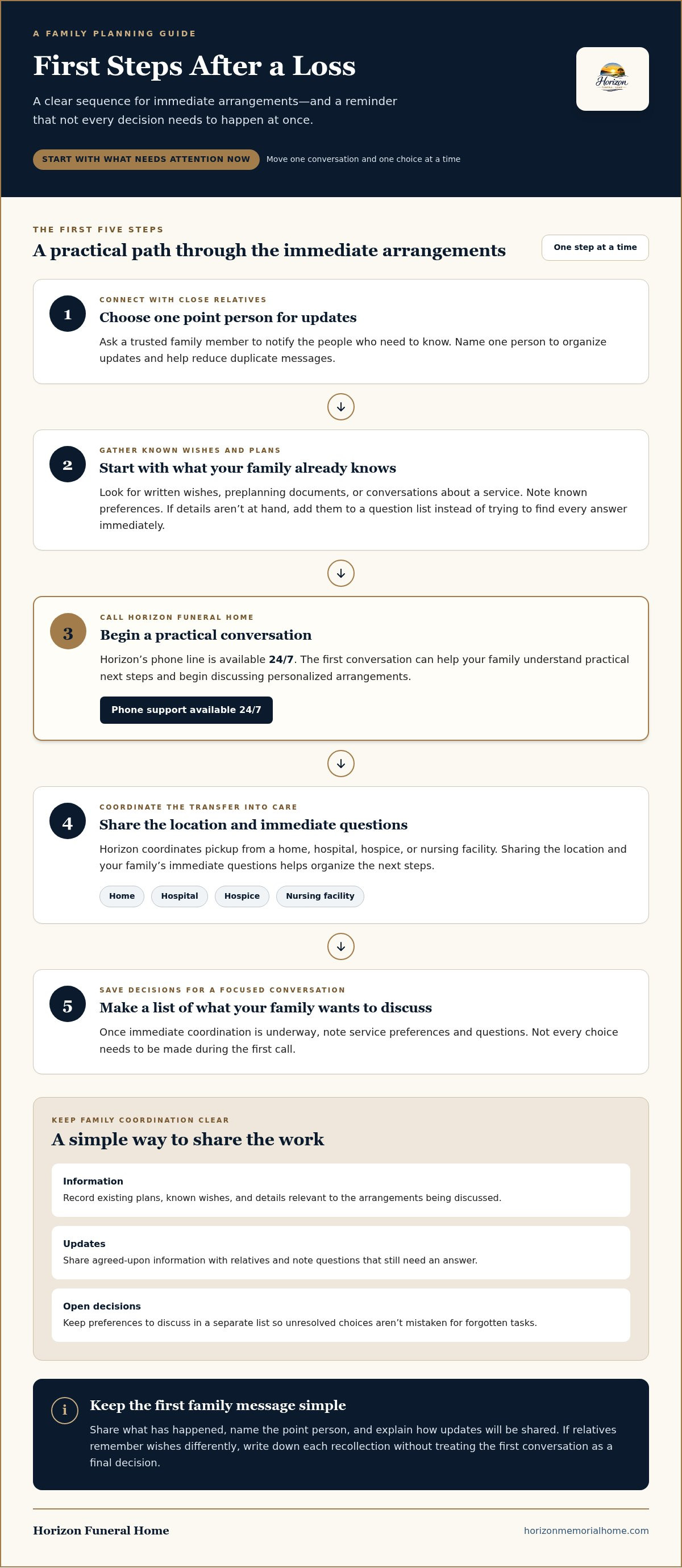
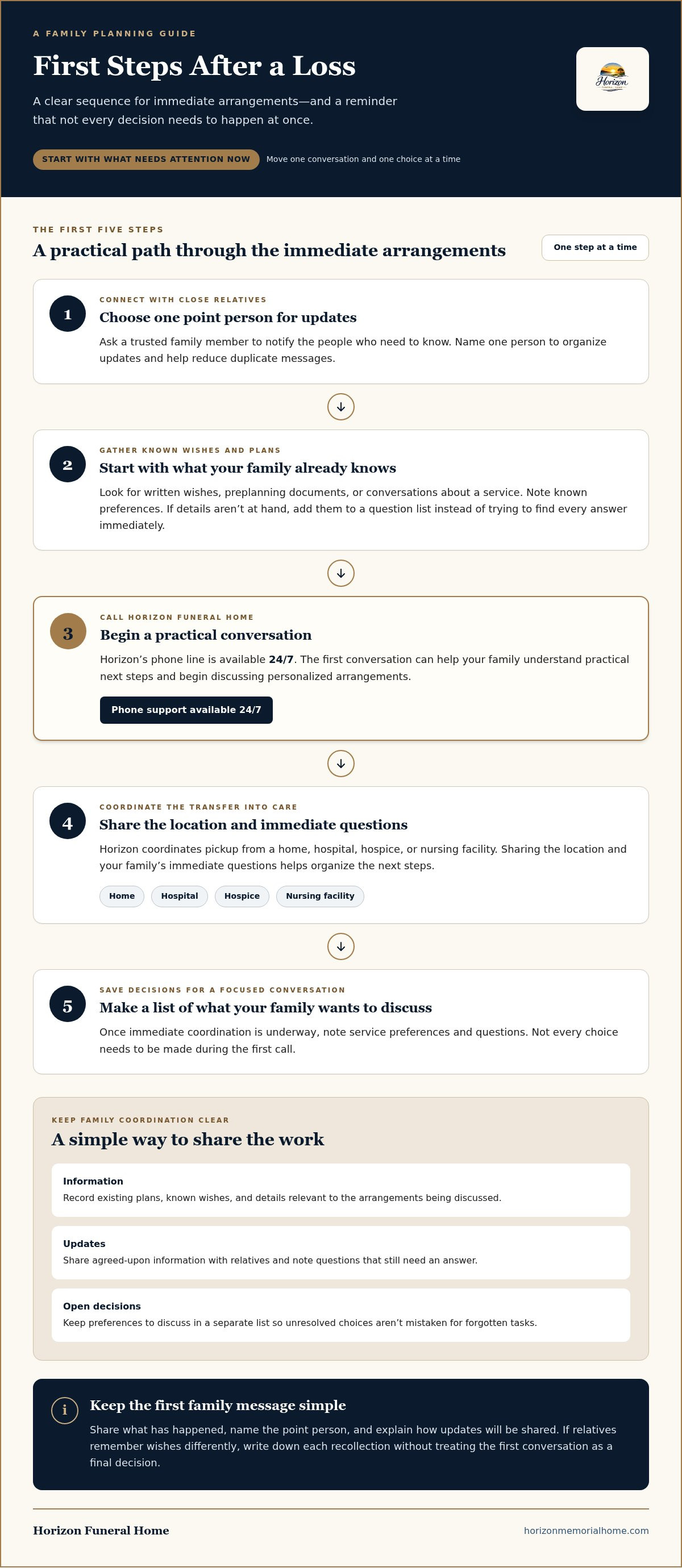
You don’t have to make every funeral decision in one sitting. Take the process one conversation and one choice at a time. A funeral planning checklist for families is most useful when it separates immediate steps from decisions that can wait until relatives have had time to talk and gather their thoughts.
Begin with information your family already has, such as written wishes, preplanning documents, or conversations your loved one had about a service. Then identify a relative who can help coordinate. You’re creating a starting point, not settling every preference or resolving every difference today.
- Connect with close relatives. Ask a trusted family member to notify the people who need to know. Choose one point person to organize updates and reduce duplicate messages.
- Gather known wishes and plans. Note any preferences or arrangements your loved one shared. If you don’t have the information at hand, add it to a question list instead of trying to find every answer immediately.
- Call Horizon Funeral Home. Horizon’s phone line is available 24/7. The first conversation can help your family understand practical next steps and begin discussing personalized arrangements.
- Coordinate the transfer into care. Horizon coordinates pickup from a home, hospital, hospice, or nursing facility. Share the location and your family’s immediate questions so the next steps can be organized.
- Save decisions for a focused conversation. Once immediate coordination is underway, list the service preferences and questions your family wants to discuss. Not every choice needs to be made during the first call.
The first conversations and practical steps
When you notify relatives, keep the first message simple: share what has happened, name the point person, and explain how updates will be shared. This helps prevent several relatives from trying to coordinate the same details. If family members remember your loved one’s wishes differently, write down each recollection without treating the first conversation as a final decision.
Traditions can guide what your family wants to discuss. If it would help to understand the range of customs and beliefs families may bring to these conversations, this overview of Funeral customs and practices offers broad cultural context. Your loved one’s wishes and your family’s traditions remain central.
Make a simple family task list
Share the work in small, clear ways. One relative can gather relevant information and known preferences; another can send updates. Someone else can keep the running notes. Choose roles that feel manageable, and adjust them as your family’s needs become clearer.
- Information: Record existing plans, known wishes, and details relevant to the arrangements being discussed.
- Updates: Share agreed-upon information with relatives and note questions that still need an answer.
- Open decisions: Keep a separate list of preferences to discuss, so unresolved choices don’t get mistaken for forgotten tasks.
Horizon provides care in English, Russian, Armenian, Georgian, and Spanish. Using the language that helps relatives express themselves comfortably can make it easier for everyone to be heard. Keep the list close, take a breath, and move forward one step at a time.
Gather the Information Your Family Needs for Funeral Arrangements
Once immediate arrangements are underway, collecting a few relevant details can make family conversations clearer. You don’t need to assemble a complete life history or find every document before discussing the service. Use this part of your funeral planning checklist for families to capture information that helps with the choices in front of you, and leave unrelated questions for another time.
Keep notes in one shared place, such as a document or notebook the relatives involved can access. Organize it by topic and label items as known, still to discuss, or not needed right now. A single record helps prevent repeated conversations and makes it easier to notice when family members remember a preference differently.
- Wishes and existing plans: Note known preferences about burial, cremation, a service, or a memorial. Record where any existing funeral plan or written instructions are kept, if the family knows.
- Personal details: Gather meaningful details that may help shape an obituary or tribute, such as a preferred name, important roles, interests, and relationships. Collect what’s relevant to the arrangements being discussed.
- Family contacts: List relatives and others the family wants to notify, along with the best way to reach them. Mark who has already been contacted to avoid duplicate or missed updates.
- Service preferences: Add photographs, music ideas, readings, or cultural and faith traditions the family may want to include. Treat these as suggestions until the family makes decisions.
- Military service: If veteran honors may be requested, note the person’s military service and gather information available to the family. Honors must be requested, and eligibility is determined by the appropriate military branch or government agency.
Keep the list focused. If the family is discussing a memorial, photographs and possible readings may be useful now, while other personal records may not be. The goal is to support a thoughtful conversation, not create another demanding task.
Sharing the work can make gathering information more manageable. A relative with time might look for photographs, while someone who knows the person’s community can help identify people to notify. Relatives can contribute in the language they’re most comfortable using. One person can keep the notes together, with the role adjusted if circumstances change.
Some preferences may take more than one conversation to understand. Mark them as undecided, note what the family still wants to discuss, and return to them when everyone has had time to reflect. If you’d like help organizing these details into personalized arrangements, Horizon Funeral Home can guide your family through the planning conversation.
Choose Burial, Cremation, and a Service That Reflects Your Loved One
Disposition and the way people gather are connected, but they’re separate choices. Burial or cremation can each be accompanied by a meaningful service. Families can shape the gathering around a loved one’s wishes, faith, culture, and the needs of relatives who’ll attend. There isn’t one right format for every family.
Compare disposition and gathering choices
Use this comparison as a starting point for conversation, not a ranking. The right fit depends on what matters most to your family and what your loved one expressed.
| Choice | Possible gathering | Consider |
|---|---|---|
| Burial | Traditional service, one-day gathering, or graveside service | Whether a formal ceremony, religious customs, or time at the graveside feels meaningful |
| Cremation | A gathering before cremation, or a memorial afterward | Whether relatives prefer to come together before or after cremation |
| Memorial | A service or celebration of life, with or without a traditional format | How the gathering can reflect the person and accommodate those attending |
A funeral-then-cremation plan is another possibility: the family can hold a funeral service before cremation. Some families prefer a traditional gathering; others choose a simpler one-day service or a graveside gathering. If you’re considering a traditional format, this guide to traditional funeral arrangements offers a closer look. Families weighing cremation can also explore this Brooklyn cremation services guide.
Embalming isn’t automatically required for every arrangement; whether it’s needed depends on the plan. As you discuss options, focus on the specific service and disposition choices your family is considering rather than assuming one process applies to all.
Make the service personal and culturally respectful
Small details can help a gathering feel true to the person being remembered. Your family might choose music, readings, photographs, a video tribute, or keepsakes. You can include familiar traditions or coordinate with clergy or a celebrant if you’d like their participation. Gather ideas first and decide together later.
For families with different languages, faiths, or cultural practices, invite each person to share what feels important and explain any tradition others may not know. A funeral planning checklist for families can keep those preferences visible without treating one relative’s perspective as the only one that matters. Horizon Funeral Home serves families in English, Russian, Armenian, Georgian, and Spanish, and respects all faiths and traditions.
As you compare choices, consider what would help people gather with care: a familiar ritual, a quiet moment for remembrance, or an opportunity to share stories. A flexible plan can honor your loved one while making space for relatives’ different needs.
Coordinate the Funeral Details and Local Arrangements in New York
Once your family has chosen a service format, a simple coordination plan can keep the details from becoming one long, confusing list. Families arranging services in Brooklyn, Queens, Staten Island, Manhattan, the Bronx, and Nassau County can track five areas: timing, location, participants, transportation, and communication. Some decisions depend on others, so note what’s settled and what still needs a family conversation.
A shared tracker helps relatives see who is handling each task and where a decision is needed. Keep it brief and update it as arrangements take shape:
- Task owner: The relative or coordinator responsible for the next step.
- Next step: The specific action, such as confirming a service location or sending an update.
- Family decision: Any preference relatives still need to discuss before the task moves forward.
Plan the ceremony and communicate with guests
Record the service time, location, and format, then coordinate participants and practical movement around the gathering. Note whether there will be a procession, who may need transportation, and whether guests should arrive at one location or meet at another. Horizon Funeral Home can coordinate transportation as part of personalized arrangements.
Keep notifications clear and consistent. A short message should give guests the time, place, and format, along with useful details about the gathering. If relatives can’t attend in person, consider online funeral viewing or livestreaming. Assign one person to share updates so changes to timing or location don’t travel through several versions of the same message.
Keep outside-provider details visible
Some parts of an arrangement involve providers beyond the funeral home. Keep those items visible in the tracker so your family can distinguish Horizon’s fees from charges that may be set separately by outside providers. Depending on the arrangements, separate charges may relate to a cemetery, crematory, clergy, permits, airline, consular process, or receiving provider. Which items apply depends on the choices and coordination involved.
For transportation beyond the local area, Horizon coordinates worldwide transportation subject to verification of documents, carrier availability, and receiving-provider requirements. Recording the destination, responsible contact, and pending details in the tracker can help relatives follow the coordination without having to reconstruct conversations.
If veteran honors are desired, add the request as its own task and identify who will follow up. Honors must be requested, and eligibility is determined by the appropriate military branch or government agency. Keeping this visible helps the family remember to raise the request while coordinating the service.
A funeral planning checklist for families works best as a working document, not a test of how much your family can manage at once. Review the tracker together, update the next step, and leave undecided choices marked for discussion. For help coordinating service details, transportation, and related arrangements, speak with Horizon Funeral Home about your family’s plans.
How Horizon Funeral Home Supports Families Through Each Step
A checklist can help organize decisions, but families don’t have to coordinate every detail alone. Horizon Funeral Home supports families as they consider service choices, gather relatives’ preferences, and work through practical arrangements. An arrangement conference can cover service choices, merchandise, transportation, and possible outside-provider charges, helping your family understand which decisions belong together and which costs may come from separate providers.
Support shaped around your family
Arrangements can reflect your loved one’s wishes and your family’s traditions. Options include a traditional service, a one-day or graveside gathering, a funeral followed by cremation, direct cremation, or a memorial. Horizon’s approach is flexible and family-centered, with respect for every faith, culture, and personal story.
Care is available in English, Russian, Armenian, Georgian, and Spanish. Relatives can share questions and preferences in the language that feels most comfortable, helping the planning conversation reflect more than one voice. If family members can’t attend in person, Horizon provides online funeral viewing and livestreaming. Families can personalize a service with music, readings, photographs, and tributes that carry particular meaning.
For a veteran’s service, honors must be requested, and eligibility is determined by the appropriate military branch or government agency. Families considering this option can use the veteran funeral honors guide to explore what to consider as part of planning.
A clear next step when you are ready
Horizon Funeral Home is based in Brooklyn and serves families across Brooklyn, Queens, Staten Island, Manhattan, the Bronx, and Nassau County. Call 347-588-5555, available 24/7, or begin arrangements using the online immediate-need prompts. You don’t need to have every preference settled before starting. Share what your family knows so far and use the conversation to identify the next decisions.
If arrangements involve transportation across borders, Horizon coordinates worldwide transportation subject to verification of documents, carrier availability, and receiving-provider requirements. The international funeral transportation guide can help families understand the coordination involved.
Your funeral planning checklist for families is there to support you, not add pressure. When you’re ready, call Horizon Funeral Home or begin arrangements online. A calm conversation can help turn the remaining questions into manageable next steps.
Take the Next Step at Your Family’s Pace
A plan doesn’t need to be perfect before it can help. Choose one unresolved decision that matters most, share it with the relatives involved, and let that conversation guide what comes next. Your funeral planning checklist for families is a tool to return to as new questions arise, not a deadline to complete everything at once.
If you’re ready to turn your family’s notes into a plan, Horizon Funeral Home can help you consider the next steps with care and respect for your loved one’s wishes. Call Horizon Funeral Home at 347-588-5555 or begin arrangements online.
Move forward one conversation at a time. Thoughtful choices can make room for both remembrance and the needs of those gathered around you.
Frequently Asked Questions
What should I do first when someone dies at home?
First, follow the instructions of the medical professional or hospice team involved. Then notify close family and contact a funeral home to discuss next steps and pickup. Horizon Funeral Home coordinates pickups from homes, hospitals, hospice, and nursing facilities, and its phone line is available 24/7. You don’t need to decide on a service format during that first call. Share what you know and note questions for later.
Is embalming always required when planning a funeral?
No. Whether embalming is appropriate depends on the family’s arrangements and circumstances. The chosen service, timing, and transportation can affect what preparation is needed, so don’t assume one rule applies to every plan. As you discuss arrangements, describe the service and timing your family is considering. Horizon can explain preparation needs in relation to those choices.
How much does funeral planning cost in New York City?
There’s no single amount that applies to every family. Costs vary based on the services, merchandise, transportation, disposition, and outside providers selected. Horizon provides current cost information directly after learning what your family needs. To keep the conversation clear, note which arrangements you’re considering and distinguish funeral-home fees from possible separate charges set by providers such as a cemetery, crematory, clergy, or airline.
Are veteran funeral honors provided automatically?
No. Veteran honors must be requested, and eligibility is determined by the appropriate military branch or government agency. If your loved one served, mention this during arrangements and share any military service information available to your family. You can also discuss whether a flag presentation or another veteran tribute would feel meaningful. Don’t assume eligibility or that honors have been arranged until the request and determination are addressed.
Can relatives attend a funeral online if they cannot travel?
Yes. Horizon offers online funeral viewing and livestreaming, allowing relatives who can’t travel to take part remotely. As you plan, identify which family members would benefit and share viewing access details with them. A livestream offers another way to join the remembrance, while your family chooses the ceremony format and personal elements that feel right for those attending in person.
Can Horizon arrange international transportation for a loved one?
Yes. Horizon coordinates worldwide transportation, including international transfers. Arrangements depend on the destination and require verification of documents, carrier availability, and receiving-provider requirements. If your family is considering transport across borders, gather the intended destination and the receiving provider’s details to help begin the coordination conversation. Airline, consular, and receiving-provider charges may be separate from Horizon’s fees.
Can a family arrange a funeral if relatives speak different languages?
Yes. Horizon provides care in English, Russian, Armenian, Georgian, and Spanish. Relatives can share their preferred language during the arrangement conversation, helping everyone express questions and wishes more comfortably. Horizon respects all faiths and traditions, so the family can discuss cultural practices and personal preferences without assuming there is one standard way to honor a loved one.