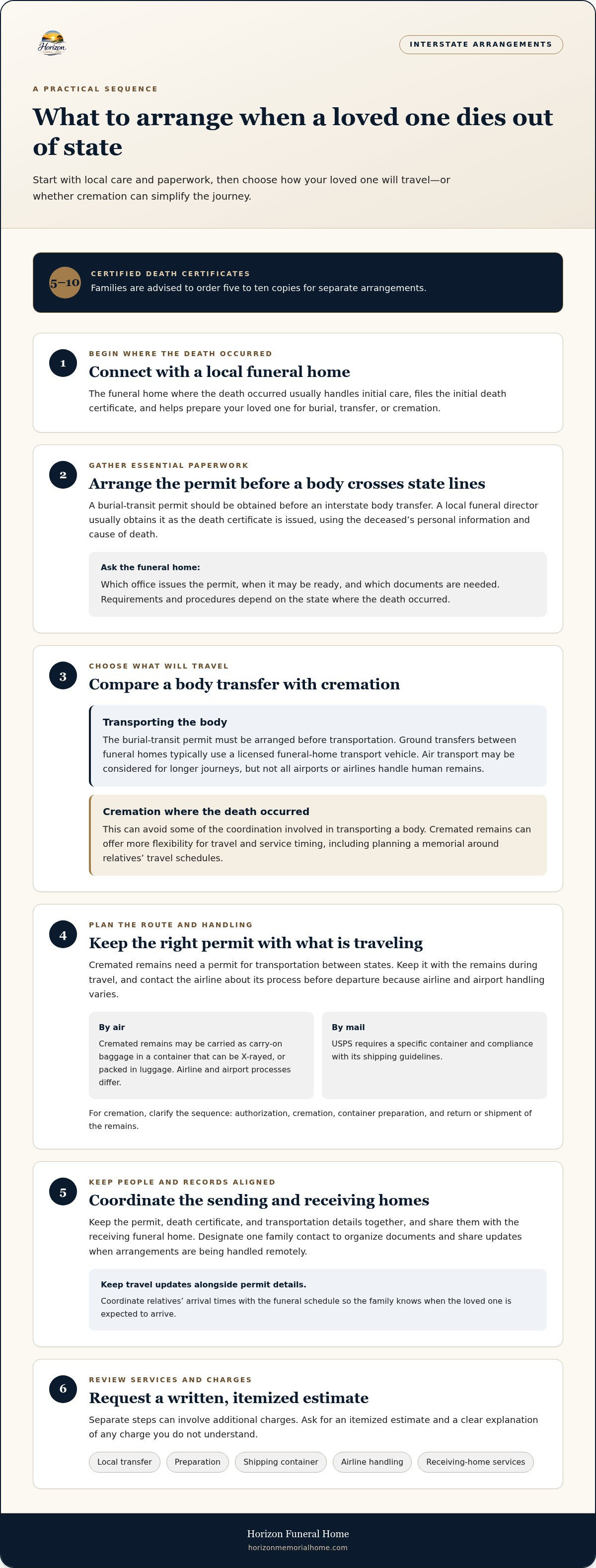

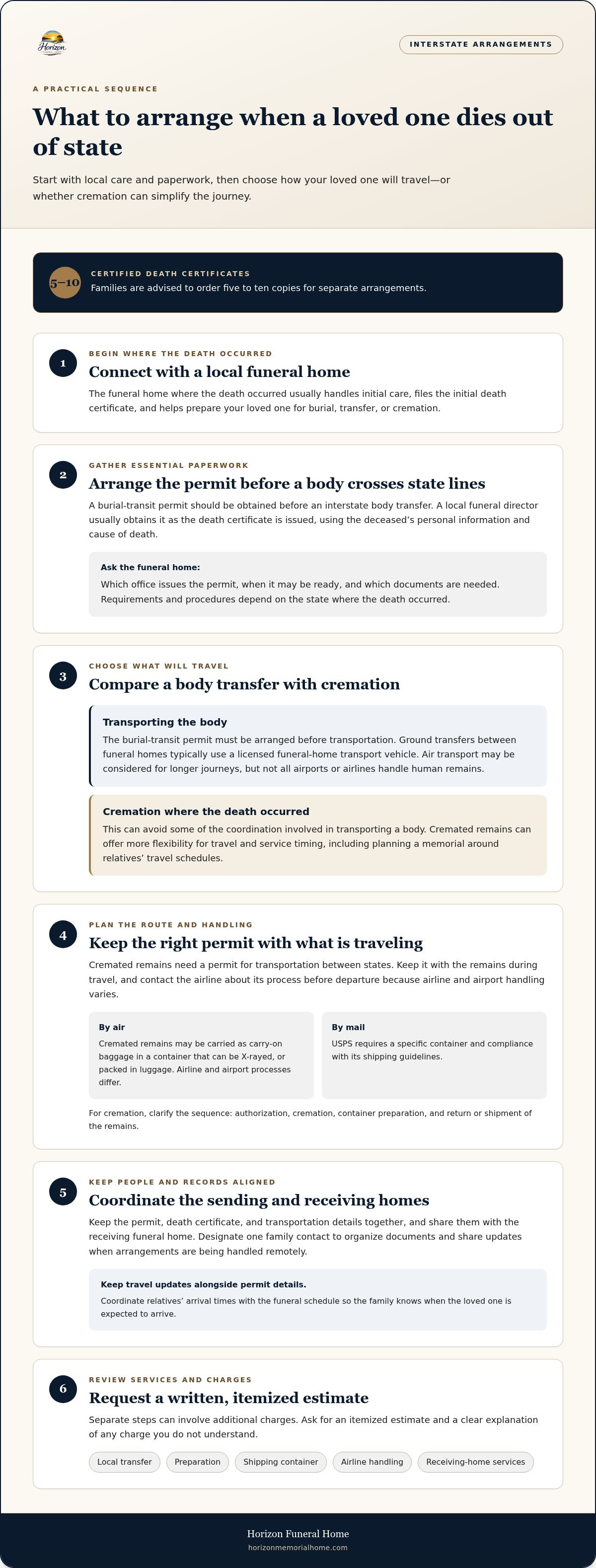
Distance doesn’t have to leave your family guessing about what happens next. Funeral logistics for an out-of-state family usually begin with a funeral home where the death occurred, which can help arrange local care and paperwork. Before a body crosses state lines, a burial-transit permit should be obtained, and families are advised to order five to ten certified death certificates.
It’s understandable to feel pulled between travel plans, family decisions, and unfamiliar forms. You don’t have to solve every detail at once. A clear sequence helps everyone see what needs attention first and what can wait.
This guide explains the permits, certificates, and authorizations to consider, then walks through choosing between transporting a body and arranging cremation. You’ll also learn how the sending and receiving funeral homes coordinate, what information to share with relatives, and how to select a funeral home for long-distance arrangements. The goal is practical clarity, so you can make the next decision with more confidence and keep your loved one’s wishes at the center.
Key Takeaways
- Arrange the burial-transit permit before an interstate body transfer, and plan to obtain five to ten certified death certificates.
- Compare transporting the body with cremation at the place of death; cremated remains can offer more flexibility for travel and service timing.
- Gather the required travel and disposition paperwork, including personal details and information about the cause of death.
- Choose one or two family members to serve as primary contacts, and keep copies of key documents available to both funeral homes.
- When selecting a funeral home, look for clear coordination between the sending and receiving locations and guidance for arrangements after arrival.
Table of Contents
- 1. Burial-transit permits and certified death certificates
- 2. Cremation out of state and shipping cremated remains
- 3. Travel documents and body disposition authorizations
- 4. Coordination between sending and receiving funeral homes
- 5. Selecting a funeral home for long-distance arrangements
- Horizon Funeral Home: Traditional Funeral Services
1. Burial-transit permits and certified death certificates
For a body traveling across state lines, arrange a burial-transit permit before transportation begins. The funeral home where the death occurred usually handles initial care, files the initial death certificate, and helps prepare your loved one for burial, transfer, or cremation. This first step anchors a challenging journey in the state where the death occurred.
State laws affect which documents are needed and how a body can travel; permit and certificate procedures depend on the state where the death occurred. A local funeral director usually obtains the burial-transit permit as the death certificate is issued, using the deceased’s personal information and cause of death. Families are advised to order five to ten certified death certificates for separate arrangements.
Ask the funeral home to explain which office issues the permit and when it may be ready. Keep the permit, death certificate, and transportation details together, and share them with the receiving funeral home. Accurate records help avoid complications on arrival. If relatives are arranging matters remotely, designate one family contact to organize documents and share updates.
Transportation depends on whether the family is moving a body or cremated remains. Ground transfers between funeral homes typically use a licensed funeral-home transport vehicle, not a personal car. For longer journeys, air transport may be considered, but not all airports or airlines handle human remains. The funeral home can coordinate transportation of an embalmed body intended for viewing, while preparation requirements depend on the route and service plans.
Cremated remains and human compost have a different permit pathway. A permit issued with either allows transportation between states, including by air. Keep the permit with the remains during travel. If flying, contact the airline about its process before departure, since airline and airport handling varies. For mailed cremated remains, USPS requirements call for a specific container and compliance with its shipping guidelines.
Separate steps can involve additional charges, such as local transfer, preparation, a shipping container, airline handling, or services from the receiving funeral home. To avoid surprises, request a written estimate that itemizes the services and charges, then compare it with the arrangements your family chose. Ask for a clear explanation of any charge you don’t understand.
Travel plans need their own coordination. Ground transportation may suit a closer transfer, while air transport can be faster over long distances; each follows different procedures. If relatives will attend services, coordinate arrival times with the funeral schedule and consider a hotel-room block or house rental. Keep travel updates alongside permit details so family members know when the loved one is expected to arrive.
2. Cremation out of state and shipping cremated remains
Arranging cremation in the state where death occurred can avoid some of the coordination involved in transporting a body home. Families who prefer burial can arrange it after cremation, or hold a memorial before deciding where the remains will be laid to rest. The choice depends on your loved one’s wishes, family traditions, and where relatives can gather.
Direct cremation where the death occurred can make scheduling more flexible. Once the cremated remains are ready, relatives can plan a service around travel schedules instead of coordinating everyone’s arrival with a body’s transfer. Families may wait to hold a service so out-of-state relatives have time to travel. A memorial can also take place in more than one location, allowing relatives in different states to gather closer to home.
Shipping cremated remains by mail requires a specific type of container and compliance with USPS guidelines. For air travel, cremated remains may be carried as carry-on baggage in a container that can be X-rayed, or packed in luggage; airlines and airports differ in their handling processes. Before choosing either route, keep the permit with the remains and plan how the container will travel securely.
Ask the funeral home arranging cremation to explain the sequence: authorization, cremation, container preparation, and return or shipment of the remains. Share the destination address or the name of the relative who will collect them. Cremated remains are placed in a secure container or urn for shipping. If family members plan to divide the ashes, discuss that before finalizing the container and delivery arrangements.
Consider the service separately from the final disposition. Some families hold a memorial first, then choose burial or another resting place; others arrange burial after the remains return home. Relatives may also keep portions of the ashes in separate locations. These choices can help family members participate across state lines while keeping the deceased’s wishes and traditions at the center.
If cremation is the path your family prefers, cremation arrangements can bring the necessary decisions into one conversation. Ask for a clear explanation of who will receive the remains, how they will be returned, and which family member will coordinate the memorial. That simple plan gives relatives a shared point of reference while navigating travel and service details.
3. Travel documents and body disposition authorizations
Travel plans affect the service date, preparation, and paperwork. Start by identifying the intended disposition: burial, cremation, or another arrangement consistent with your loved one’s wishes. Then give the funeral director the destination, expected travel method, and whether relatives want a viewing. These details help determine which authorizations and travel preparations need attention.
State requirements differ. Alabama, Arkansas, and New Jersey require embalming when a body is transported across state lines. Some states also require embalming for public transportation or when a body cannot reach its destination within roughly 24 to 48 hours. Commercial air transport usually involves embalming and coordination between the sending and receiving funeral homes. For ground travel, the body is typically placed in a secure transport container approved for travel.
Embalming isn’t required for every funeral service, but the transportation method and planned viewing matter. The funeral home weighs travel time, whether the service includes a public viewing, and applicable state requirements. Some states require embalming for interstate travel, while approved containment may be another preparation consideration. Discuss the route and service plan together, rather than treating preparation as a separate decision.
Schedule the service around relatives’ travel needs and the expected arrival of the deceased. Families sometimes hold services a week or more after a death, allowing loved ones time to travel. If a public viewing is planned, share its location and timing with the funeral director early. A private gathering at the place of death may involve different preparation needs from a service held after interstate transportation.
Travel protection deserves a separate review. Read any travel-insurance policy for language about repatriation, exclusions, covered travelers, and required documentation. Don’t assume ordinary medical coverage will pay for arrangements after a death away from home: basic health insurance plans and Medicare do not cover those arrangements. Keep policy records with travel documents, and identify who can contact the insurer if needed.
Before approving transportation, gather required authorizations, travel documents, and preparation details in one file. Include the destination funeral home’s information and copies for the family contact. If plans change, such as switching from ground travel to commercial air transport, notify both funeral homes promptly; the route can affect preparation, containment, and timing.
4. Coordination between sending and receiving funeral homes
If you can’t attend in person, a funeral service may be livestreamed so relatives can watch in real time. Families can also hold memorial services in different locations, giving loved ones another opportunity to gather. To arrange remotely, choose one or two family members as primary contacts and ask them to share decisions, documents, and timing updates with relatives.
The sending funeral home handles arrangements where the death occurred; the receiving funeral home prepares for arrival and helps plan the service or final resting place. Direct coordination can reduce confusion over transportation, paperwork, and expected arrival. Agree on who will communicate updates so relatives aren’t left piecing together separate messages.
Start a shared record with the deceased’s legal name, date of birth, next-of-kin contact, destination, and preferred service arrangements. Keep copies of the death certificate and any burial-transit permit with that record. Consistent details help the sending and receiving funeral homes coordinate the transfer and prepare for arrival.
Hospitals and local officials may be involved before a funeral home can move forward. The funeral home near the place of death typically helps with initial care and death-certificate paperwork. Make sure the family contact knows which paperwork is complete and which arrangements are underway. A simple status update helps relatives understand the next step without duplicating calls.
Digital forms and video calls make remote decisions easier to organize. A family contact can circulate forms electronically, gather relatives’ preferences, and arrange a call with both funeral homes. Keep a current copy of each document in a shared folder, with clear file names such as “death certificate” and “transport permit.” Use one message thread for schedule changes and arrival updates.
For a smooth handoff, keep the transfer details together: destination funeral home, expected arrival, service plans, and copies of key paperwork. The receiving funeral home can guide arrangements after the transfer, while the sending home coordinates preparation and transportation. If the plan changes, communicate it promptly to both funeral homes and the family contact.
Families can reduce decision fatigue by recording preferences before relatives begin making separate arrangements. Choose the service type, identify who will approve arrangements, and decide how updates will reach relatives in other states. A short written summary gives everyone the same reference point, while a livestream or second memorial can help distant family members take part meaningfully.
5. Selecting a funeral home for long-distance arrangements
For a transfer between states, two funeral homes may have distinct roles. The funeral home where the death occurred handles local arrangements and prepares the transfer. The receiving funeral home coordinates care after arrival and helps plan a service or final resting place. Clear communication between them is central to managing distance, paperwork, and timing.
The Federal Trade Commission (FTC) requires funeral homes to offer Receiving Remains and Forwarding Remains options. Receiving Remains covers services after a loved one arrives from elsewhere; Forwarding Remains covers preparation and transfer from the place of death. These options clarify which funeral home handles each stage. The receiving home can then guide the family through a service or final resting place.
Consider how transportation decisions connect to the service plan. Air transport arrangements may involve preparation and coordination between the sending and receiving funeral homes. Ground transportation uses a different process, and distance, preparation, shipping-container requirements, airline fees, and coordination all affect the plan. A funeral home should explain how those pieces fit together, not leave relatives to reconcile separate updates themselves.
Remote communication can make arrangements manageable when relatives live in different states. Designate one or two family members as primary contacts, keep copies of key paperwork, and share updates digitally. For example, one contact can distribute expected arrival and service timing, while another gathers preferences about burial, cremation, or a memorial. This limits conflicting instructions and gives relatives a shared reference.
Pay attention to how decisions are documented. A written summary can identify the selected disposition, service location, transfer responsibilities, and the person coordinating family communications. Keep the death certificate and any permit with the arrangement records. If the destination or service plan changes, update both funeral homes and the family contact to keep the transfer and gathering aligned.
The right arrangement makes responsibilities understandable: who prepares the transfer, who receives your loved one, and who supports service planning afterward. For families arranging a traditional service, direct burial, or cremation across state lines, discuss long-distance funeral arrangements to bring the transportation and service decisions into one conversation.
Horizon Funeral Home: Traditional Funeral Services
Horizon Funeral Home can help families bring transportation and service arrangements into the same conversation. Its Worldwide Transportation coordinates a loved one’s transfer, while Funeral Services, Cremation Services, and Memorials & Celebrations of Life offer ways to honor personal wishes. Families can discuss timing, disposition, and how relatives in different states will participate.
For a veteran’s service, Horizon Funeral Home also offers Veteran Services. Honors must be requested, and eligibility is determined by the appropriate military branch or government agency. Share where your loved one is, the intended destination, and whether your family is considering burial or cremation to start planning. Horizon provides care in English, Russian, Armenian, Georgian, and Spanish.
Take the Next Step at Your Own Pace
Distance can make a difficult family moment feel divided between places. A helpful next step is to choose one person to gather the family’s immediate questions and share the decisions that matter most. Take the arrangements one conversation at a time, keeping your loved one’s wishes at the center.
If you’re managing funeral logistics for an out-of-state family, Horizon Funeral Home offers Funeral Services, Cremation Services, and Worldwide Transportation. These services can bring transfer and service arrangements into a coordinated plan shaped around your family’s needs.
When you’re ready to talk through what comes next, contact Horizon Funeral Home for guidance. You don’t need to have every decision settled before beginning the conversation. A thoughtful first step can help your family move forward together, with care and clarity.
Frequently Asked Questions
How Do I Go About Getting It?
Begin by contacting the funeral home where the death occurred and explaining that family members live out of state. Share the preferred destination, whether burial or cremation is being considered, and who can make decisions for the family. One relative can serve as the main contact while others share preferences by phone or video call. This gives the funeral director a clear starting point for organizing next steps.
How Does It Work?
Long-distance arrangements connect care where the death occurred with plans at the destination. The family chooses the disposition and service approach, while funeral professionals coordinate the transfer and receiving arrangements. For example, if relatives want a gathering near home, the receiving funeral home can help plan it after the transfer. Funeral logistics for an out-of-state family are easier to manage when everyone agrees on one decision-maker and shares updates consistently.
Who Handles the First Steps When Death Happens Out of State?
The funeral home near the place of death generally handles initial care and helps with the first paperwork. The family can identify a relative to speak with that funeral home, provide the deceased’s identifying details, and communicate wishes or cultural preferences. If death occurred in a hospital or care facility, the local funeral home coordinates the next transfer step with that location. Relatives living elsewhere can participate remotely rather than traveling before plans are settled.
What Should Out-of-State Family Do First When a Loved One Dies?
First, identify the local funeral home caring for your loved one and choose a family contact to coordinate decisions. Then gather practical information, such as the deceased’s full legal name, current location, and any written funeral wishes. A relative can keep a shared note of questions and decisions for the next call. Whether family members are in Brooklyn, Queens, or another city, a phone or video conversation can bring them into the discussion.
What Documents and Authorizations Are Needed to Plan a Funeral From Out of State?
Common records include the death certificate and, for an interstate body transfer, a burial-transit permit. The funeral director uses the deceased’s personal information and cause of death as part of the permit process. Families should also clarify who has authority to approve the chosen disposition and arrangements, since required paperwork can depend on state procedures. Keep document copies together and provide consistent names and destination details to everyone coordinating the service.
How Can Family Members Travel With a Body or Cremated Remains Across State Lines?
For a body transfer, funeral homes coordinate ground or air transportation and prepare the required documents and travel arrangements. Most states allow family members to transport a body themselves, but requirements differ by state and route. Cremated remains can travel with a permit between states, including by air; USPS shipments must follow its container and mailing guidelines. Before travel, organize the documents and confirm who will receive the remains at the destination.
What Are the Costs of Transporting a Body Across State Lines?
Costs vary based on distance, transportation method, preparation, shipping-container requirements, airline charges, and coordination between funeral homes. Ground and air transfers involve different arrangements and charges. A case-specific cost estimate follows a discussion of the services and transport details your family needs. For a useful comparison, ask for transfer components to be itemized separately from funeral or memorial arrangements, and note that third-party charges may be separate.
How Do Funeral Homes Coordinate With Out-of-State Relatives and Local Providers?
The sending and receiving funeral homes coordinate transfer details, documents, and arrival plans, while a designated family contact shares decisions with relatives. The FTC requires funeral homes to offer Receiving Remains and Forwarding Remains options. Relatives can use video calls and digital forms to participate without traveling, then share updates in one family communication thread. If a local cemetery or other provider is involved, its timing and arrangements can be added to the shared plan.