
A standard mortuary license alone is not enough when you need to bring a family member home across state lines or international borders. True repatriation requires active diplomatic coordination, strict airline cargo compliance, and meticulous chain-of-custody protocols. Finding a funeral home with shipping expertise ensures you have a partner who manages those complex logistics so you don't carry that burden alone. When you are grieving, the fear of transit paperwork errors, consular holds, or prolonged flight delays is an exhausting weight.
You deserve quiet confidence and complete transparency during this journey. In this guide, you will learn how to identify and partner with a qualified director who possesses authentic mortuary shipping capabilities to safely bring your loved one home. We will outline the essential steps of domestic and international repatriation, provide a practical vetting checklist to guide your conversations, and explain how cross-border legal clearances work from departure to arrival.
Key Takeaways
- Understand the critical difference between local mortuary care and the complex aviation, diplomatic, and health regulations required for cross-border transit.
- Discover the non-negotiable documentation you need, including consular apostilles, health department transit permits, and non-communicable disease declarations.
- Learn how to evaluate and partner with a funeral home with shipping expertise by verifying essential credentials like TSA Known Shipper registration.
- Compare the distinct logistical timelines and container standards between domestic interstate travel and international repatriation.
- Gain peace of mind knowing how a dedicated mortuary shipping coordinator manages every airport cargo clearance and receiving transfer on your family's behalf.
Table of Contents
- What Defines a Funeral Home with Genuine Shipping Expertise?
- Navigating Consular, Legal, and Airline Logistics in Mortuary Transit
- Domestic Funeral Shipping vs. International Repatriation: Key Differences
- How to Evaluate and Select a Reputable Shipping Funeral Director
- Entrusting Your Loved One's Journey to Horizon Funeral Home
What Defines a Funeral Home with Genuine Shipping Expertise?
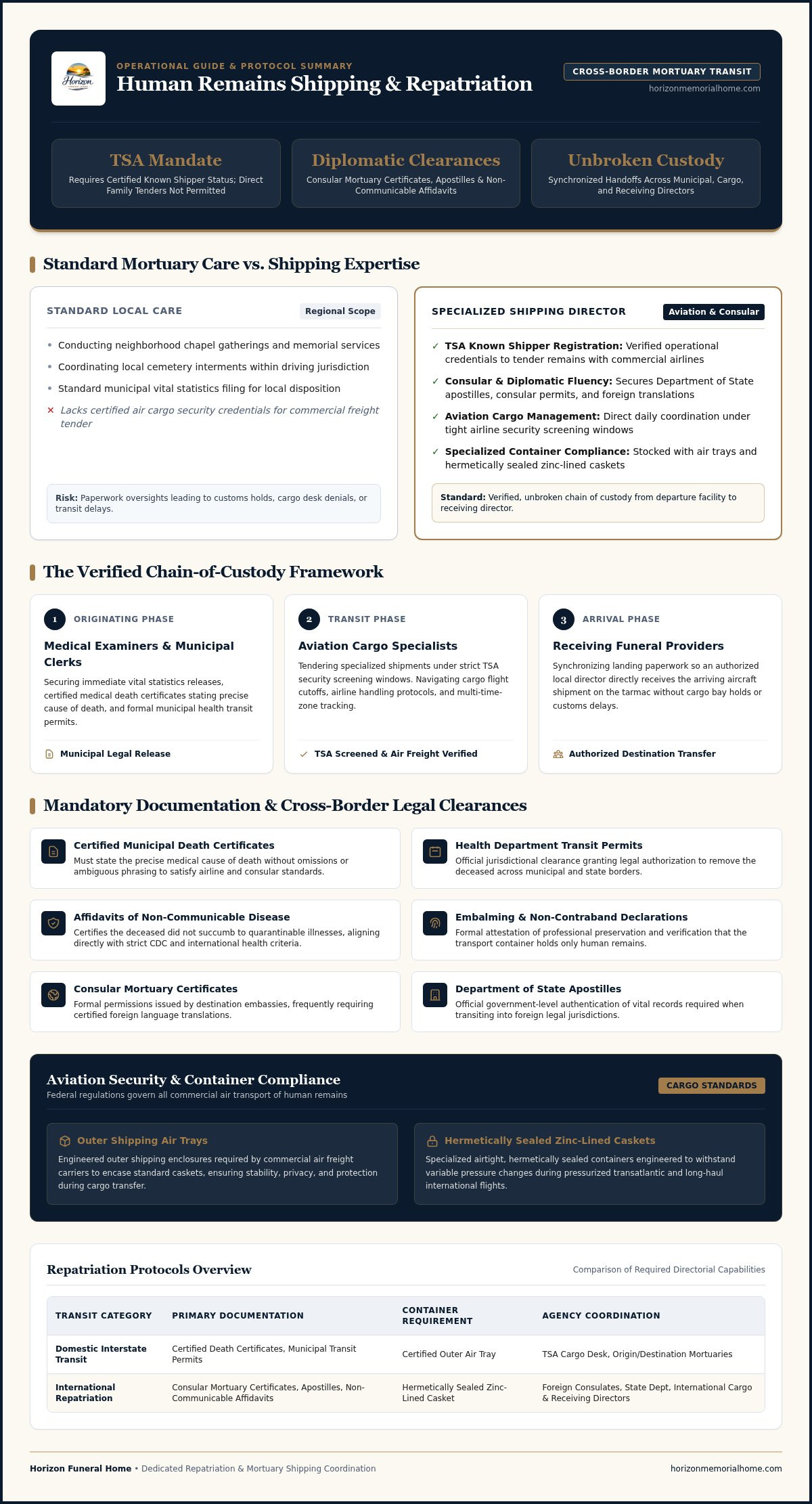
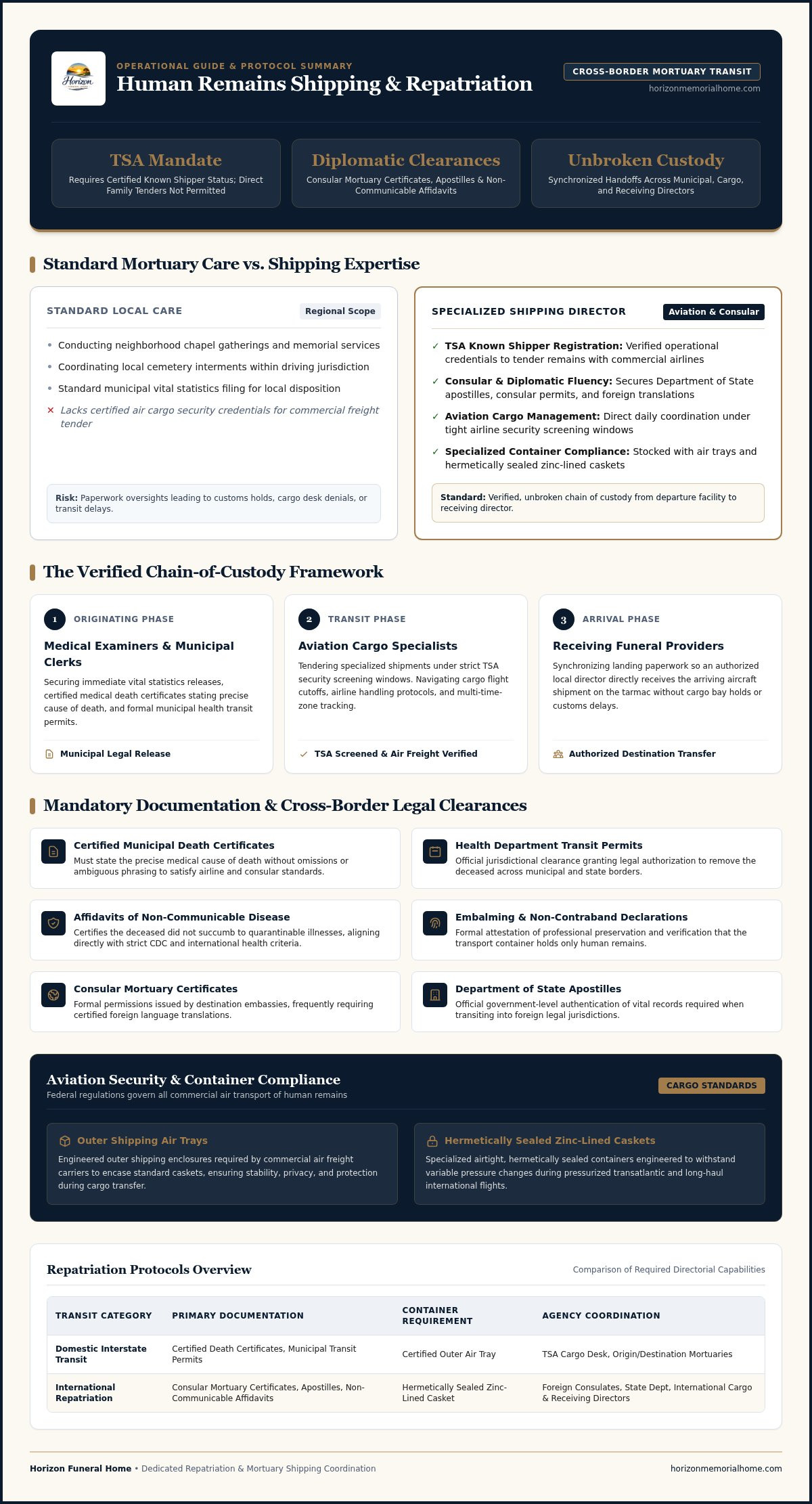
Most local mortuaries excel at arranging chapel gatherings, coordinating regional cemetery burials, and comforting neighborhood families. However, cross-border transit introduces a completely separate discipline that demands specialized logistics. Selecting a funeral home with shipping expertise means choosing a team capable of managing global aviation rules, bilateral treaties, and municipal health permits simultaneously. Without specialized experience, standard practitioners can inadvertently create paperwork oversights that cause heartbreaking customs delays or airline denials.
Authentic mortuary transport providers maintain direct daily channels with commercial cargo carriers, foreign consular corps, and air freight forwarders. They understand that the legal and logistical framework for the repatriation of human remains requires an unbroken, verified chain of custody. Every handoff, from the originating hospital morgue to a regional air cargo tarmac thousands of miles away, must be accounted for with precision.
The Logistical Realities Behind Human Remains Transportation
Specialized mortuary shipping bridges municipal health regulations with strict international aviation cargo protocols. Coordinators work across conflicting time zones, operating under narrow scheduling windows dictated by municipal bureaus and commercial flight cutoffs. When coordinating a transfer, your director manages delicate custodial handoffs across multiple official entities:
- Medical examiners and municipal clerks: Securing immediate vital statistics releases, certified deaths certificates, and formal permits to transit.
- Aviation cargo specialists: Tendering specialized shipments under strict cargo security screening windows prior to aircraft departure.
- Receiving funeral providers: Synchronizing landing paperwork so an authorized local director meets the arriving aircraft without cargo bay holds.
Essential Credentials of a Qualified Mortuary Shipping Specialist
A capable shipping specialist holds distinct operational credentials that standard providers simply do not maintain. Above all, they must be registered as a certified Known Shipper under federal Transportation Security Administration (TSA) mandates. Individual families cannot tender remains directly to an airline cargo desk; commercial carriers accept human remains exclusively from certified shippers with verified security credentials.
Additionally, a qualified funeral home with shipping expertise brings comprehensive fluency in international documentation. This includes arranging official multilingual document translations, securing consular mortuary certificates, and completing Department of State apostilles when transit cross-cuts foreign jurisdictions. They also maintain a verified inventory of required transit containers, including certified outer shipping air trays and hermetically sealed zinc-lined caskets engineered to withstand pressurized transatlantic cargo environments.
Navigating Consular, Legal, and Airline Logistics in Mortuary Transit
Transporting a loved one across national or international boundaries requires an exacting sequence of legal permissions. A single clerical error on a death certificate or an unverified signature can stall travel arrangements at cargo customs for days. Working with a dedicated funeral home with shipping expertise removes this uncertainty. Your director handles every filing, ensuring local health department permits align precisely with federal and international mandates.
Consular Clearances and Mandatory International Documentation
International repatriation depends on securing formal approvals from destination embassies. Coordinators liaise directly with consular officers to obtain an official consular mortuary certificate, often requiring certified foreign-language translations and Department of State apostilles. Depending on the country of arrival, the packet must contain:
- Certified municipal death certificates: Stating the precise medical cause of death without omissions.
- Health department transit permits: Granting official authorization to remove the deceased from the municipal jurisdiction.
- Affidavits of non-communicable disease: Confirming the individual did not succumb to quarantinable illnesses, which directly mirrors strict CDC importation requirements when transferring remains into the United States.
- Embalming and non-contraband declarations: Attesting that the casket contains solely the deceased and essential personal effects.
TSA Known Shipper Status and Airline Cargo Regulations
Commercial passenger airlines carry mortuary shipments within specialized, climate-controlled cargo compartments beneath the main cabin. Federal aviation rules strictly prohibit private citizens from tendering these shipments directly to an air carrier. Licensed directors must maintain active registration under the TSA Known Shipper program to book cargo space, submit air waybills, and complete mandatory chain-of-custody documentation.
A seasoned coordinator synchronizes flight schedules to avoid prolonged cargo layovers, coordinating through major international freight hubs like JFK International Airport. Families who need guidance through these intricate transit steps can consult Horizon Funeral Home's worldwide transportation team to ensure direct, compliant airline routing.
Specialized Casket Preparation and Approved Air Trays
Aviation environments present unique atmospheric pressures and physical movements. Because of this, airlines and receiving nations mandate specialized protective containers. Many European, South American, and Caribbean jurisdictions require a hermetically sealed zinc or metal inner liner to ensure a completely airtight seal.
For flight transit, directors secure the casket inside a heavy-duty, wooden-bottomed outer air tray approved by the International Air Transport Association. If the journey involves an un-casketed transfer, an engineered combination unit provides dignified structural protection. These strict physical safeguards preserve both dignity and sanitary integrity from takeoff to final arrival.
Domestic Funeral Shipping vs. International Repatriation: Key Differences
While both paths bring someone home with care, domestic relocation and global repatriation operate under fundamentally different rules. Domestic transfers are governed by interstate commerce regulations, state department of health rules, and regional flight routing. Cross-border repatriation, by contrast, layers bilateral trade agreements, national customs scrutiny, and international public health mandates on top of ordinary funeral directing. A funeral home with shipping expertise understands how to balance these contrasting frameworks without compounding your family's grief.
Interstate Mortuary Transfers Within the United States
Moving a loved one across state lines is often completed within a few days. The primary focus involves aligning state vital statistics filings and obtaining reciprocal burial-transit permits. If travel spans neighboring regions, dedicated private ground transport often provides a gentler, more direct journey than air freight, eliminating airport cargo handoffs entirely. For longer transcontinental journeys, vetted domestic airlines carry the casket inside an approved outer container. Families comparing state-to-state logistics with foreign transit can review the detailed steps in international funeral transportation to see how documentation requirements expand once an international border is crossed.
Cross-Border Repatriation and International Protocol
International journeys regularly span one to two weeks, largely due to sovereign consular protocols and customs inspections at ports of entry. Every document must match destination laws precisely, often requiring certified translations and notarized verification before foreign consuls approve departure. In addition, preservation mandates vary widely by country. While domestic transfers may allow dry ice under specific airline guidelines, most foreign destinations strictly mandate comprehensive arterial embalming and sealed metal caskets to meet national border health ordinances.
Common Logistical Pitfalls That Trigger Painful Transit Delays
Unexpected setbacks during transit rarely stem from flight availability; they almost always arise from administrative inaccuracies. Partnering with an experienced funeral home with shipping expertise helps prevent the most frequent logistical failures:
- Name discrepancies on legal records: Even a minor misspelling across the death certificate, foreign passport, and transit permit can cause receiving customs agents to reject cargo clearance.
- Unanticipated consular closures: Embassies close for regional holidays that may not appear on domestic calendars, which can halt consular seal processing if not planned for in advance.
- Uncoordinated destination handoffs: Tendering an international flight before verifying that the receiving funeral provider possesses the exact clearance paperwork will lead to agonizing cargo holds upon arrival.
How to Evaluate and Select a Reputable Shipping Funeral Director
Entrusting someone you love to cross-country or transoceanic care requires complete trust in your coordinator's competence. You should never feel pressured to make quick decisions without verifying that a firm possesses real operational infrastructure. When you interview prospective directors, look for verifiable credentials, clear timelines, and direct answers about past transports. Choosing a qualified funeral home with shipping expertise guarantees that your family is guided with steady reassurance rather than administrative guesswork.
Essential Questions to Ask During Your Initial Consultation
A direct, thoughtful conversation reveals whether a mortuary regularly handles long-distance cases or simply outsources them to third parties. Consider presenting these specific questions early in your discussion:
- How frequently do you coordinate transit to our destination state or country? Familiarity with specific regional offices and bilateral entry requirements prevents avoidable administrative pauses.
- Do you maintain active TSA Known Shipper registration? Direct air cargo booking depends entirely on this federal credential.
- Will your staff personally deliver documentation to foreign consulates in Manhattan? Courier-handled or in-person filings move considerably faster than remote postal submissions.
- What contingency protocols do you follow if flight schedules or weather ground a connection? Your coordinator must have established protocols to protect physical integrity during unexpected transit interruptions.
Collaborating with Receiving Mortuaries Worldwide
A smooth journey depends on complete alignment between the sending and receiving providers. Your shipping director must contact the destination firm immediately to confirm their regional licensing, local airport clearance authority, and vehicle availability for tarmac pickups. This coordination allows your family to integrate travel plans smoothly with local gatherings or traditional funeral arrangements without worrying about sudden flight arrivals catching the destination staff unprepared.
Transparent Communication and Milestone Tracking
Anxiety softens when you receive reliable, proactive communication. Dependable shipping directors assign a dedicated point of contact who delivers structured daily updates on municipal filings, apostille verifications, and flight bookings. Once your loved one is tendered to the airline cargo facility, your director will provide an active airway bill tracking number so you can monitor progress across each transfer. To speak with a team that provides this calm, methodical oversight, you can contact Horizon Funeral Home to discuss mortuary transit options whenever you are ready.
Entrusting Your Loved One's Journey to Horizon Funeral Home
Managing the transit of someone dear to you shouldn't be an isolating experience. When geographic distances separate your family from their final resting place, you need an advocate who understands the intricate realities of transportation logistics. As a compassionate funeral home with shipping expertise, Horizon Funeral Home lifts the bureaucratic weight from your shoulders. Our directors guide families across Brooklyn, Queens, Manhattan, Staten Island, the Bronx, and Nassau County, providing steady support so you can focus entirely on remembering your loved one.
Strategic Coordination Across the New York Metropolitan Area
New York City serves as the country's primary diplomatic and aviation gateway, presenting distinct operational advantages for families. Our team maintains established working connections with foreign consulates and municipal agencies across Manhattan. Through prompt in-person filings, we secure vital apostilles and consular seals without relying on unpredictable mail processing. In addition, our direct access to JFK International Airport's global freight terminals allows for synchronized transit coordination, eliminating unnecessary layovers and ensuring dignified flight departures.
Comprehensive Care Combining Local Services with Global Reach
Logistical care must honor personal traditions. Before any departure, our staff helps you organize private family gatherings, religious rites, or commemorative services locally. For families looking ahead, we offer compassionate funeral preplanning services that document cross-border transit wishes in advance. If your family prefers traveling with an urn rather than casketed transport, our respectful cremation services provide a dignified alternative that complies fully with domestic and international airline regulations.
Taking the First Reassuring Step Toward Bringing Them Home
You don't have to decipher complex cargo manifests, consular forms, or health certifications alone. From your initial conversation, our experienced directors walk you through each procedural phase with clarity, patience, and warmth. We take on the calls, the filings, and the airport handoffs, giving your family the space you need during a time of loss. Connect with the dedicated coordinators at Horizon Funeral Home to begin arranging their safe, honored journey home.
Bringing Your Loved One Home with Dignity and Peace of Mind
Navigating long-distance domestic transit or global repatriation shouldn't compound your family's grief. Bringing a loved one home requires far more than ordinary funeral directing; it demands methodical precision with municipal transit permits, foreign consular seals, and strict airline cargo protocols. Partnering with a proven funeral home with shipping expertise ensures that every flight booking, border clearance, and receiving transfer is completed without distressing delays.
From our direct courier access to Manhattan consulates to our synchronized freight handling through JFK International Airport, we manage every administrative detail with patient care. Horizon Funeral Home provides quiet, steady assistance to families throughout Brooklyn, Queens, Manhattan, Staten Island, the Bronx, and Nassau County. You don't have to carry this logistical burden alone. When you are ready, speak with our compassionate funeral directors at Horizon Funeral Home to ensure your loved one receives a safe, dignified journey home.
Frequently Asked Questions
What qualifies a funeral home to legally ship human remains internationally?
A funeral director must be a certified Known Shipper through the Transportation Security Administration (TSA) to book international air cargo. Beyond federal air security clearances, a qualified funeral home with shipping expertise maintains active working relationships with foreign consulates, understands apostille legalizations via the Department of State, and complies with destination-specific health codes and casket sealing standards.
Can a family book mortuary airline tickets directly without a funeral home?
No, airlines do not allow private individuals to book or tender human remains directly. Under federal aviation security mandates, commercial carriers exclusively accept human remains from verified entities registered in the TSA Known Shipper program. Families must partner with a licensed funeral director who coordinates the air cargo booking, generates the official air waybill, and completes chain-of-custody handoffs at the cargo terminal.
How long does the international mortuary repatriation process typically take?
International repatriation typically takes between five business days and two weeks. The exact timeline depends on embassy processing hours, foreign national holidays, and the speed of municipal health departments issuing transit permits. In New York, our proximity to Manhattan consular missions and JFK International Airport allows us to file documents in person, which significantly reduces processing delays for families in Brooklyn, Queens, and Long Island.
What documents are required to transport a deceased loved one out of New York?
Out-of-state and overseas transfers require several legal clearances. At minimum, you need certified municipal death certificates, an official burial-transit permit issued by the New York City Department of Health, and a physician's non-contagious disease declaration. For international travel, the destination consulate requires verified embalming certificates, non-contraband declarations, certified translations, and apostille authentication from the New York Department of State before granting travel clearance.
Can cremated remains be transported instead of a full casketed body?
Yes, selecting cremation simplifies long-distance transport significantly. Families can carry cremated remains aboard commercial flights in carry-on luggage, provided the urn is made of wood, plastic, or lightweight material that can pass airport security screening. Alternatively, remains can be shipped domestically using the U.S. Postal Service Priority Mail Express Cremated Remains Box. International shipments require consular approval and destination customs declarations beforehand.
What happens if a flight carrying human remains experiences an unexpected delay?
Airlines treat mortuary shipments as top-priority cargo. If a flight experiences a delay, mechanical cancellation, or missed connection, the carrier secures the remains inside a temperature-controlled cargo holding facility. Your coordinating funeral director tracks the air waybill continuously, liaising with airline cargo managers to arrange immediate rebooking on the next available route while keeping the receiving funeral home and family informed.
How do receiving funeral homes coordinate with the shipping funeral director?
Both directors establish direct contact before flight departure. The shipping director provides the receiving firm with flight numbers, airway bill documents, and copies of consular seals. This coordination ensures that the receiving mortuary is cleared to meet the cargo transport at the destination airport, complete customs clearances, and safely transfer your loved one into their care without unnecessary holds or emotional stress for the family.