
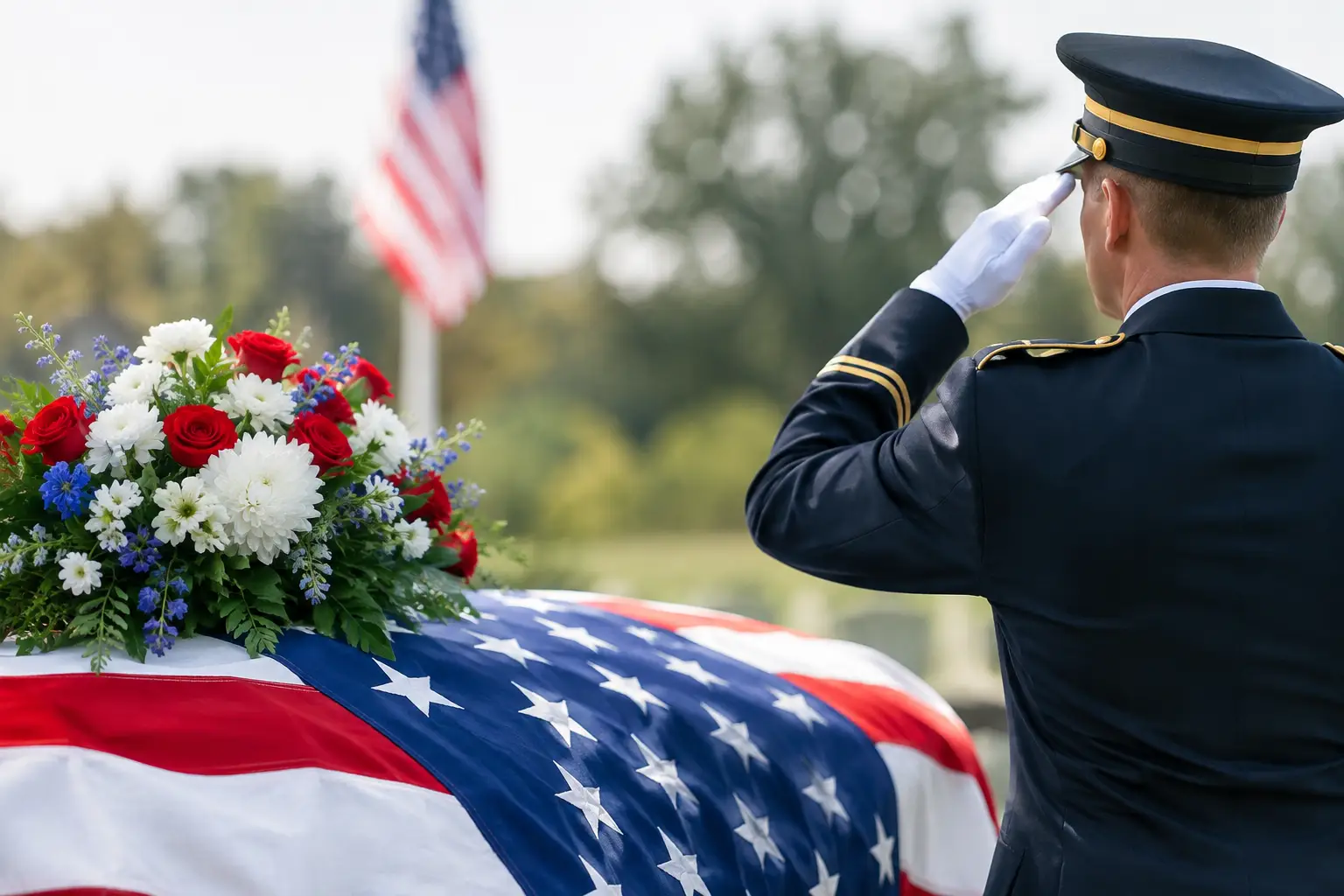
A folded flag placed in a spouse’s hands can say more than a long speech. For many military families, the best veteran burial honors are not about formality or display. They are a clear, respectful acknowledgment of service, sacrifice, and the life lived beyond the uniform.
Each veteran and each family is different. One family may find deep comfort in hearing Taps; another may prefer a quiet graveside prayer, a favorite song, or a gathering that reflects the veteran’s faith, culture, and personality. Knowing what honors may be available gives families room to make choices with care rather than feeling rushed by unfamiliar details.
What Are Veteran Burial Honors?
Military funeral honors are a ceremonial tribute provided for eligible veterans. At a minimum, the ceremony generally includes two uniformed service members, with at least one representing the veteran’s branch of service. The team performs the flag-folding ceremony, presents the burial flag to the next of kin or an appropriate recipient, and provides Taps, either played live or by an approved ceremonial recording.
When personnel and scheduling permit, families may request additional elements. These can include a rifle volley, a color guard, pallbearers, or a bugler. Availability varies by branch, location, date, and the number of services being coordinated. A funeral director can help request the honors, but military participation is not something a funeral home can independently guarantee.
The goal is not to create one “correct” military service. It is to provide a dignified recognition that feels fitting for the person being remembered.
The Best Veteran Burial Honors Reflect the Person
A veteran’s military history matters, but it is only one part of their story. The most meaningful service often balances that history with the roles they held at home: parent, grandparent, spouse, friend, mentor, neighbor, artist, or caregiver.
For some families, a traditional military graveside ceremony feels right. The honor guard arrives, the flag is folded, Taps is played, and the family shares a prayer before the burial. Others may choose cremation and arrange military honors at a memorial service, funeral chapel, religious service, cemetery, or another suitable location. An urn can be honored with the same care, including a burial flag displayed nearby or presented to the family.
There are also personal choices that can make the occasion feel less distant. A family member may read a letter written during deployment. Grandchildren may place flowers. A clergy member, celebrant, or loved one may speak about the veteran’s values and the way they showed up for others. These details do not take away from the military tribute. They make it more personal.
Confirm Eligibility Before Making Promises
Most veterans who were discharged under conditions other than dishonorable are eligible for military funeral honors. Service members who died while on active duty, and certain members of the Selected Reserve, may also qualify. Eligibility can be more complicated in some cases, particularly when records are incomplete or the nature of a discharge needs review.
The DD Form 214, commonly called a DD-214, is usually the key document for confirming military service and discharge status. If the family cannot locate it, do not assume honors are unavailable. Records can often be requested, though the process may take time. A funeral home can explain what is needed and help families begin the request while arrangements move forward.
For a smooth request, gather the following when possible:
- The veteran’s full legal name, date of birth, and Social Security number
- A copy of the DD-214 or other discharge papers
- Branch of service, rank, and service dates
- The date, time, and location of the service or committal
- The name and contact information for the next of kin
If a service is taking place soon and paperwork is not immediately available, tell the funeral director what you know. There may still be practical options while records are being located.
Understand the Difference Between Honors, Benefits, and Burial Choices
Families often hear several terms at once after a death: military honors, burial flag, cemetery benefits, headstone or marker, and burial allowance. They are related, but they are not the same thing.
Military funeral honors refer to the ceremony itself. A burial flag is provided for an eligible veteran and may be used to drape a casket or accompany an urn. It is then folded and presented to the family. The family typically keeps the flag afterward.
Veterans may also be eligible for burial in a national or state veterans cemetery, depending on service history and available space. A government-furnished headstone, grave marker, or medallion may be available for eligible veterans, including those buried in a private cemetery. Certain families may qualify for burial reimbursements, but those payments have eligibility rules and do not necessarily cover all funeral or cemetery expenses.
These distinctions matter because families can choose a private cemetery, a faith-based burial ground, a cremation memorial, or a veterans cemetery while still requesting appropriate honors. The right path depends on personal wishes, faith traditions, family location, budget, and whether the veteran expressed a preference during life.
Timing Matters, Especially for Graveside Services
Military honors should be requested as early as possible. This is particularly true for services held on holidays, weekends, or during periods when local honor guard teams are serving many families. Advance notice gives the coordinating office the best chance to provide the requested ceremony.
Still, a sudden loss should not prevent a family from asking. Funeral professionals regularly coordinate services under short timelines and can communicate directly with the appropriate military contacts. If a full honor guard is not available at the preferred time, families can discuss alternatives, such as adjusting the service time, scheduling a separate memorial tribute, or incorporating a flag presentation and remembrance led by loved ones.
A delay or limitation in ceremonial staffing is not a reflection of the veteran’s worth. It is usually a scheduling reality, and a caring arrangement team can help find a respectful solution.
Make Room for Faith, Culture, and Family Traditions
Military ceremony and religious practice can stand together gracefully. A rabbi, priest, imam, pastor, spiritual leader, or secular celebrant may lead the service before or after military honors. Families may choose readings in English, Russian, Armenian, Georgian, Spanish, or another language that feels like home.
For some families, the military portion is brief and formal, followed by a larger gathering where food, stories, and photographs bring the veteran’s full life into view. For others, the graveside service itself is intentionally small. Neither approach is more meaningful than the other.
It can help to decide in advance who will receive the flag, who will speak if anyone speaks, and whether children will attend the committal. There is no need to shield children from every part of a funeral, but they should be prepared in age-appropriate language for what they may see and hear, including the sound of a rifle volley if one is planned.
Questions to Ask When Planning Veteran Honors
When you speak with a funeral director, clarity comes from a few practical questions. Ask whether military honors have been requested and confirmed, which elements are expected, and what time the honor guard should arrive. Ask who will receive the flag and whether the cemetery has any rules about flags, floral tributes, music, or a rifle volley.
If cremation is planned, ask where honors can be held and whether the urn will be present. If burial is out of state or a loved one is being transported to another country, ask which portions of the service can occur locally and what documentation may be needed. Careful coordination is especially valuable when family members are traveling from different places or when a burial must follow a particular cultural timetable.
A Farewell Built on Respect
A military tribute does not have to be elaborate to be powerful. The sound of Taps, the careful folding of a flag, and a few honest words from someone who loved the veteran can create a moment the family carries for years.
You do not have to know every rule before asking for help. Begin with the veteran’s wishes, the family’s needs, and the documents you have. From there, a calm care team can handle the coordination behind the scenes, leaving your family more space to be present with one another and honor a life of service.