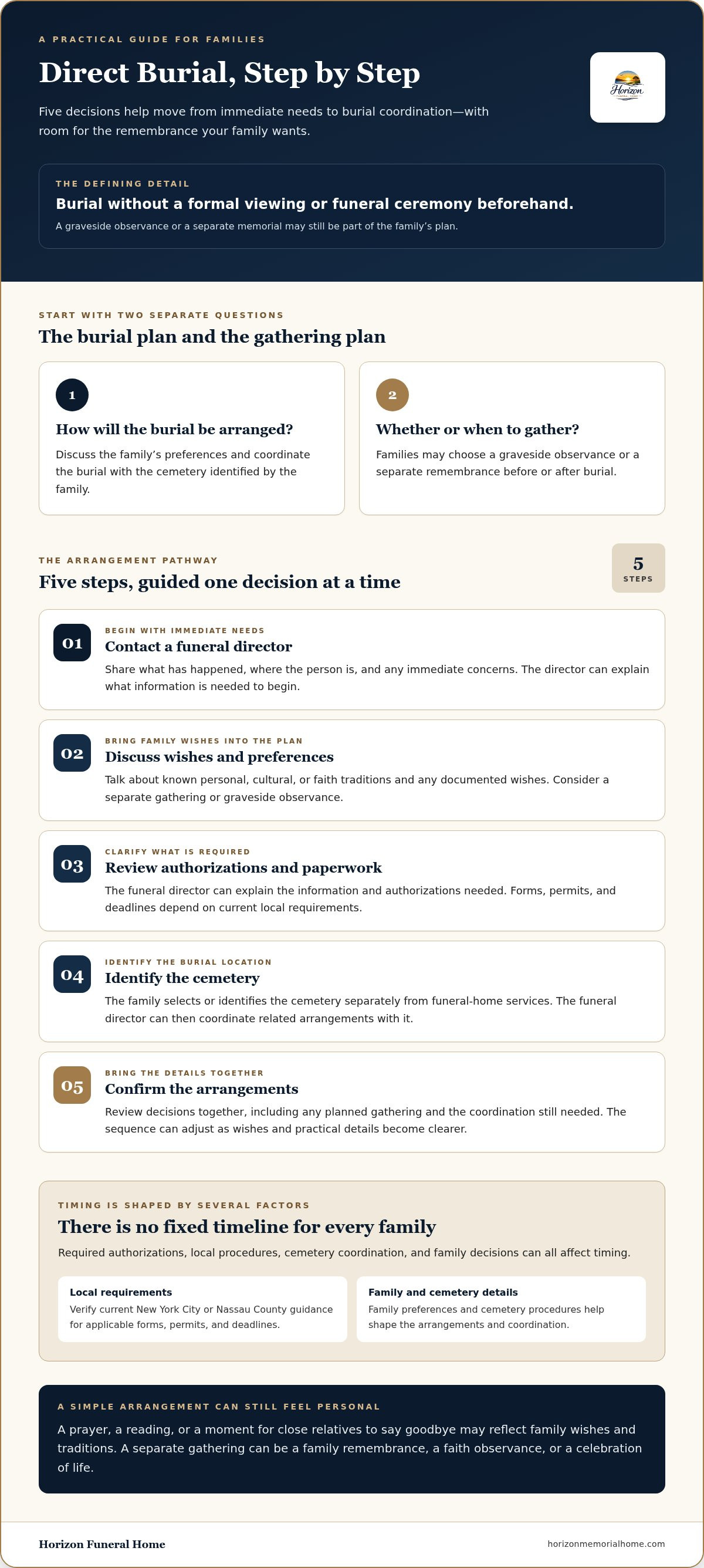
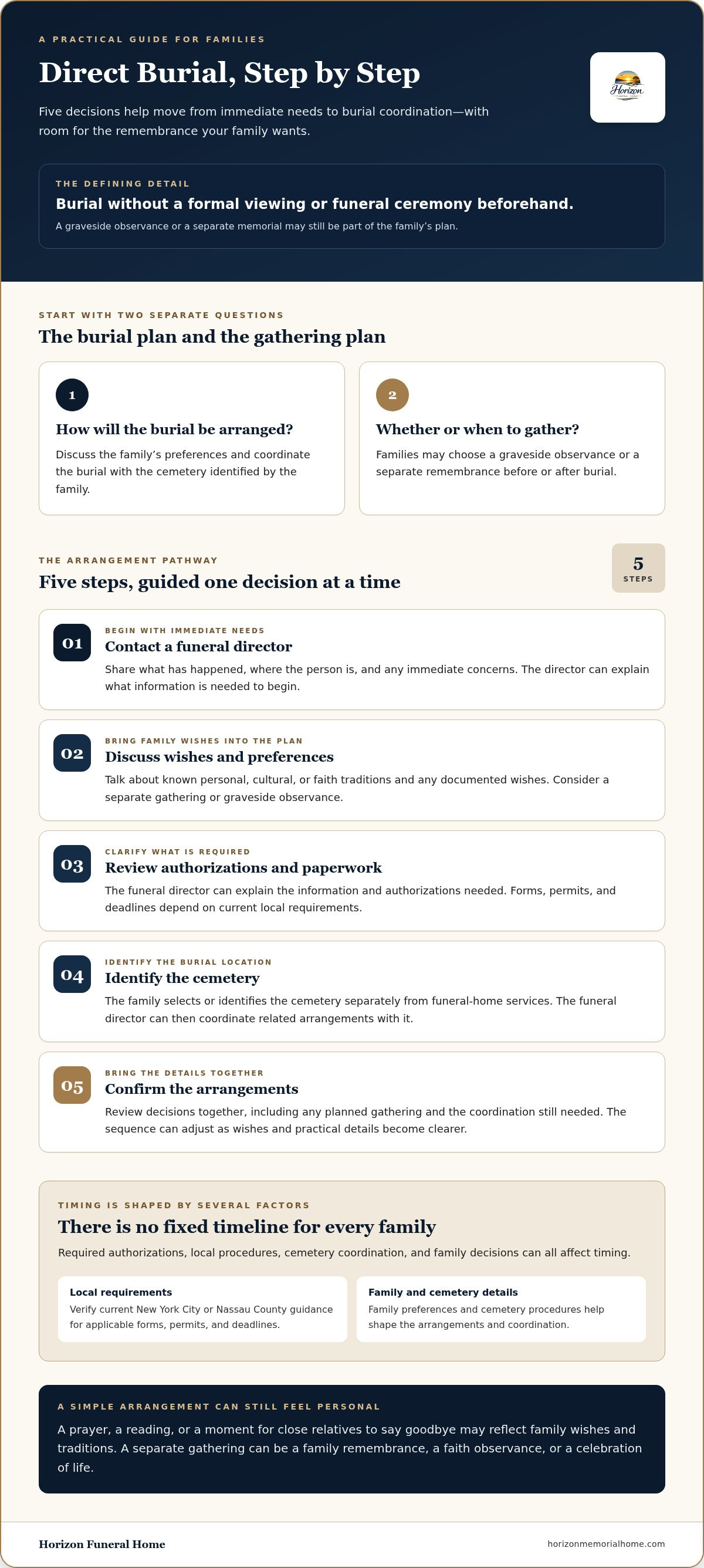
What if a simpler burial could still leave room for care, dignity, and remembrance? When you’re arranging a direct burial, it can be hard to know what the choice includes, which decisions need attention first, and how to honor your family’s traditions. The arrangements may be simpler, but the care and coordination still matter.
If paperwork, timing, or knowing where to begin feels overwhelming, you’re not alone. A funeral director can organize the necessary steps and explain your choices at a manageable pace. A direct burial generally takes place without a formal viewing or funeral ceremony beforehand. Your family may still choose a graveside observance or hold a separate gathering.
This guide walks you through the process, from understanding direct burial to considering personal or cultural wishes and planning a memorial if you’d like one. Horizon Funeral Home provides funeral direction and direct burial arrangements for families across Brooklyn, Queens, Staten Island, Manhattan, the Bronx, and Nassau County, helping you make informed decisions without feeling rushed.
Key Takeaways
- Understand how direct burial differs from a viewing, funeral ceremony, or memorial, and which gatherings can be arranged separately.
- When arranging a direct burial, start by sharing your family’s immediate needs and preferences with a funeral director.
- Compare burial and gathering options by purpose, timing, and the kind of remembrance that feels right for your family.
- Discuss authorizations, paperwork, family wishes, and cemetery coordination early, since these factors can affect timing.
- Horizon Funeral Home provides funeral direction and personalized memorial support for families across New York City and Nassau County.
Table of Contents
- What Arranging a Direct Burial Means for Your Family
- How to Arrange a Direct Burial in New York City, Step by Step
- Direct Burial or a Separate Memorial: Choosing What Feels Right
- Documents, Timing, and Questions to Discuss Before Burial
- Arrange a Direct Burial with Steady Guidance from Horizon Funeral Home
What Arranging a Direct Burial Means for Your Family
A direct burial is an arrangement in which a person is buried without a formal viewing or funeral ceremony beforehand. Families may still choose a graveside observance or a separate memorial. The details depend on family wishes and the arrangements selected. “Direct” describes a simpler approach to gathering around the burial, not a lack of care or respect.
Burial traditions differ across cultures and faiths, and personal wishes can shape what feels appropriate. A simple arrangement can still include meaningful practices, such as a prayer, a particular reading, or a moment for close relatives to say goodbye. For broader context on burial practices, see this overview of Burial.
What is typically part of a direct burial arrangement?
A funeral director guides the arrangements, coordinates practical details, and explains the decisions your family needs to make. This may include discussing your wishes and coordinating the burial with the cemetery. Funeral-home arrangements and cemetery arrangements are related, but they are separate considerations. Cemetery procedures and family preferences can shape the plan, so discuss them as you arrange the burial.
There is no single plan that suits every family. A funeral director can help clarify what matters to you and coordinate accordingly, without assuming that every simple arrangement should look the same.
Does direct burial mean there cannot be a memorial?
No. Choosing direct burial does not prevent family and friends from gathering to remember the person. Some families hold a remembrance before burial; others gather afterward, when relatives have had time to travel or decide how they would like to honor their loved one. The gathering might be a family remembrance, a faith observance, or a celebration of life.
A memorial can reflect the person’s character and family traditions without following a formal template. Horizon Funeral Home helps families coordinate personalized memorials and celebrations of life alongside funeral arrangements. For ideas on creating a personal tribute, explore personalized memorial services in Brooklyn.
How to Arrange a Direct Burial in New York City, Step by Step
When a death has occurred, you do not need to have every detail decided before reaching out. A funeral director can identify immediate needs, explain the choices, and guide your family through arranging a direct burial one decision at a time.
- 1. Contact a funeral director. Share what has happened, where the person is, and any immediate concerns. The director can explain what information is needed to begin and help organize the next steps.
- 2. Discuss wishes and preferences. Talk about known personal, cultural, or faith traditions, as well as any documented wishes. Consider whether your family would like a separate gathering or graveside observance.
- 3. Review authorizations and paperwork. The funeral director can explain what information and authorizations are needed for the arrangements. Forms, permits, and deadlines can depend on current local requirements, so verify New York City or Nassau County details against current official guidance.
- 4. Identify the cemetery. The family selects or identifies a cemetery separately from funeral-home services. Once those plans are known, the funeral director can coordinate the burial arrangements with the cemetery.
- 5. Confirm the arrangements. Review the decisions together, including any planned gathering and the coordination still needed. The sequence can adjust as family wishes and practical details become clearer.
In brief, the process moves from sharing immediate needs to discussing wishes, completing applicable authorizations, and coordinating the burial with the chosen cemetery. There is no fixed timeline for every family. Required authorizations, local procedures, cemetery coordination, and family decisions can all affect timing.
What information should the family gather first?
Gather what you already know, such as the person’s identifying details, written instructions, and preferences they shared about burial or remembrance. You do not need to assemble a complete file before speaking with a funeral director. The director can explain which information is relevant and help you work through decisions as they arise.
How does cemetery coordination fit into the process?
The cemetery is a separate part of the arrangement. Your family identifies or selects where the burial will take place, while the funeral director coordinates related arrangements with the cemetery. Procedures can differ by location, so check current local guidance for a cemetery in New York City or Nassau County. Horizon Funeral Home provides direct burial and funeral direction for families in these communities. To discuss the next steps, connect with Horizon Funeral Home.
Direct Burial or a Separate Memorial: Choosing What Feels Right
There is no single right way to honor someone. As you consider arranging a direct burial, separate two questions: how you want the burial arranged, and whether or when you would like family and friends to gather. A simpler burial can accompany a meaningful remembrance, while traditional funeral arrangements may bring the gathering and burial plans together.
| Option | Purpose | Timing and gathering |
|---|---|---|
| Direct burial | Arranges burial without a formal viewing or funeral ceremony beforehand. | The burial is the central arrangement; a graveside observance may be considered. |
| Separate memorial | Creates time and space to remember the person apart from the burial. | May take place before or after burial, with the format and gathering shaped by the family. |
| Traditional funeral arrangements | Can bring people together for a viewing, ceremony, or other observance connected with the burial. | The gathering typically takes place before burial, though specific arrangements vary. |
These options can help frame a conversation, but they are not rules about what a respectful farewell must include. Talk with the funeral director about faith, culture, privacy, and practical preferences, then shape the arrangements around what matters most. For a broader overview of the choices involved, read about traditional funeral arrangements in Brooklyn.
What if relatives want a chance to gather?
A separate gathering gives relatives and friends room to share memories, offer support, or observe a faith tradition without requiring a formal ceremony before burial. It might be an intimate family remembrance or a larger celebration of life. The location, format, and timing depend on your family’s preferences and how the arrangements come together. A ceremony is not required for a dignified goodbye.
How can family traditions guide the decision?
Traditions are personal, even within the same faith or culture. Before meeting with the funeral director, note any wishes the person expressed, practices the family hopes to observe, and preferences around privacy or gathering. The director can listen and help coordinate the choices respectfully, while making space for different perspectives among relatives.
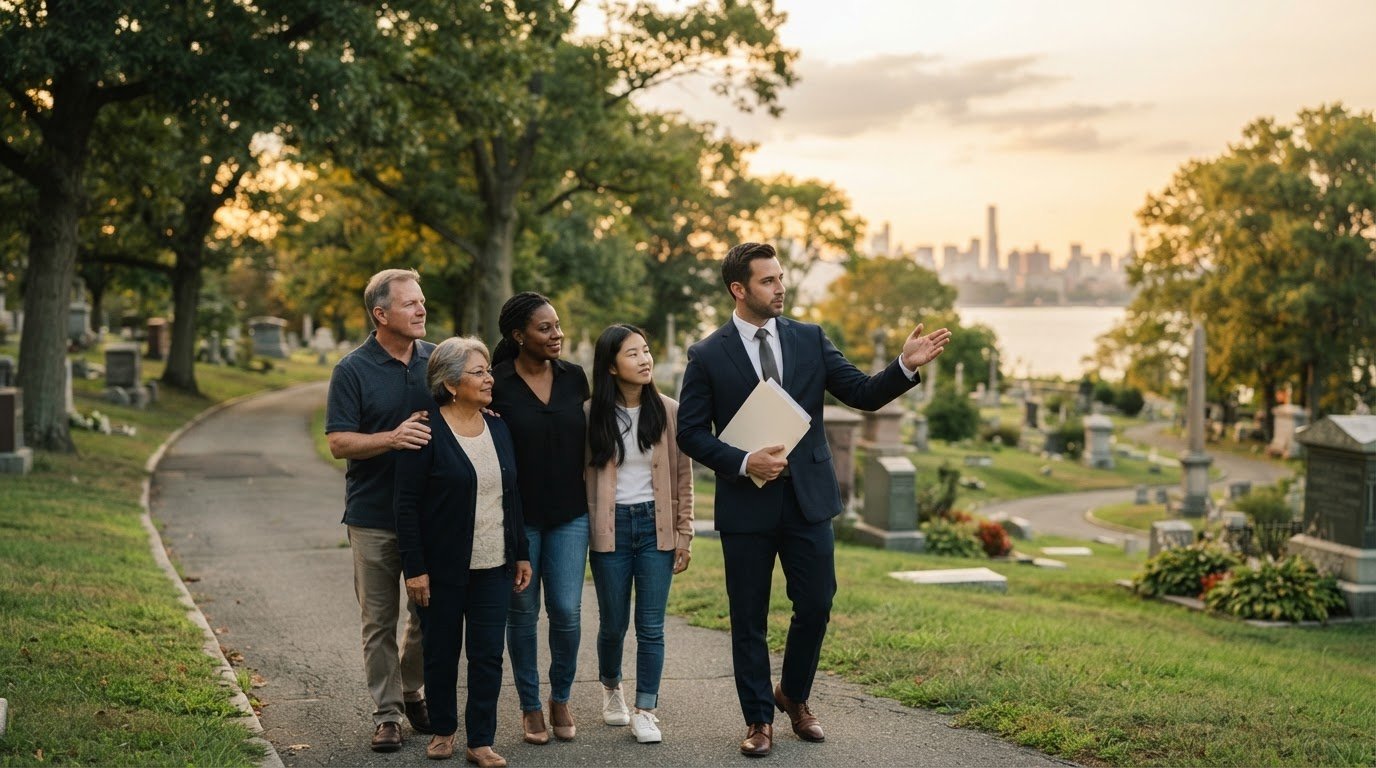
Documents, Timing, and Questions to Discuss Before Burial
Paperwork and timing can feel like a lot to manage while you’re grieving. You do not need to arrive with every document or decision in hand. Start by gathering information or written wishes you already have, then let the funeral director explain what applies to your family’s arrangements.
This checklist offers general planning guidance; legal requirements and cemetery-specific procedures depend on current rules and location. For a burial in New York City or Nassau County, verify current state and local requirements with relevant official sources. A funeral director can explain the arrangements and identify what information or authorizations are needed.
Which questions can help make arrangements clearer?
Use these prompts to focus the conversation. They are questions to discuss, not a universal list of required documents:
- What information or authorizations are needed to move forward with the arrangements?
- Which decisions need attention now, and which can be made later?
- Are there written wishes, faith practices, or family preferences we would like to share?
- Who will communicate with relatives and help gather information?
- Would a separate remembrance gathering be meaningful, and what would the family want it to feel like?
- What cemetery arrangements need to be coordinated, and who will handle each part?
You do not need to resolve every question at once. Horizon Funeral Home’s funeral direction can help you sort through choices, understand the next steps, and keep your family’s priorities in view while arranging a direct burial.
What can affect the timing of a direct burial?
Timing depends on the circumstances and the details that must come together. Required documentation or authorizations, cemetery coordination, and family decisions can each affect the sequence. Your family may also need time to communicate with relatives or decide whether to hold a separate gathering.
There is no standard number of days that applies to every arrangement. Local requirements and cemetery procedures can vary, so check current official guidance for New York-specific timing and documentation. The funeral director can explain how those requirements relate to your plans and what needs attention next.
If you are unsure where to begin, talk with Horizon Funeral Home about direct burial arrangements. A calm conversation can help turn a difficult set of questions into manageable next steps.
Arrange a Direct Burial with Steady Guidance from Horizon Funeral Home
Arranging a direct burial does not mean carrying every decision alone or settling everything at once. Your family can move through the process in manageable steps: sharing immediate needs, discussing wishes, understanding the arrangements, and coordinating the practical details. Some choices may be clear from the beginning. Others can take shape as you talk them through.
Horizon Funeral Home provides direct burial and funeral direction for families in Brooklyn, Queens, Staten Island, Manhattan, the Bronx, and Nassau County. The team can help you consider practical arrangements while keeping personal, cultural, and faith preferences in view. If your family would like to gather separately, you can also discuss a personalized memorial or celebration of life. It is an option, not an obligation.
What support can families expect from a funeral director?
A funeral director offers a steady point of contact as your family discusses preferences and works through the arrangements. You can share what matters most, ask questions as they arise, and receive guidance about the next decisions. This support connects your family’s wishes with the coordination involved in direct burial, without assuming every family needs the same kind of farewell.
What is a gentle first step for the family?
Begin with what you know. Share where the person is, any wishes they expressed, and the questions or concerns that feel most pressing. It is all right if some details are uncertain. The Horizon Funeral Home team can listen, clarify the choices ahead, and guide your family through the next steps at a considerate pace.
If a conversation would help, speak with Horizon Funeral Home about direct burial. Begin by sharing what you need right now and take the arrangements one step at a time.
Take the Next Step at Your Own Pace
Arranging a direct burial is a series of decisions, not a test of how quickly your family can make them. Understanding what the arrangement involves, gathering known wishes, and discussing timing and cemetery coordination with a funeral director can make the process feel more manageable.
A simpler burial can still reflect personal, cultural, and faith preferences. If your family would like to gather, a separate memorial or celebration of life can offer space to remember in a way that feels right. Neither choice needs to look the same for every family.
Horizon Funeral Home provides direct burial and funeral direction for families in Brooklyn, Queens, Staten Island, Manhattan, the Bronx, and Nassau County. The team can help you talk through the arrangements and consider personalized memorials, without pressure to decide everything at once.
Speak with Horizon Funeral Home about arranging a direct burial. Start with the questions or wishes on your mind today, and take the next step one at a time.
Frequently Asked Questions
What is included when arranging a direct burial?
A direct burial generally involves funeral direction and coordination of the burial without a formal viewing or funeral ceremony beforehand. The exact arrangements depend on your family’s preferences and the services selected. A funeral director can explain what information and authorizations are needed, coordinate with the cemetery, and discuss personal or faith-based wishes. Cemetery arrangements are a separate consideration, so discuss how those details fit into the plan.
Can a family hold a memorial after a direct burial?
Yes. A family can hold a memorial after a direct burial. Some families gather afterward to remember their loved one, share stories, or observe a faith tradition. The event may be an intimate family remembrance or a celebration of life. Its timing, location, and format can reflect what feels appropriate to the family. A separate gathering is optional, and a ceremony is not required for a dignified farewell.
How do you arrange a direct burial in New York City?
Begin by speaking with a funeral director and sharing the immediate circumstances, known wishes, and questions your family has. The director can guide you through decisions, explain applicable information and authorizations, and coordinate arrangements with the cemetery your family identifies. Local procedures can vary, so verify current New York City requirements with relevant official sources. Horizon Funeral Home provides direct burial and funeral direction in Brooklyn, Queens, Staten Island, Manhattan, the Bronx, and Nassau County.
How long does it take to arrange a direct burial?
There is no single timeline for every direct burial. The sequence can depend on required authorizations and documentation, family decisions, and cemetery coordination. If relatives need time to share preferences or decide whether to hold a separate memorial, that may also shape the arrangements. A funeral director can explain what needs attention next. For New York City or Nassau County, verify current local timing requirements with relevant official sources.
Is direct burial the same as a traditional funeral?
No. Direct burial generally means the person is buried without a formal viewing or funeral ceremony beforehand, although a graveside observance may be considered. Traditional funeral arrangements can include a viewing or ceremony connected with the burial. Families may arrange a separate memorial with either choice. The right approach depends on personal wishes, cultural or faith practices, and the kind of gathering the family wants, not on one approach being more respectful than another.
How much does a direct burial cost in NYC?
The cost depends on the arrangements and the services and cemetery-related expenses involved, so there is no single figure that applies to every family. Funeral-home services and cemetery costs, such as plot or grave-opening expenses, are separate considerations. Request an itemized explanation of the selected arrangements so you can understand what each part covers. Horizon Funeral Home can discuss direct burial arrangements with your family and help clarify the decisions involved without pressure.
What happens if the family has not chosen a cemetery?
If your family has not chosen a cemetery, share that with the funeral director as you discuss the arrangements. The family identifies or selects the cemetery separately from funeral-home services, and coordination can proceed as those plans take shape. Procedures may vary by location, so verify current cemetery-specific requirements. You do not need to have every detail resolved before asking for guidance; the funeral director can help you understand which decisions are ahead.