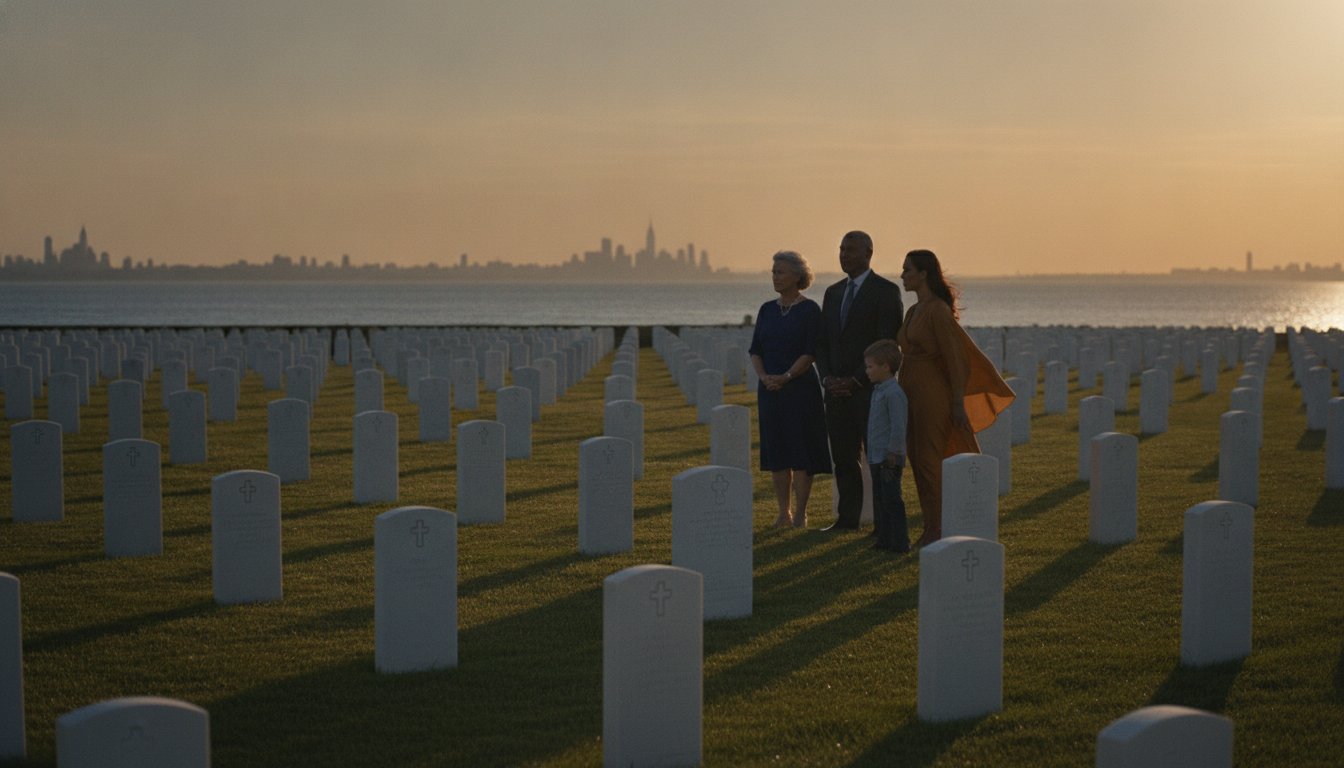
Imagine standing in a quiet corner of a national cemetery, the sound of "Taps" echoing in the air as a folded flag is placed into your hands. It's a moment of profound dignity, yet many families in the New York metropolitan area worry they might lose this opportunity because they don't fully understand military funeral honors eligibility or how to navigate the required documentation. You want to honor your loved one's service with the respect they earned, but the path to getting there often feels clouded by complex forms and military jargon.
You've already given so much as a military family. The last thing you need right now is a mountain of bureaucratic stress or the fear that a specific discharge status might disqualify your veteran. It's completely natural to feel overwhelmed by these logistics while you're trying to process your grief. We believe that every hero deserves a dignified farewell, and that the process of securing it should be a source of peace rather than a cause for anxiety.
This guide will strip away the confusion, showing you exactly who qualifies for these honors and how to secure them for your loved one. We'll walk through the essential documents you need, the specific service requirements for 2026, and how a local partner can step in to manage the military coordination on your behalf.
Key Takeaways
- Understand the symbolic elements of a professional military tribute, from the precise folding of the flag to the final sounding of Taps.
- Learn the specific requirements for military funeral honors eligibility, including the standards for active duty, reserve members, and veterans with qualifying discharge statuses.
- Identify the critical role of the DD Form 214 and discover the steps to take if your loved one's discharge papers are currently missing or damaged.
- Navigate the logistical timeline for the New York metropolitan area, including why coordinating with branch casualty offices requires at least 48 hours' notice.
- See how a dedicated funeral partner can manage the administrative coordination with military branches so you can focus on your family's healing.
Table of Contents
- What Are Military Funeral Honors and Why Do They Matter?
- Who Qualifies for Military Funeral Honors? Eligibility Criteria
- Essential Documentation: The DD Form 214 and Beyond
- Requesting Honors in the NYC Metro Area
- How Horizon Funeral Home Supports Our Veterans
What Are Military Funeral Honors and Why Do They Matter?
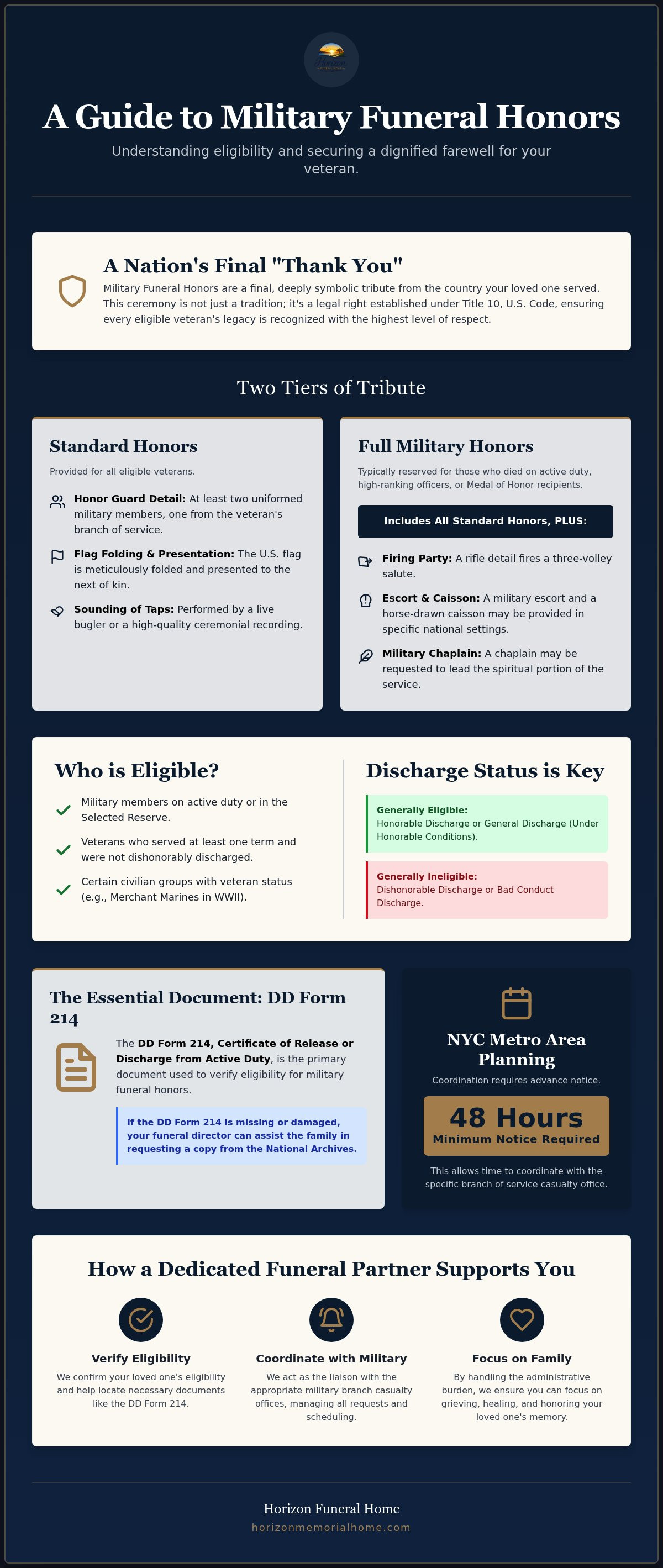
Military funeral honors are a final, deeply symbolic "thank you" from the country your loved one served. This ceremony isn't just a tradition; it's a legal right established under Title 10 of the United States Code. Understanding What Are Military Funeral Honors helps you appreciate the weight of each gesture, from the crisp snap of the flag to the haunting echo of a bugle. While the setting might change depending on whether you choose a private plot in Queens or a site at a National Cemetery, the core of the tribute remains the same. The law mandates that the Department of Defense provides these honors to any veteran who meets the requirements for military funeral honors eligibility, ensuring their legacy is recognized with the highest level of respect.
The Standard Honors Ceremony
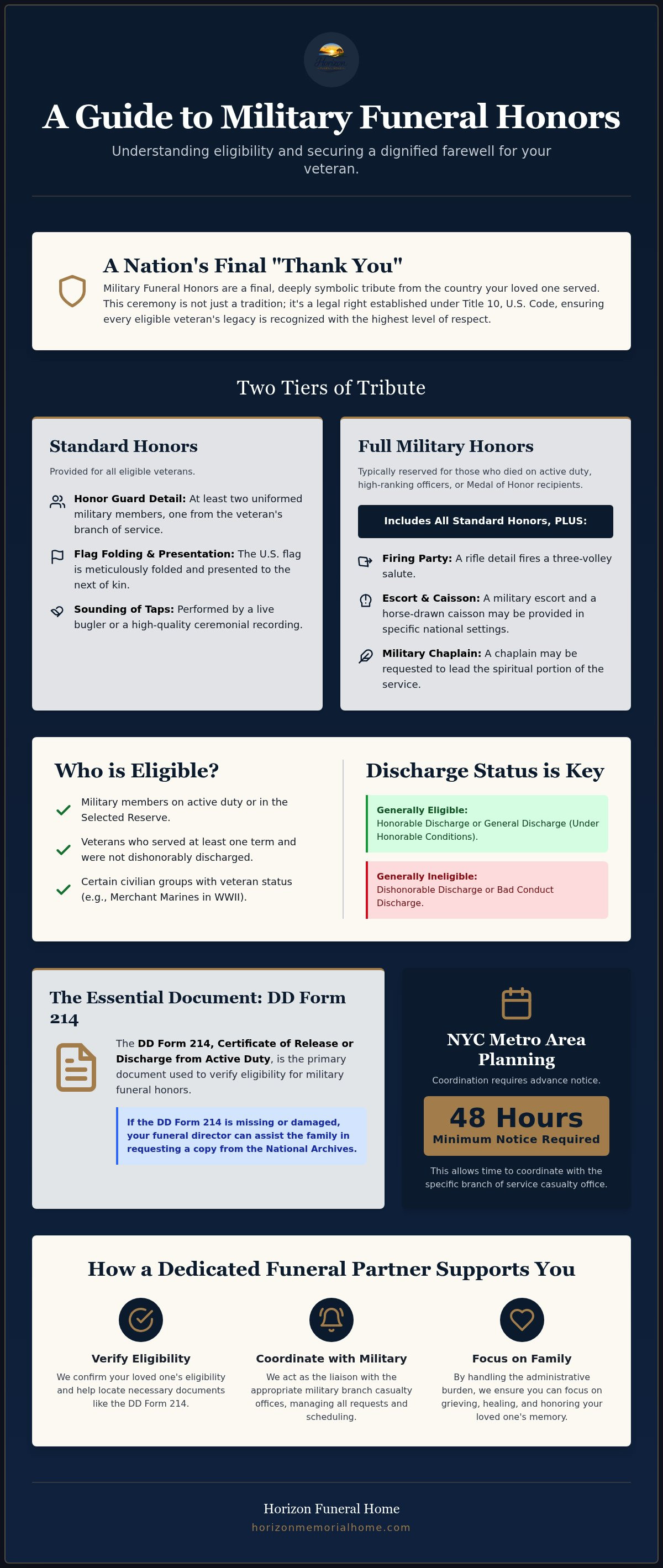
A standard ceremony provides a steady, rhythmic sense of peace during a difficult day. It requires a detail of at least two uniformed military members, with at least one representing the branch in which your loved one served. You can expect the ceremony to include the sounding of Taps, which may be performed by a live bugler or via a high-quality electronic recording. Following this, the detail will meticulously fold the United States flag into a precise triangle. This process is silent and intentional. When the flag is presented to the next of kin, the representative will lean in and speak softly. They'll say, "On behalf of the President of the United States, the United States [Branch of Service], and a grateful nation, please accept this flag as a symbol of our appreciation for your loved one's honorable and faithful service."
Full Military Honors vs. Standard Honors
While every eligible veteran receives the standard honors, some families may see additional elements based on the veteran's rank or circumstances of service. Full military honors are typically reserved for active duty members, Medal of Honor recipients, or career retirees. These services might include a firing party to perform a three-volley salute or even a horse-drawn caisson in specific national settings. A military chaplain may also be requested to lead the spiritual portion of the service, offering words of comfort that bridge the gap between service and faith. Each branch, from the Navy to the Marines, brings its own specific traditions to the graveside. These nuances ensure the ceremony feels personal to their unique story. We help you navigate military funeral honors eligibility to determine exactly which level of tribute your loved one has earned, coordinating these moving parts so you can focus on your family.
Who Qualifies for Military Funeral Honors? Eligibility Criteria
Determining if your loved one meets the criteria for military funeral honors eligibility is often the first step in planning a service that reflects their commitment to our country. While the process might feel daunting, the requirements are designed to be inclusive of those who served with dedication. Broadly speaking, honors are available to active duty service members, veterans who completed at least one enlistment with an honorable discharge, and members of the Selected Reserve or National Guard. Even certain civilian groups, such as Merchant Marines who served during specific wartime periods, may be recognized with veteran status for burial purposes.
The Military Funeral Honors ceremony is a benefit provided to those who served faithfully, and the VA maintains clear guidelines to ensure every veteran is treated with consistent respect. If you're unsure where your loved one's service falls, we can help you review their history to find the right path forward.
Understanding Discharge Status
The nature of a veteran's departure from the military is the most significant factor in determining their benefits. An Honorable Discharge serves as the primary gateway to military benefits. This status confirms that the service member met or exceeded the standards of conduct and performance during their time in uniform. Many families also ask about a "General Discharge" or service "Under Honorable Conditions." In most cases, these statuses still allow for full honors at the graveside.
However, some administrative or legal hurdles exist. Discharges labeled as "Dishonorable" or "Bad Conduct" typically disqualify a veteran from receiving military honors. These classifications are rare and usually follow specific legal proceedings within the military justice system. For the vast majority of NYC families we serve, the path to eligibility is clear and welcoming. If you have questions about a specific discharge code on a document, our team can provide a quiet, confidential review of the paperwork to give you the answers you need.
Eligibility for Reserve and Guard Members
Members of the National Guard and Selected Reserve represent a vital part of our local community, and their service is honored with the same dignity as active duty members. To qualify, a Guard or Reserve member typically must have completed at least one full term of enlistment and received an honorable discharge. If a member passed away while still actively serving in the Selected Reserve, they are automatically eligible for honors regardless of their length of service.
Documentation for these branches can sometimes be different than the standard DD Form 214. For National Guard members, the NGB Form 22 is often the essential document needed to verify service time and discharge status. Additionally, if a veteran was discharged due to a service-connected disability before completing their full enlistment, they often remains eligible for a full military tribute. We understand that these nuances can feel like a lot to manage, but we are here to stand beside you as you gather these necessary details.
Essential Documentation: The DD Form 214 and Beyond
The DD Form 214, officially titled the "Certificate of Release or Discharge from Active Duty," is the most critical document you will need to secure a veteran's tribute. It acts as the definitive record of a service member's time in uniform, detailing their dates of service, rank, and the nature of their departure. Without this paperwork, military casualty offices cannot verify military funeral honors eligibility, which can lead to painful delays during an already difficult time. Preparing these papers ahead of time through funeral preplanning services NYC ensures that your focus remains on your loved one's memory rather than a search for misplaced folders.
While the DD214 is the standard, don't feel discouraged if you cannot find it immediately. Military casualty offices may sometimes accept alternative records, such as an NGB Form 22 for National Guard members or official discharge certificates from older eras of service. The key is providing a government-issued document that clearly states the character of service. These records are the bridge that allows the Department of Defense to confirm eligibility for military funeral honors and dispatch a detail to the ceremony.
How to Request a Replacement DD214
If your loved one's papers are lost or damaged, the National Archives offers a system called eVetRecs to handle urgent requests. When a death has occurred, these requests are often prioritized to ensure honors can be performed on schedule. To start this search, you'll need the veteran's full legal name, Social Security number, branch of service, and approximate dates of enlistment. We often step in to help families navigate this system, using our experience to expedite the search and reduce the administrative burden on your shoulders.
Identifying the 'Character of Service'
When you locate the DD214, you must ensure you have the "Member 4" copy. This specific version contains the "Character of Service" box, usually located in Box 24, which is required to confirm military funeral honors eligibility. The "Member 1" short-form copy is often insufficient because it omits the discharge status. You'll want to look for terms like "Honorable" or "Under Honorable Conditions." You might also see various abbreviations or "RE" codes. These are internal military markers, and we can help you decode them to ensure your loved one receives every benefit they've earned through their dedicated service.
Requesting Honors in the NYC Metro Area
Securing a military tribute in a city as fast-paced as New York requires a steady hand and a clear timeline. To ensure a branch representative can attend the service, the military generally requires at least 48 hours' notice. This lead time allows the regional casualty office to verify military funeral honors eligibility and assign a dedicated detail to the ceremony. Whether you are planning a service at a local funeral home or a graveside committal, this window is essential for seamless coordination. You have the right to choose where these honors take place, ensuring the tribute fits the unique needs of your family.
Coordinating with Local Military Branches
New York City is served by regional casualty offices for the Army, Navy, Air Force, Marines, and Coast Guard. These offices manage the schedules of honor guards across the five boroughs and Nassau County. Sometimes, if a specific branch detail is unavailable due to high demand, inter-service support may be arranged. This ensures that another branch steps in to provide the honors so that no veteran goes without their earned tribute. This coordination is a standard part of traditional funeral arrangements in Brooklyn, where local logistics can be complex. We step in to manage these phone calls and scheduling details, acting as your advocate with the military coordinators.
National Cemeteries Serving NYC
For many families in our community, the final resting place is one of the national cemeteries nearby. Calverton National Cemetery on Long Island serves as a primary site for NYC veteran burials, offering a peaceful and expansive setting for a final farewell. Long Island National Cemetery is another significant option, while Cypress Hills National Cemetery in Brooklyn holds deep historical ties to the city, though it is primarily limited to existing family plots. Scheduling a service at these locations involves a specific intake process through the VA.
When honors are performed at a national cemetery, they typically take place at a committal shelter. This provides a sheltered, dignified space for the sounding of Taps and the presentation of the flag. We work directly with the National Cemetery Scheduling Office to align the burial time with the arrival of the military detail. This careful planning ensures the ceremony flows naturally without any feeling of rush or confusion. If you are ready to begin this process, reach out to our team to start coordinating these honors for your loved one.
How Horizon Funeral Home Supports Our Veterans
At Horizon Funeral Home, our commitment to honoring our heroes in New York is the heartbeat of what we do. We understand that while you want to provide a dignified tribute, the weight of paperwork can feel like an unnecessary barrier during a time of loss. Our role is to act as your meticulous coordinator, stepping in to manage the complex details so you can focus on your family's healing and the legacy of the person you loved. We don't just provide a service; we provide a sanctuary of stability when everything else feels uncertain.
Beyond the ceremony itself, we offer ongoing support to help your family navigate the financial and commemorative benefits available through the Department of Veterans Affairs. This includes assisting with applications for VA burial allowances and coordinating the arrival of government-furnished headstones or markers. We stay beside you long after the service ends, ensuring that every benefit earned through years of service is properly secured and respected.
Logistical Coordination on Your Behalf
Navigating the requirements for military funeral honors eligibility involves several moving parts that we are uniquely equipped to handle. Our team takes the lead in verifying service history and, if necessary, securing the correct copy of the DD214 through the appropriate channels. We maintain steady, professional relationships with the military casualty offices across the NYC metro area, ensuring that your request for an honor guard is processed accurately and promptly. By handling these administrative hurdles, we ensure that every element of the ceremony, from the arrival of the detail to the final sounding of Taps, is executed with the quiet dignity your veteran deserves.
A Steady Guide Through the Process
We've seen how clear, patient communication can lower a family's anxiety. Our expertise allows us to answer your questions with confidence, whether you're curious about military funeral honors eligibility or the specific traditions of a particular branch. Beyond the formal honors, we specialize in helping you create personalized memorial services in Brooklyn that reflect the individual story of the person who served. This might include displaying personal mementos, playing specific music, or incorporating cultural traditions alongside military protocol. Our goal is to ensure the service feels like a true reflection of their life and character. We invite you to call us for a free consultation to discuss your loved one's veteran benefits and how we can help you secure the honors they've earned.
Honoring a Legacy of Service in New York
Honoring a veteran is about more than just protocol; it is about recognizing a life of sacrifice and dedication with the dignity it deserves. We have explored how the DD Form 214 serves as the essential key to your loved one's benefits and how the regional casualty offices across New York City coordinate these moving tributes. Understanding military funeral honors eligibility is the first step toward a dignified farewell, but you don't have to navigate these requirements by yourself. By preparing your documentation and understanding the specific timelines for local national cemeteries, you can ensure a smooth and respectful ceremony that truly reflects their story.
Our team stands ready to manage every logistical detail, from branch coordination to VA benefit assistance, with the empathy and local expertise your family deserves. We act as your steady guide, lifting the administrative burden so you can focus on healing. Secure the honors your loved one earned; contact Horizon Funeral Home today. You don't have to walk this path alone. We are here to provide the quiet confidence and professional reliability you need to find peace during this time of transition.
Frequently Asked Questions
Who is eligible for military funeral honors?
Military funeral honors are available to active duty service members, veterans who completed at least one enlistment with an honorable discharge, and members of the Selected Reserve or National Guard. This also includes certain civilian groups like Merchant Marines with veteran status. Families across Brooklyn and the five boroughs can access these tributes as long as the discharge status is other than dishonorable. We help you verify these details to ensure your loved one receives the recognition they earned.
How do I prove my loved one is eligible if I don't have their papers?
If you can't find the DD Form 214, you can request a replacement through the National Archives eVetRecs system. When a death has occurred, these requests are often prioritized to meet funeral timelines. We act as your advocate by helping you gather necessary information like Social Security numbers and service dates to expedite the search. Having these records ready is a key part of our commitment to supporting NYC families during their time of need.
Are military funeral honors free for the family?
Yes, the military provides the honor guard, the ceremonial flag folding, and the sounding of Taps at no cost to the family. This is a legal right for those who meet military funeral honors eligibility requirements. While the funeral home may charge a fee for the professional coordination of these logistics, the military personnel themselves never accept payment. We ensure these honors are seamlessly integrated into your service without any hidden administrative stress.
Can a veteran with a General Discharge receive honors?
Yes, veterans with a General Discharge under honorable conditions are typically eligible for military honors. The primary requirement is that the character of service is not "Dishonorable" or "Bad Conduct." If you are looking at a document and feel unsure about the codes or abbreviations, we can provide a quiet, expert review of the paperwork. Our goal is to ensure every eligible veteran in the New York area receives a dignified farewell.
Does the military provide a firing party for every funeral?
A firing party is not part of a standard military honors ceremony. Most veterans receive the standard detail, which includes at least two uniformed members who fold the flag and play Taps. Full honors, which can include a firing party or a caisson, are generally reserved for career retirees, active duty members, or Medal of Honor recipients. We coordinate with the specific branch casualty office to determine exactly which honors your loved one has earned.
How much notice does the military need to provide an honor guard?
The military casualty offices in the NYC metro area generally require at least 48 hours of notice to schedule an honor guard. This time allows the branch to verify military funeral honors eligibility and assign a team to your location in Brooklyn, Queens, or Nassau County. While we always strive to accommodate shorter timelines, providing this notice ensures the detail can be present. We manage this scheduling directly so you can focus on being with your family.
Can we have military honors at a private cemetery in Brooklyn?
You can absolutely have military honors at a private cemetery in Brooklyn or anywhere else in the metropolitan area. Honors are not restricted to national cemeteries; they can take place at a funeral home, a house of worship, or a private family plot. Whether you are at a historic site like Green-Wood or a local parish, we coordinate with the military detail to ensure the ceremony is performed with the same level of respect.
What happens if the veteran died while on active duty?
When a service member dies while on active duty, they are eligible for Full Military Honors. In these cases, the military branch assigns a Casualty Assistance Officer to work alongside the family. We partner closely with this officer to manage the funeral arrangements and logistics. This ensures that the high level of protocol required for active duty honors is met while providing your family with a steady, supportive presence here in New York.