
When a Catholic family is grieving, the days after a death can bring both deep sorrow and many decisions. This guide to Catholic funeral rites offers a clear, gentle overview of what may take place, what the Church’s rituals mean, and how to begin making arrangements that honor your loved one’s faith and life.
Catholic funeral rites are not simply a sequence of services. They are prayers of commendation, centered on the belief in Christ’s resurrection and the dignity of every person. While customs can vary by parish, culture, and family tradition, the Church generally celebrates three principal moments: the Vigil, the Funeral Liturgy, and the Rite of Committal.
The Three Parts of Catholic Funeral Rites
The rites may occur over two or three days, though families can adapt the schedule when travel, work, health, or other circumstances make that necessary. A funeral director can coordinate with the parish and help create a timetable that gives family members room to gather without adding unnecessary pressure.
The Vigil: A Time for Prayer and Remembrance
The Vigil for the Deceased, often called a wake or prayer service, usually takes place at a funeral home, family home, or church. It gives relatives, friends, and parish members a place to come together, offer condolences, and pray for the person who died.
A priest, deacon, pastoral minister, or another qualified leader may lead the Vigil. Scripture readings, prayers, and a litany for the deceased are common. The service can also include a eulogy or personal words of remembrance, depending on parish practice. In many families, the Vigil is where stories are shared most naturally - a favorite memory, a person’s generosity, their devotion to family, or the quiet details that made them themselves.
The Vigil does not need to be elaborate to be meaningful. For some families, a brief evening prayer service is right. For others, a longer visitation with a formal Vigil offers needed time for loved ones to arrive, especially when family is traveling to Brooklyn or from out of state or abroad.
The Funeral Liturgy: Usually a Funeral Mass
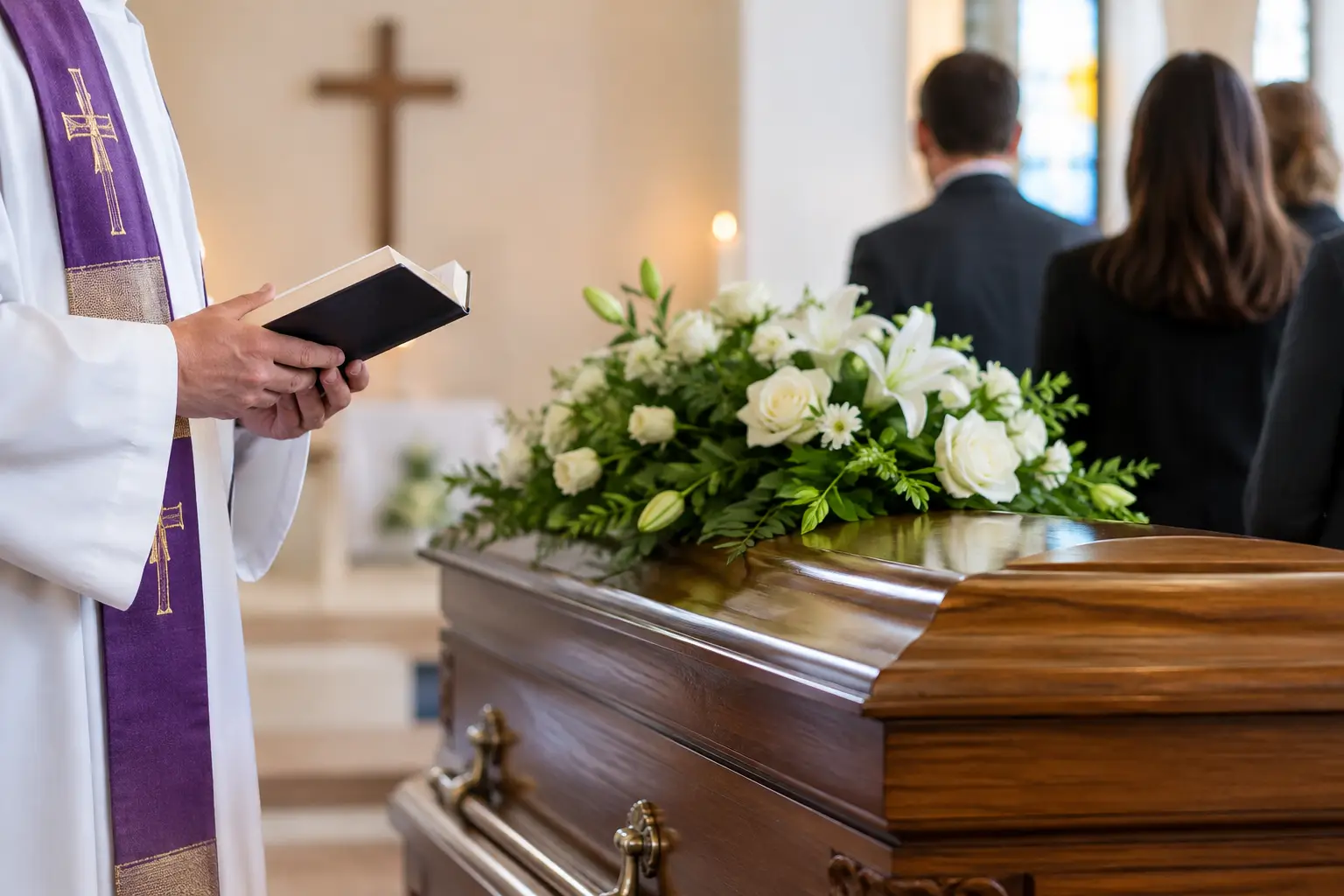
The Funeral Liturgy is the central celebration of Catholic funeral rites. When possible, it is celebrated as a Funeral Mass in the parish church. The Mass includes the Liturgy of the Word, the Eucharist, prayers for the deceased, and the final commendation.
At the beginning of the Mass, the casket or urn is received at the church. A pall, a large white cloth, may be placed over the casket as a sign of baptismal dignity and equality before God. The Easter candle is often placed nearby, expressing Christian hope in the resurrection. Family members may be invited to bring forward the bread and wine, read Scripture if they are comfortable doing so, or participate in other appropriate ways.
Near the end of the Mass, the priest offers the final commendation. Incense may be used as a sign of honor and prayer rising to God, and holy water may be sprinkled as a remembrance of baptism. These gestures can feel especially moving because they acknowledge both the reality of loss and the Church’s promise of prayerful care.
A eulogy is not traditionally part of the Funeral Mass itself, because the Mass is primarily directed toward worship and prayer for the deceased. Many parishes permit brief words of remembrance before the Mass begins, after Communion, or at the Vigil. The parish can explain its local practice. If several people wish to speak, the funeral home or reception afterward may offer a more comfortable setting.
When a Funeral Mass Is Not Possible
Sometimes a Funeral Mass cannot be arranged. This may be because a priest is unavailable, the family’s schedule is limited, or the deceased was not able to receive the sacraments regularly. In those circumstances, the Church may offer a funeral service outside of Mass, often led by a deacon or lay minister.
This service still includes Scripture, prayers, and the final commendation. It is a fully respectful Catholic funeral liturgy, not a lesser expression of care. A family should never feel that circumstances have prevented them from giving their loved one a faithful farewell.
The Rite of Committal: The Final Farewell
The Rite of Committal takes place at the cemetery, mausoleum, or other place of burial. It is usually brief, but it carries great meaning. The priest or deacon leads prayers as the body is buried or placed in a mausoleum, entrusting the deceased to God’s care.
For many families, this is the hardest moment of the day. It can also be a moment of quiet support, as relatives stand together, make the sign of the cross, and say goodbye. Military honors, when appropriate for a veteran, are generally coordinated around the committal and can be included respectfully alongside Catholic prayers.
A Guide to Catholic Funeral Rites and Cremation
The Catholic Church permits cremation, provided it is not chosen for reasons contrary to Christian belief in the resurrection. A Catholic Funeral Mass may be celebrated with the body present before cremation, which remains the Church’s preferred practice. But a Mass or funeral liturgy may also be celebrated with cremated remains present.
Cremated remains should be treated with the same reverence given to the body. The Church directs that ashes be buried in a cemetery, placed in a mausoleum, or interred in another sacred place. Keeping ashes permanently at home, dividing them among family members, or scattering them is generally not consistent with Catholic teaching.
This can be difficult when a family holds different views or wants to honor a loved one in a particular way. It helps to discuss the options early with the parish and funeral director. A cemetery niche, family plot, or burial of cremated remains can provide a permanent place for prayer and remembrance while respecting the family’s needs.
Practical Choices Families Can Make
Catholic funeral rites provide a spiritual framework, but there is still room to reflect the person’s life and your family’s traditions. The parish will guide what is appropriate during the liturgy, while the funeral home can help with the surrounding arrangements.
Families may choose Scripture readings and hymns with the parish’s approval. They may display photographs at the visitation, select a meaningful casket or urn, arrange flowers, prepare an obituary, and host a meal or gathering afterward. In multilingual households, prayers, readings, or personal remarks may sometimes be offered in another language if the parish can accommodate them.
If the death has occurred away from home, transportation can add another layer of decisions. Whether a loved one needs to be brought to New York, sent to another state, or transported internationally, the funeral rites can still be planned around the family’s parish, cemetery, and preferred schedule. Clear coordination helps protect time for prayer rather than leaving the family to manage logistics alone.
What to Do First After a Death
If a death has just occurred, start with the immediate care needed and contact a funeral home. Let the funeral director know that the family would like Catholic rites. They can contact the parish, confirm the priest or deacon’s availability, arrange transportation, and help schedule the Vigil, church service, and cemetery committal.
If your loved one had a parish, call that parish as soon as you are able. Share the person’s name, date of death, and any known wishes. If there is no current parish connection, a funeral director can help identify a local Catholic parish and explain the available options.
Bring questions with you. Families often need clarity about whether a viewing is required, whether cremation is permitted, who may read at Mass, or how to arrange burial. There is no need to know every answer at the first meeting. A caring team should explain each choice plainly and allow you time to decide.
At Horizon Funeral Home, families can receive support with these arrangements around the clock, including coordination with parishes, cemeteries, and families traveling from different places. The purpose is not to rush decisions, but to create order and space for what matters most.
A Catholic funeral does not remove grief, and no service can capture every part of a loved one’s life. But prayer, familiar ritual, and the presence of people who care can give a family a place to set down some of what they are carrying. Take one decision at a time, and let the rites hold both your sorrow and your hope.