
Imagine receiving the news of a loved one's passing while you're thousands of miles away, perhaps in another state or even across an ocean. The immediate weight of grief is heavy enough without the sudden, overwhelming realization that you aren't physically there to handle the next steps. It's a deeply unsettling feeling to be separated from someone you care for by borders and time zones. You likely feel a sense of urgency to act, yet you're unsure where to begin with funeral planning for non-residents. You're not alone in this uncertainty.
It's natural to feel anxious about the complexities of transporting a body across state lines or coordinating with international consulates. You want to ensure your loved one is treated with the highest level of dignity, but the distance makes you feel disconnected from the process. This article will help you navigate these logistical hurdles with clarity and professional support. We'll walk through the essential steps of repatriation, explain the necessary legal documentation, and show you how a reliable partner in New York City can handle the local details so you can focus on healing. You'll gain a clear understanding of how to bring your loved one home with peace and steady guidance.
Key Takeaways
- Learn how to navigate the specific legal requirements and cross-jurisdictional challenges that arise when a death occurs away from home.
- Understand the detailed process of repatriation, including the logistical differences between domestic transfers and international transportation.
- Explore whether a traditional service or direct disposition best honors your loved one’s memory while managing the practicalities of distance.
- Identify the essential documents and immediate steps required for funeral planning for non-residents to ensure a smooth, dignified transition.
- Discover how professional coordination acts as a steady presence, managing complex paperwork and airline logistics to provide your family with peace of mind.
Table of Contents
- Understanding Funeral Planning for Non-Residents
- The Logistics of Worldwide Transportation and Repatriation
- Comparing Options: Traditional Service vs. Direct Disposition for Non-Residents
- Checklist for Families Planning from a Distance
- Why Expert Guidance Matters for Non-Local Families
Understanding Funeral Planning for Non-Residents
Losing a loved one is a profound experience that demands your full emotional presence. When that loss happens far from home, or when you wish to bring someone back to New York for their final rest, the logistical burden can feel like a barrier to your grieving process. Standard funeral guides often assume you're standing in the same zip code as the funeral home. However, funeral planning for non-residents requires a different level of coordination and specialized knowledge of cross-jurisdictional laws.
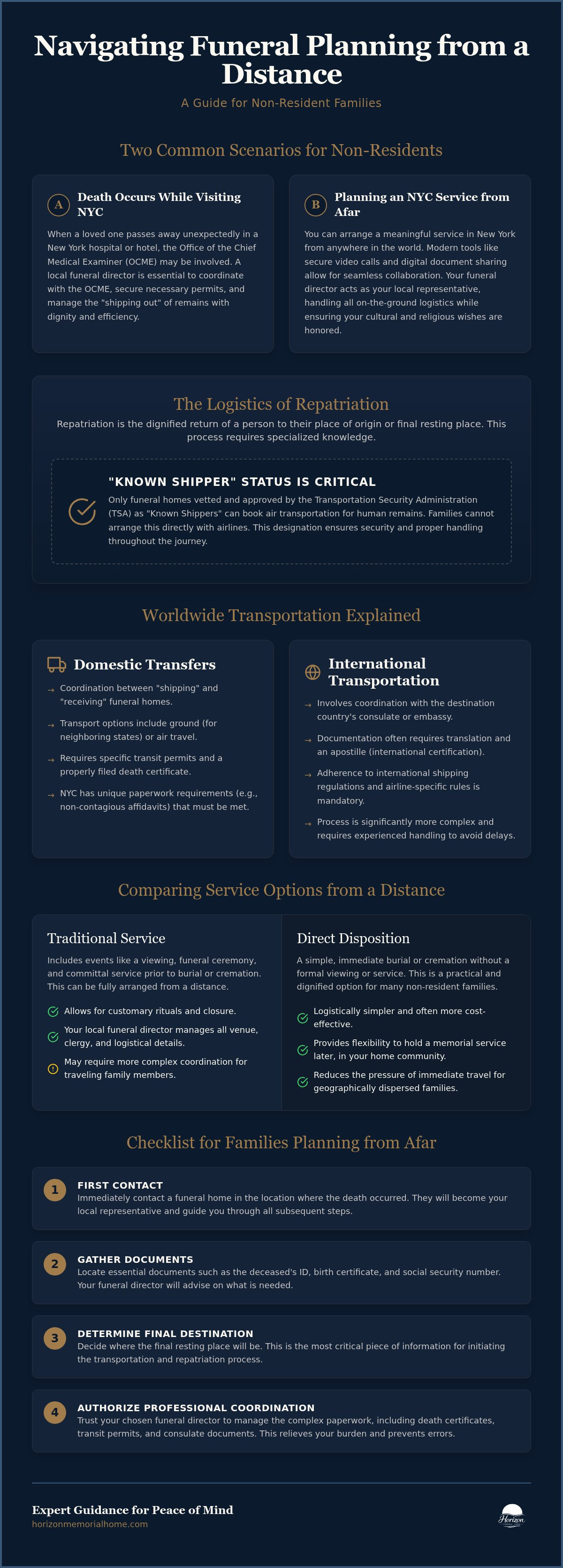
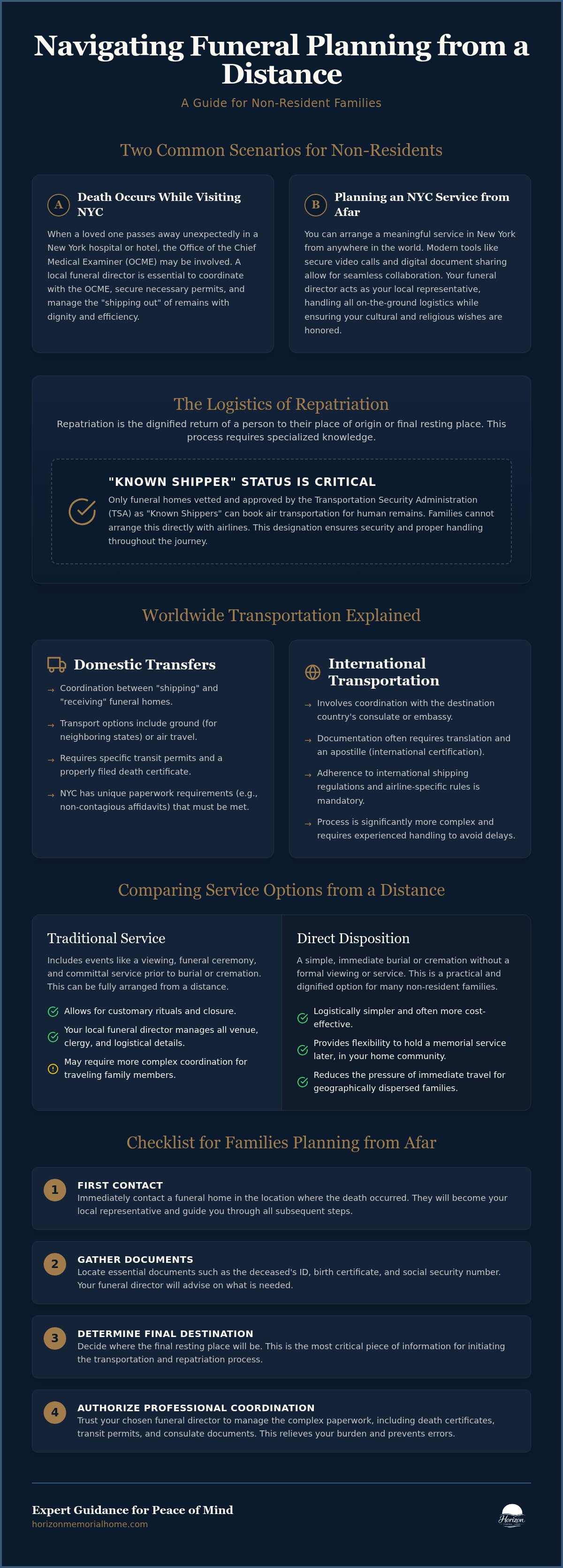
The process usually involves one of two paths. You might be dealing with an unexpected death while a family member was visiting the city, or you might be trying to bring a loved one back to a family plot in New York from another state or country. Both scenarios involve Repatriation, which is the dignified return of a person to their place of origin. Because regulations vary significantly between jurisdictions, a specialized funeral director becomes your vital local representative. They handle the complex paperwork and physical logistics so you don't have to navigate the bureaucracy alone.
Scenario A: When a Loved One Passes Away While Visiting NYC
If a death occurs in a New York hospital or hotel, the immediate steps can feel overwhelming. In many cases, the New York City Office of Chief Medical Examiner (OCME) may become involved to certify the cause of death. This is a standard procedure, but it adds a layer of legal requirements. It's essential to partner with a firm experienced in "shipping out" remains. They'll coordinate directly with the OCME and ensure that all transit permits are secured promptly, maintaining a steady pace that respects your family's timeline and the dignity of the deceased.
Scenario B: Planning a NYC Service from Another State or Country
Distance doesn't mean you lose your voice in the process. You can effectively arrange a funeral in Brooklyn or Queens from anywhere in the world. Modern technology has made this easier, allowing families to bridge the gap through digital arrangement tools. We use these resources to share documents and finalize details through secure video calls. This partnership ensures that specific cultural or religious needs are honored with the same care as if you were here in person. By serving as your local guide, we manage the NYC metro area logistics while you focus on the emotional needs of your family.
The Logistics of Worldwide Transportation and Repatriation
When you're faced with the task of moving a loved one across great distances, you're entering a process known as repatriation. At its heart, this is the dignified return of a person to their place of origin or their final resting place. It's a journey that requires meticulous coordination and a deep understanding of transport regulations. One of the most critical aspects of this process is the "Known Shipper" status. Only licensed funeral homes that have been vetted and approved by the Transportation Security Administration (TSA) can book airfare for human remains. You cannot make these arrangements directly with an airline; you need a partner who holds this professional designation to act on your behalf.
In the New York metro area, the paperwork can be particularly dense. Unlike other regions, NYC has specific requirements for transit permits and non-contagious affidavits that must be secured before any movement occurs. If the death is under the jurisdiction of the Medical Examiner, these steps require even more precise timing. We manage these local hurdles daily, ensuring that death certificates are filed correctly and that every legal requirement is met without adding to your stress. This level of detail is a cornerstone of funeral planning for non-residents, as it prevents the logistical delays that can occur when a firm isn't familiar with the city's unique bureaucracy.
Navigating Domestic Transfers Within the United States
Moving a loved one between states involves a careful hand-off between a "shipping" funeral home and a "receiving" funeral home. We coordinate this entire relay for you. Depending on the distance, we'll help you decide between ground transportation and air transport. Ground transport is often a gentle, direct option for neighboring states, while air travel is necessary for longer distances. Each method has its own set of requirements, but our goal is always to find the most dignified and efficient path forward for your family.
Managing International Repatriation from New York
International transfers are significantly more complex and involve working closely with foreign consulates and embassies located right here in New York City. Each country has its own strict set of rules. We handle the specialized tasks of obtaining Apostilles, which are international certifications for documents, and arranging for professional translations when required. Our team has specific expertise in shipping to diverse regions, including Georgia and Armenia, where we understand the unique cultural expectations and consulate requirements. We also ensure compliance with CDC requirements for importing human remains when bringing a loved one back into the United States. If you're feeling overwhelmed by these global requirements, you might find it helpful to speak with a worldwide transportation specialist who can explain the process at a pace that feels comfortable for you.
Comparing Options: Traditional Service vs. Direct Disposition for Non-Residents
Deciding how to honor a loved one while managing the logistics of distance is a deeply personal choice. You might feel torn between holding a service in the city where they lived for decades and moving them immediately to a family plot elsewhere. In the context of funeral planning for non-residents, we often help families weigh the emotional value of a local farewell against the practicalities of transportation. There isn't a single right answer; there's only the path that brings your family the most peace. Taking the time to evaluate these options ensures that the final tribute feels authentic to your loved one’s story.
A full service in New York before transportation allows local friends and colleagues to pay their respects. This is often a vital step for those who spent a significant portion of their lives here. However, it does require additional coordination, as the body must be prepared for both a viewing and subsequent travel. On the other hand, choosing immediate repatriation or a direct disposition can simplify the timeline. We provide a steady hand to help you perform a cost-benefit analysis of these choices, looking at both the financial aspects and the emotional needs of those left behind.
Traditional Services for the "Coming Home" Scenario
Many people who moved away from the NY metro area still consider it home. For these families, traditional funeral arrangements in Brooklyn provide a sense of closure that a distant service might not achieve. You can organize a viewing or a religious ceremony that honors their New York roots before they begin their journey to a final resting place. We specialize in creating personalized memorial services in Brooklyn that bridge these two worlds. It's a way to balance local traditions with the requirements of the destination, ensuring the transition is handled with grace.
Streamlining the Process with Direct Burial or Cremation
Sometimes, the most supportive thing we can do is simplify the process. Direct burial or cremation is often the most practical choice when funeral planning for non-residents, especially when travel needs are urgent. A direct burial involves moving the deceased to their final resting place without a preceding ceremony in New York. If you choose cremation, you gain a significant amount of flexibility. Transporting cremated remains is less complex and allows your family the time needed to plan a meaningful memorial at a later date, in a location that's most convenient for everyone to gather. This approach reduces the immediate logistical pressure while still maintaining the dignity your loved one deserves.
Checklist for Families Planning from a Distance
The first 48 hours following a loss are often a blur of phone calls and heavy decisions. When you're managing these moments from a distance, the list of tasks can feel insurmountable. Success in funeral planning for non-residents depends on a clear, prioritized approach. You don't need to do everything at once. Focus first on securing your loved one's physical safety and establishing a chain of communication. This initial window is about gathering information and choosing a steady partner who can act on your behalf in New York City.
Step 1: Establishing Local Representation
You might not be able to be physically present to sign every form or visit the hospital. Selecting a NYC funeral director to act as your legal proxy is the most important decision you'll make. This professional serves as your eyes and ears on the ground. One of their first tasks is authorizing the release of remains from a medical facility or the New York City Office of Chief Medical Examiner (OCME). By setting up a primary point of contact, you ensure that information flows through one reliable channel. This reduces the risk of conflicting instructions and provides you with a single, calm voice to guide you through the logistics.
Step 2: Documentation and Legal Compliance
Documentation is the backbone of this process, especially when crossing state or international lines. You'll need to secure multiple certified copies of the death certificate; many jurisdictions require their own original copies for local filing. In New York, applying for the NYC Burial/Transit Permit is a mandatory step that must be completed before any transportation occurs. If your loved one was a member of the armed forces, honoring our heroes with veteran funeral honors adds another layer of coordination. We handle these applications for you, ensuring that every document is filed correctly to avoid delays.
There are also practical financial steps to consider. Under the FTC Funeral Rule, you're entitled to an itemized price list, even when coordinating from afar. This ensures you only select the services that truly matter to your family. You should also check for a one-time Social Security lump-sum death payment of $255, which is available to eligible spouses or children if you apply within two years of the death. If you're feeling unsure about where to start, you can reach out to a compassionate coordination expert to help organize your next steps.
Why Expert Guidance Matters for Non-Local Families
Managing a death from a distance adds a layer of isolation to an already painful time. You’re trying to honor a legacy while navigating a sea of unfamiliar regulations and time zones. This is where funeral planning for non-residents becomes less about a checklist and more about finding a steady hand to hold. A professional coordinator doesn't just fill out forms; they carry the weight of the logistics so you can focus on the emotional reality of your loss. By managing the minute details of the NYC metro area, we reduce the risk of logistical delays that can so often prolong a family’s distress. This partnership allows you to step back from the role of a coordinator and return to the role of a grieving family member.
A Sanctuary of Support in the NYC Metro Area
At Horizon Funeral Home, we view ourselves as your local family surrogate. We understand that you can't be in two places at once, and you shouldn't have to be. Our commitment is to provide unhurried, methodical care for funeral planning for non-residents that mirrors a supportive, face-to-face conversation. Whether your loved one is being moved from a hospital in Brooklyn to another state or across the globe, we ensure every detail is handled with the same dignity we would offer our own neighbors. We take as much time as necessary to explain each step. This steady presence creates a sanctuary of stability during a period of deep uncertainty, ensuring that distance never diminishes the respect shown to your loved one.
Securing Peace of Mind for the Future
For those who currently live elsewhere but have deep ties to New York, looking ahead can provide an immense sense of relief. Engaging in pre-planning funeral services in Brooklyn ensures that your wishes are documented and understood long before a crisis occurs. You can also explore various pre-funding options to protect your family from future logistical and financial stress. These proactive steps allow you to lock in your preferences and reduce the decision-making burden on your children or spouse. Choosing a partner who stands beside you, regardless of the miles between you, is the final step in transitioning from a place of worry to a place of lasting peace. You deserve a guide who values tradition and personal detail as much as you do.
Finding a Path Forward with Confidence
Distance shouldn't be an obstacle to a dignified farewell. You've learned about the intricacies of repatriation, the vital role of local representation in New York, and how to balance traditional services with the practicalities of transportation. While funeral planning for non-residents is undeniably complex; you don't have to carry that burden alone. By focusing on essential documentation and choosing a partner who understands the unique landscape of the NYC metro area, you can ensure your loved one is treated with the utmost respect and care.
As specialists in worldwide transportation with over 20 years of expert coordination, we're here to serve families across Brooklyn, Queens, and the greater NYC area. We offer a steady presence to help you navigate these logistics with patience and clarity. If you need support, please Contact Horizon Funeral Home for Expert Non-Resident Guidance. You can move forward knowing that every detail is being managed with meticulous dedication. We're ready to stand beside you during this time of transition, offering the stability you need to find lasting peace.
Frequently Asked Questions
Can I arrange a funeral in New York if I live in another state?
You can absolutely arrange a full service or transportation from another state without being physically present. We use digital arrangement tools and remote consultations to act as your local representative in the New York metro area. This specialized approach to funeral planning for non-residents allows you to make all necessary decisions from the comfort of your own home while we handle the local logistics.
How much does it cost to ship human remains internationally from NYC?
International shipping costs are determined by the destination country, the weight of the remains, and current airline cargo rates. These expenses include professional coordination by a "Known Shipper" and necessary documentation. Because every situation is unique, we provide a detailed, itemized estimate that reflects the specific requirements of your loved one's journey, ensuring you have a clear understanding of the logistics involved.
What documents are required for funeral planning for a non-resident?
You'll need several key documents, including a certified death certificate and a NYC Burial/Transit permit. International transfers also require a non-contagious affidavit and often a consular mortuary certificate. We help gather these essential papers to ensure funeral planning for non-residents stays on track and meets all legal requirements across borders, providing you with peace of mind during a difficult time.
How long does the repatriation process typically take?
Domestic transfers often take 3 to 7 days, while international repatriation can take 10 to 14 days. These timelines are influenced by the speed of consulate approvals, airline availability, and the processing of local death certificates. We maintain a steady, unhurried pace to ensure every detail is handled correctly, keeping you updated throughout the entire journey to reduce any anxiety regarding the timeline.
Do I need two funeral homes for an out-of-state burial?
You will typically need two funeral homes to manage an out-of-state burial. One firm handles the initial care and preparation at the place of death, while the second manages the arrival and final service at the destination. We act as the local coordinator in NYC, working seamlessly with your chosen funeral home in another state to ensure a dignified hand-off and smooth transition.
Can a non-resident be buried in a New York state cemetery?
Non-residents can be buried in New York cemeteries if they already own a family plot or choose to purchase one. Many people who once lived in Brooklyn or Queens wish to return to their roots for their final rest. We coordinate the arrival logistics and work with the cemetery staff to ensure the interment process is handled with the respect and care your loved one deserves.
Is embalming required for international transportation of remains?
Most airlines and destination countries require embalming for the international transportation of human remains. This procedure ensures compliance with international health regulations and maintains the dignity of your loved one during transit. We'll verify the specific 2026 requirements for your destination country to ensure that every step of the process meets the necessary legal standards and airline protocols for a safe journey.
What happens if a foreign citizen passes away in New York City?
When a foreign citizen passes away in New York, we coordinate with their home country's consulate to secure the necessary approvals for repatriation. This often involves working with the New York City Office of Chief Medical Examiner to obtain transit permits. Our team specializes in these complex international logistics, providing a calm, expert presence for families who are navigating this crisis from abroad.