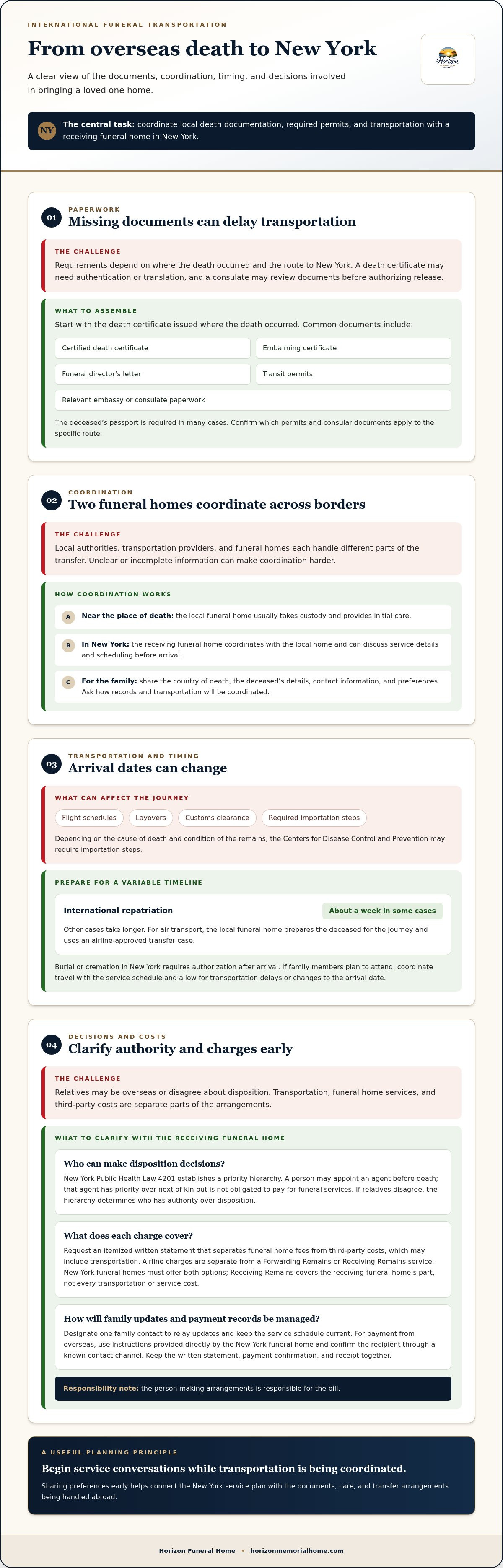

Distance doesn’t prevent you from arranging a funeral from another country for someone in NY. The process involves coordinating local death documentation, required permits and transportation with a funeral home in New York. The documents and approvals depend on where the death occurred and how your loved one will be brought home.
Paperwork and decisions can feel difficult to manage while you’re grieving and far away. This article explains how international funeral transportation works, what can affect timing, and how you can begin planning a service in New York before your loved one arrives.
You’ll also learn how transporting a person differs from transporting cremated remains, and which practical questions can clarify the arrangements. Taking the process one step at a time can make it easier to coordinate across borders.
Key Takeaways
- Gather the local death certificate and identify the permits, certifications, and consular paperwork needed for transport.
- Begin discussing service details with the receiving funeral home while transportation is being coordinated.
- Consider how the family’s wishes, destination-country rules, and transport requirements affect the choice between shipping a person and cremated remains.
- Religious and cultural traditions may shape whether a family brings a loved one to New York or returns them to their home country.
- Ask clear questions about paperwork, coordination, timing, and charges so you understand what each part of the arrangements involves.
Table of Contents
- What Is International Funeral Shipping?
- Can service planning begin before the deceased arrives in New York?
- International shipping and cremation considerations
- Reasons families may return a loved one to their home country
- Questions to ask a funeral service provider
- Horizon Funeral Home: Traditional Funeral Services
What Is International Funeral Shipping?
International funeral transportation involves coordinating the documents, permits, and travel needed to bring a deceased person to New York. You can contact a New York funeral home while local authorities document the death abroad, so both sides can begin coordinating the next steps.
International Transport Documents and Permits
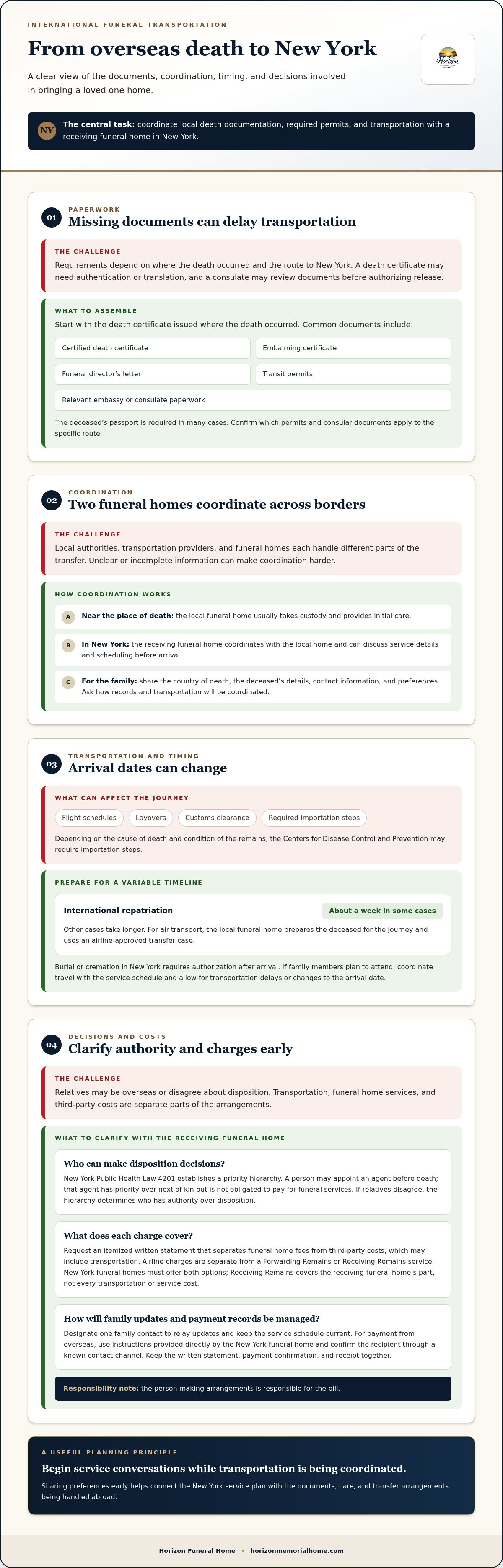
International transport documentation includes the records and approvals needed to release and receive human remains across borders. Missing paperwork can delay transportation. Start with the death certificate issued where the death occurred, then establish which permits and consular documents are required for the route to New York.
Common documents include a certified death certificate, an embalming certificate, a funeral director’s letter, transit permits, and paperwork from the relevant embassy or consulate. The deceased’s passport is required in many cases. A death certificate may need authentication or translation before New York accepts it, and a consulate may review documents before authorizing release.
Funeral Home Coordination for Transportation
A funeral home near the place of death usually takes custody and provides initial care. It coordinates with the receiving funeral home in New York, while officials and transportation providers handle their respective tasks. Coordination between the funeral homes helps keep documents, permits, and the transfer plan aligned.
Choose a New York funeral home that can coordinate with the family and the intended service or cemetery location, then contact it directly. Share the country where the death occurred, the deceased’s details, and your preferences. Ask how the funeral homes will coordinate records and transportation. You can discuss service details and scheduling before your loved one arrives.
Transferring a Deceased Person to New York
Overseas transportation may be needed when a family wants burial or a funeral in New York after a death abroad. The local funeral home arranges the official transfer permit and prepares the deceased for the journey. For air transport, the deceased is placed in an airline-approved transfer case before being taken to the airport.
Flight schedules, layovers, and customs clearance can affect the journey. International repatriation may take about a week in some cases, while other cases take longer. Depending on the cause of death and condition of the remains, the Centers for Disease Control and Prevention may require importation steps. Burial or cremation in New York requires authorization after arrival.
Authorization and Family Consent From Abroad
Funeral authorization identifies who has the right to make disposition decisions, even when relatives live overseas. New York Public Health Law 4201 establishes a priority hierarchy and allows a person to appoint an agent before death. An appointed agent has priority over next of kin but isn’t obligated to pay for funeral services.
If you’re arranging a funeral from another country for someone in NY, ask the receiving funeral home which authorization paperwork is required. If relatives disagree, New York’s hierarchy determines who has authority over disposition; the person making arrangements is responsible for the bill. If you plan to attend the funeral, coordinate travel with the service schedule and allow for transportation delays or changes to the arrival date.
Can service planning begin before the deceased arrives in New York?
Yes. You can discuss service details, scheduling, and arrangements with the receiving funeral home while transportation is underway. Starting these conversations early connects your New York plans with the documentation and care being handled abroad.
A funeral home near the place of death usually takes custody and provides initial care. It coordinates with the receiving funeral home in New York, while transportation providers and officials handle their respective tasks. Share the deceased’s full name, the location of death, family contact details, and the arrangements you’re considering. Clear information helps both funeral homes coordinate the transfer and prepare for the arrival.
Tell the New York funeral home whether you’re considering burial, cremation, a viewing, or a service after arrival. Cultural and religious needs can affect scheduling and logistics. For example, a requested viewing may shape discussions about preparation and timing, while a service after burial may call for a different schedule. You can also name relatives who should receive updates, avoiding the need to pass information through several people.
New York funeral customers must be informed of charges in advance. Request an itemized written statement that separates funeral home fees from third-party costs, which may include transportation. Airline charges are separate from a Forwarding Remains or Receiving Remains service. New York funeral homes must offer both options. Receiving Remains covers the receiving funeral home’s part of the arrangements, not every transportation or service cost.
For payment from overseas, use instructions provided directly by the New York funeral home and confirm the recipient through a known contact channel before transferring funds. Keep the written statement, payment confirmation, and receipt together. New York families should receive a receipt for funeral arrangements. These records help relatives abroad understand what has been paid and what remains outstanding.
Designate one family contact to relay updates between relatives and the funeral homes. That person can share arrival updates, clarify which family members are making decisions, and keep the service schedule current. If plans change, tell the receiving funeral home promptly so arrangements can be adjusted before guests travel or gather.
If you’re planning from overseas, coordinate funeral arrangements with the receiving home while transportation is being organized. Early communication gives the family and both funeral homes a shared plan to work from.
International shipping and cremation considerations
Choosing between transporting a deceased person and cremating before transport affects the paperwork and arrangements. The family’s wishes, the country’s rules, and the intended service in New York all shape the decision.
In New York, burial or cremation after arrival requires authorization. If the death occurred abroad, local authorities document it and issue a death certificate under that jurisdiction’s requirements. When cremation is arranged in New York, the funeral director must give the customer a copy of the Customer’s Designation of Intentions form. These steps connect the original death record with the final disposition.
If a death occurs in another U.S. state, you can discuss cremation with a funeral home there when you don’t need a viewing or ceremony before cremation. Direct cremation takes place shortly after death and does not include formal viewings or ceremonies at the place of death. You can then plan a memorial or celebration of life in New York at a time that works for relatives, separating the cremation from the later gathering.
Cremation abroad may simplify international transportation because cremated remains face fewer government restrictions and airline policies than a full casket. Requirements still vary by country and may include embassy review, legal translations, or notarized paperwork. Some countries prohibit or limit cremation, including certain predominantly Catholic or Muslim countries. Check the destination’s requirements and consider the family’s beliefs before choosing this option.
Transporting a deceased person in a full casket is more complex and generally more expensive than cremating abroad. Full-casket shipping commonly involves embalming, a specialized airtight sealer casket or zinc-lined container, and specialized air cargo booking. In some countries, embalming isn’t widely practiced, and alternative preparation for shipment may prevent viewing. Discuss viewing expectations early, since preparation choices can affect whether it is possible.
Families bringing remains into the United States may need to meet Centers for Disease Control and Prevention importation requirements, depending on the cause of death and condition of the remains. Cremated remains also have transport requirements; airlines may allow them in carry-on baggage when the container can be x-rayed. Compare the practical implications of transporting the person with those of cremation, including the ceremony your family hopes to hold.
After cremation, clarify who will receive the cremated remains and how they’ll be transported to New York. If the family plans burial, cemetery arrangements and New York authorization remain part of the next steps. If relatives are in different countries, a later memorial can allow more time to gather while honoring the deceased’s traditions.
Reasons families may return a loved one to their home country
A family may choose burial or a funeral in the country where relatives, faith traditions, or a family cemetery are rooted. Some Jewish families may choose burial in Israel; some Muslim families may prefer Janazah services followed by burial in an Islam-majority country. Some Hindu families may request cremation and ash immersion in sacred rivers, while some Catholic families may choose a family plot overseas.
Repatriating a deceased person from New York begins with the family’s intended destination and choice of disposition. Contact a New York funeral home to coordinate with the destination country’s consular authorities and transportation providers. Ask the destination country’s embassy about current documentation and regulations, which may require translations, notarized paperwork, or embassy review. The receiving country may also require preparation of the death certificate and other documents.
Bringing a loved one to the United States is the reverse journey. If the death occurred abroad, local authorities document it and issue a local certificate. The U.S. Department of State can issue a Consular Report of Death Abroad for U.S. citizens who die overseas. Families bringing remains into the United States may need to meet Centers for Disease Control and Prevention importation requirements, depending on the cause of death and condition of the remains.
You can plan a New York service after a loved one returns from abroad or after cremation overseas. A memorial or celebration of life lets relatives gather in New York while respecting the family’s religious and cultural wishes. If the plan includes burial, coordinate the service with the cemetery and required New York authorization. For cremation, consider how the remains will be transported and where relatives intend to gather.
For a New York burial, keep the cemetery deed as part of the family’s records. A funeral director who holds the deed must return it within 7 days after the funeral, unless a different agreement has been made. This is a practical detail to settle alongside service arrangements, especially when relatives managing the paperwork live abroad.
International transportation involves separate charges for funeral arrangements and the journey. The person making funeral arrangements in New York is responsible for the bill. Ask for an advance explanation of charges and keep receipts with the certificate and consular documents. This gives relatives in different countries a clear record of the decisions and payments.
Whether a loved one is being brought to New York or sent abroad, the family’s wishes, destination regulations, and required documents shape the arrangements. Early coordination with the funeral home and consular authorities helps align the service plan with the transportation process.
Questions to ask a funeral service provider
Clear questions help you understand who handles each task, which paperwork remains, and how charges are presented. Keep answers in writing so relatives overseas can follow the same plan.
- Which funeral home handles each stage? Ask who coordinates with the funeral home abroad, who receives the remains in New York, and who updates your family. A written division of responsibilities can prevent missed handoffs.
- Which documents and approvals are outstanding? Request a list covering the death certificate, transit permits, consular paperwork, and any authentication or translation needs. Ask who submits each document and how embassy holidays or closures could affect timing.
- What does the written charge statement include? New York funeral customers must be informed of all charges in advance. Ask which services and merchandise are included, which third-party costs are separate, and request a receipt for the arrangements.
- How are airline and transfer costs handled? The airline ticket cost is additional to a Forwarding Remains or Receiving Remains package. Ask how the airline booking fits into the total plan and what transportation arrangements the package covers.
- What choices affect the service? Explain whether the family wants a viewing, burial, cremation, or later memorial. Ask how those preferences affect the schedule and which decisions must be made before transportation.
New York rules also specify charges that cannot be added. A funeral home may not charge extra for filing a death certificate or obtaining its medical certification. It may not add a handling fee for paying third parties on your behalf, handling a casket you supply, or providing services and merchandise you didn’t select. Review the itemized statement with these rules in mind.
According to the FTC, funeral homes must offer Forwarding Remains and Receiving Remains options. Ask which option describes the work being arranged and whether the airline charge is separate. For cremation comparisons, ask whether the amount includes crematory and permit fees.
Before sending payment from abroad, use instructions provided directly by the funeral home and retain the receipt and transfer record. Ask for a written explanation of each charge, especially third-party expenses. This gives relatives a shared record and helps distinguish funeral home fees from transportation or airline costs.
For a clearer discussion of the arrangements, discuss funeral arrangements and the service choices that matter to your family.
Horizon Funeral Home: Traditional Funeral Services
Horizon Funeral Home coordinates arrangements when a loved one needs to be brought to New York and the family is planning a service. Its Worldwide Transportation service coordinates the international transfer, subject to verification of documents, carrier availability, and receiving-provider requirements. Traditional Funeral Services can support families planning a formal service after arrival. Cremation Services and Veteran Services are also available when they fit the family’s wishes.
Share the information you have about the place of death, transportation paperwork, family preferences, and the kind of service you hope to arrange. These details help shape a plan that respects your loved one’s traditions and gives relatives a clear understanding of the next steps.
For thoughtful guidance with arrangements, contact Horizon Funeral Home when you’re ready.
Take the Next Step With Care
Distance can make family decisions harder, especially when relatives are grieving in different places. Choose a family contact who can share updates, gather questions, and keep everyone aligned on the wishes that matter most. A shared written record can help prevent important details from getting lost between time zones.
If you’re arranging a funeral from another country for someone in NY, Horizon Funeral Home can help with Worldwide Transportation and support the family’s plans for Traditional Funeral Services or Cremation. The right path depends on your loved one’s wishes and the kind of gathering your family hopes to create. You can take the conversation one decision at a time.
Contact Horizon Funeral Home for help with the next steps. Your family doesn’t have to organize every detail at once; a thoughtful beginning is enough to move forward with care.
Frequently Asked Questions
How long does international repatriation of remains usually take?
International repatriation may take about a week in some cases, while other arrangements take longer. Timing depends on document processing, consular review, airline schedules, and customs clearance along the route. For example, a delay in obtaining a local certificate or embassy clearance can affect when an airline accepts the remains. Plan tentative service details and adjust the gathering schedule as arrival information develops.
What Should I Do if Someone Dies Abroad Unexpectedly?
Start by contacting the local authorities where the death occurred so they can document it and issue a local death certificate. If you’re outside that country, the nearest U.S. embassy or consulate may help initiate documentation and legal verification. For a U.S. citizen who dies overseas, the U.S. Department of State can issue a Consular Report of Death Abroad. Keep copies of official records together for family coordination.
What can I do if I feel the prices are too high?
Ask for an itemized statement and review each selected service, merchandise item, and outside charge. New York funeral customers must receive information about charges in advance, and you’re responsible for the arrangements you authorize. A funeral home may not charge for services or merchandise you didn’t select, filing a death certificate, or handling a customer-supplied casket. Keep the receipt and written estimate together as you decide what best fits your family.
Who can make funeral arrangements?
New York Public Health Law 4201 sets a priority order for who may control disposition, and a person appointed as an agent has priority over next of kin. That agent isn’t automatically responsible for paying. The person who makes the funeral arrangements is responsible for the bill. If relatives disagree, identify whether the deceased appointed an agent and use the statutory priority to clarify who can make disposition decisions.